What is Pentagon calculating by using Taiwan question to hold allies hostage?: Global Times editorial
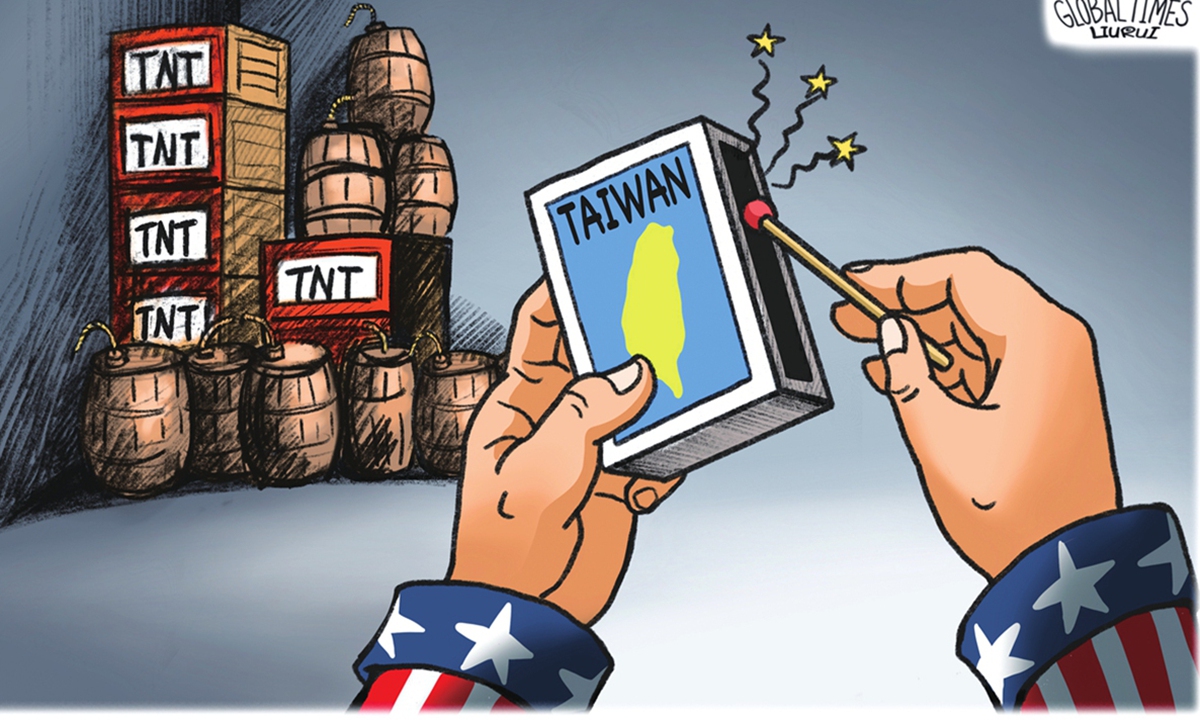
Illustration:Liu Rui/GT
The Pentagon is pressing Japan and Australia to make clear what role they would play if the US and China went to war over the Taiwan region, the Financial Times reported on Saturday. This amounts to pressuring them to commit to taking frontline roles in the event of a "Taiwan contingency." According to the report, this move has left both Tokyo and Canberra "frustrated," as the US itself has not given "a blank cheque guarantee to Taiwan." Sources familiar with the matter revealed that the Pentagon has been "pushing the issue in meetings with Japanese and Australian defense officials in recent months," with the main driver being Elbridge Colby, US under-secretary of defense for policy and an extreme hawk in Washington.
The Taiwan question is entirely China's internal affair and it is the first red line that cannot be crossed in China-US relations. At no time can the Taiwan question be treated as a bargaining chip. The Pentagon's move to provoke regional sensitivities at the edge of this red line is highly irresponsible. It not only contradicts the US longstanding statements about adhering to the one-China policy, but it also constitutes a blatant interference in the independent foreign policy positions of its allies. When asked about the matter during his visit to China on Sunday, Australian Prime Minister Anthony Albanese made it clear that "We support the status quo when it comes to Taiwan. We don't support any unilateral action there." Just last week, during a meeting with Chinese Foreign Minister Wang Yi in Kuala Lumpur, Japanese Foreign Minister Takeshi Iwaya also reaffirmed that "The Japanese side has not changed its position on the Taiwan question as stated in the 1972 Japan-China Joint Statement." The one-China principle is the foundation and prerequisite for both China-Australia and China-Japan relations. The Pentagon has no authority to hijack other countries with the Taiwan question.
For a long time, Japan and Australia have been designated by the US as the "cornerstones of the Indo-Pacific," and they have faced pressure to take sides in geopolitical rivalries. However, the Taiwan question is far more sensitive than other regional flashpoints, and both countries are keenly aware of the costs of becoming entangled in a potential conflict there. When the Pentagon recklessly pushes for a definition of roles, the instinctive response from Tokyo and Canberra has been cautious. Neither country is willing to foot the bill for Washington's strategic calculations, nor are they prepared to risk a disruptive blow to their relations with China. If they are passively reduced to tools of US interference, and even anti-China weapons, their own security could ultimately suffer. The Pentagon may believe that coercion breeds compliance, but in reality, it is accelerating the centrifugal forces within the alliance.
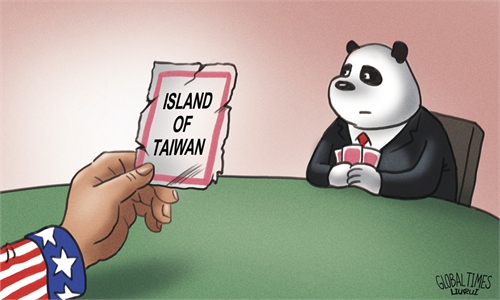
The Pentagon's move sends a wrong signal to "Taiwan independence" forces. In reality, Washington has never changed its strategic view of Taiwan as a pawn - a tool to contain China. Taiwan is something that the US is prepared to abandon if circumstances dictate, it will never sacrifice its own national interests for the "Taiwan independence" forces. The latest move of the Pentagon has not deviated from this positioning; instead, it further confirms Washington's calculations. It is laughable that the Democratic Progressive Party authorities and "Taiwan independence" forces still hope to "rely on the US to seek independence," while the US is already preparing to pass this hot potato to its allies.
Recently, the Pentagon has frequently deployed military power in the Asia-Pacific region, urging its allies in the region to increase defense spending like NATO countries, and continuously conducting joint military exercises targeting China. This highlights the strategic misalignment of the Pentagon. This move reveals that the military intervention of external powers is the biggest trigger for the outbreak of conflict in the Taiwan Straits, with some in Washington acting as the troublemakers willing to undermine peace and stability in the Asia-Pacific region. As a spokesperson for the Chinese Ministry of National Defense said, the Chinese military has the capability to thwart any form of "Taiwan independence" separatist schemes and will resolutely defend national sovereignty and territorial integrity. If the Pentagon insists on acting recklessly, it will surely suffer the consequences.
After being asked to increase defense spending, Japan canceled a ministerial meeting with the US. This reveals the stark reality of being "instrumentalized" by the US, which is awakening a sense of strategic autonomy in some countries. Just as the Pentagon is forcing its allies to "take sides," Australian Prime Minister Albanese has embarked on his first visit to China since his reelection, leading a large delegation that includes executives from major companies like BHP and Fortescue. The seven-day itinerary covers three cities in China, highlighting the vibrant vitality of China-Australia economic and trade cooperation. These facts vividly illustrate that maintaining stability, strengthening economic and trade interactions and striving for win-win cooperation are the common aspirations and main theme of countries in the Asia-Pacific region, and that provoking camp confrontations has neither a market nor a future in this area.
The Asia-Pacific region is a land of peaceful development and shared prosperity, not a battleground for geopolitical games. If the US genuinely wants peace and stability in the Taiwan Straits, it should align its words with actions, adhere to the one-China principle and the provisions of the three China-US joint communiqués, oppose "Taiwan independence," and support China's reunification. The Pentagon should immediately correct its unpopular and misguided practices, cease all the wrong practice of interfering in the Taiwan Straits, and genuinely uphold peace and stability in the Asia-Pacific region as a responsible major power.
RELATED ARTICLES