Nvidia CEO defends China chip sales ahead of Beijing visit, saying the nation ‘doesn’t need Nvidia chips to build military’
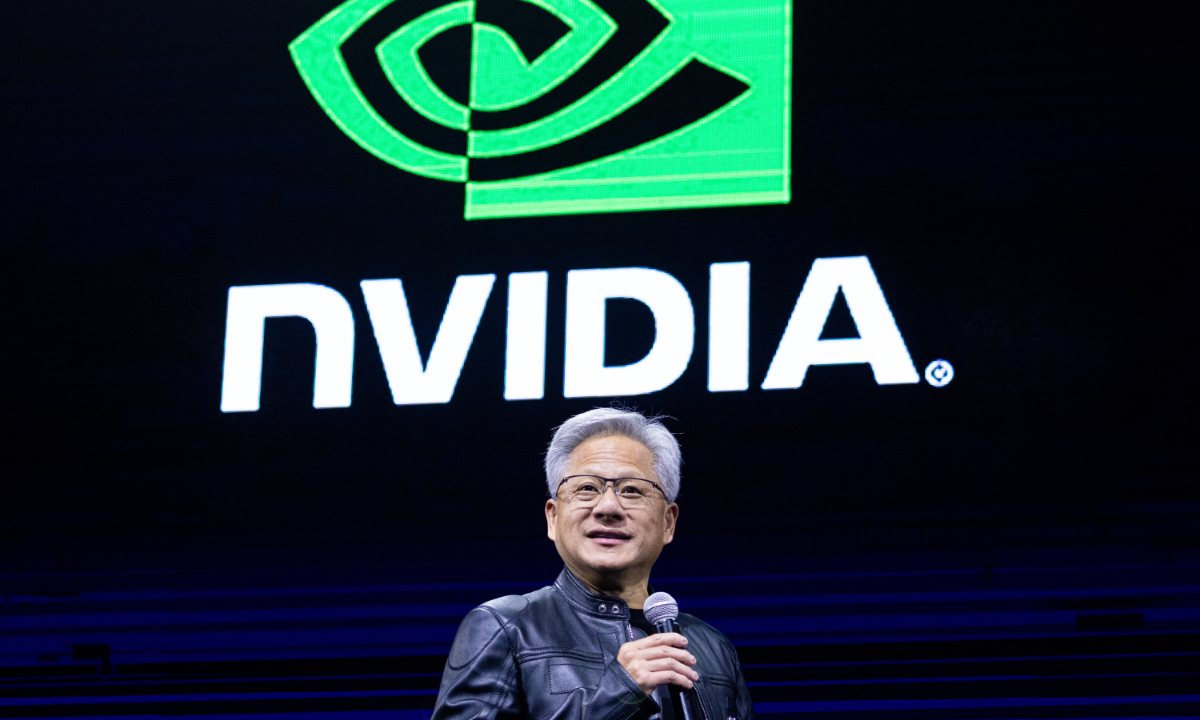
NVIDIA CEO Jensen Huang Photo: VCG
Nvidia CEO Jensen Huang has once again rejected concerns over the company's chip exports to China, dismissing claims that Nvidia's technologies could be used to enhance Chinese military capabilities. The remarks came during a recent CNN interview aired ahead of Huang's trip to China, during which he is expected to hold a media briefing in Beijing on Wednesday, according to Reuters citing an Nvidia official.Responding to CNN host Fareed Zakaria's concerns that Nvidia chips might "supercharge" weapons used by Chinese military and intelligence agencies, Huang said China already possesses "plenty of computing capacity… that are already in operation." He emphasized that "they don't need Nvidia chips, or American tech stacks in order to build their military."
In the interview, Huang expressed opposition to ongoing export restrictions on advanced chips, arguing that such controls may ultimately hinder the development of US technology. He warned that blocking Chinese AI developers from using Nvidia products could incentivize them to develop independent alternatives instead of relying on US systems.
"We want the American tech stack to be the global standard ... in order for us to do that, we have to be in search of all the AI developers in the world," Huang said, noting that China is "incredible in AI" given that "50 percent of the world's AI developers are in China and Chinese."
Huang also challenged the notion that Chinese-trained AI models pose inherent risks. Referring to China's DeepSeek R1 model, he stated that "there's no evidence" it is dangerous simply because it was trained in China. "The technology itself is really completely incredible," he added.
At the conclusion of the interview, Huang echoed Microsoft co-founder Bill Gates' view that putting bans on China spurred China to develop its own industry, which Gates described the bans as "counterproductive," reinforcing his longstanding opposition to US chip export controls.
"The fact of the matter is we (China and US) are competitors, but we are highly interdependent, and to the extent that we can compete and both aspire to win, it is fine to respect our competitors," Huang said. "They're not doing anything that we don't want to do for our own people. They're not doing anything that we don't aspire for ourselves," he added.
Huang's remarks come as scrutiny intensifies over US tech engagement with China. On Friday, a bipartisan group of US senators sent a letter to Huang about his China trip, urging him to avoid meetings with firms linked to military or intelligence bodies in China, or those listed on the US export restrictions list, according to Reuters.
Since 2022, Washington has placed tight curbs on Nvidia's most advanced chip exports to China, citing concerns over potential military applications. The US government also expanded the ban earlier this year to include sales of Nvidia's H20 AI chips. Reuters reported that Nvidia is working on another chip that is compliant with the latest export controls.
Huang has previously voiced his opposition to the US restrictions on chip exports to China on multiple occasions, including during a quarterly earnings call where he stated that the US export control policy on AI chips to China was "clearly wrong."
Global Times
RELATED ARTICLES