China approves Synopsys' acquisition of Ansys with conditions
‘Positive sign’ after economic, trade talks in London: expert
By and Ma Tong Published: Jul 14, 2025 04:59 PM

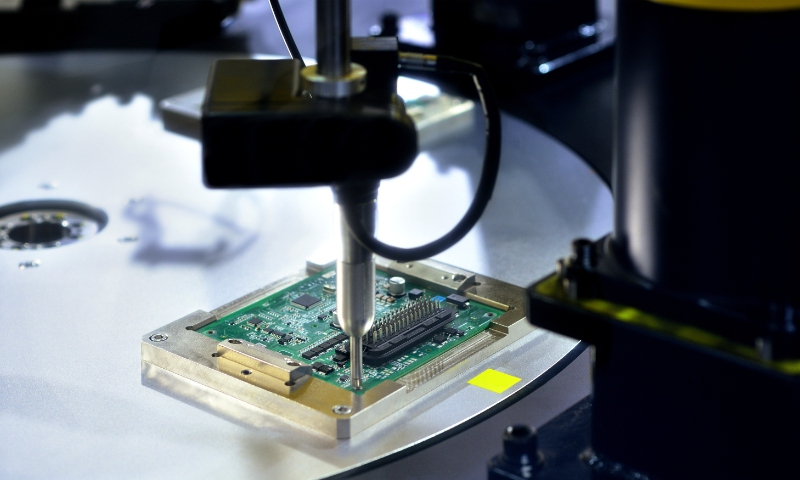
Production of semiconductor chip File photo: VCG
China's State Administration for Market Regulation (SAMR) announced on Monday that it has approved the acquisition of simulation software company Ansys by Synopsys with conditions. Both companies are based in the US.
The SAMR's decision follows the recent easing of US export restrictions on chip design software, allowing firms like Synopsys to resume supplying chip design software to Chinese customers.
The approval was granted based on the commitments submitted by the relevant companies, requiring the merged entity to comply with specific obligations, the SAMR said.
Under these conditions, the companies must honor existing customer contracts, including pricing and service terms, and continue supplying electronic design automation (EDA) products to Chinese customers on fair, reasonable and non-discriminatory terms.
Additionally, the companies ought to maintain and renew interoperability agreements upon request from Chinese customers.
This decision not only reflects the positive role of antitrust reviews in ensuring fair competition in China's EDA software and design IP markets, but also demonstrates China's determination to maintain fair competition in the global EDA software and design IP markets, said the SAMR.
"Judging by the overall market trend, this is a clear signal conducive to win-win cooperation between China and the US. It could also be interpreted as a positive sign that the two countries are accelerating efforts to implement the outcomes agreed upon during their economic and trade talks in London," Ma Jihua, an industry veteran, told the Global Times on Monday.
It also shows that the Chinese government is market-oriented, rather than taking a crackdown approach toward the merger involving US firms, Ma added.
The move came after some positive interactive actions in recent days. On July 3, Synopsys said it had been informed by the US Department of Commerce that the export restrictions related to China, pursuant to a letter received on May 29, 2025, had been rescinded, effective immediately.
German EDA provider Siemens was recently notified by the Bureau of Industry and Security, US Department of Commerce, that the export control restrictions on EDA software and technology to customers in China set forth in the May 23 letter received by Siemens are no longer in place.
On July 4, a spokesperson for the Chinese Ministry of Commerce said that China will accelerate its rare-earth export approval process regarding shipments to the US in accordance with the law, and the US will remove a series of restrictive measures imposed on China accordingly.
Founded in 1986 in the US, NASDAQ-listed Synopsys primarily engages in EDA software and design IP businesses, providing solutions for companies involved in chip and electronic system development.
Established in 1970 in the US, the core business of Ansys focuses on developing and selling simulation and analysis (S&A) software and services. Its S&A software can be applied in the semiconductor design field, serving chip designers in their workflow, and can be considered a form of EDA software.
Synopsys, which makes EDA tools for chip design, announced the $35 billion cash-and-stock deal to acquire Ansys in early 2024, Reuters reported. The transaction has faced antitrust scrutiny in major markets, though some countries, including the UK, have already granted approval.
China has always adhered to the position of fair competition and open cooperation despite the various blockades and restrictions imposed by the US on China's technology and products, Hu Qimu, a deputy secretary-general of the Forum 50 for Digital-Real Economies Integration, told the Global Times on Monday.
In Hu's view, China does not use antitrust reviews as a political tool, nor does it take the opportunity to ask the US to relax export controls and other additional conditions. Instead, China proceeds from market rules and conducts reviews in accordance with the law, reflecting China's basic position of not attaching political conditions in promoting industrial development and international economic and trade cooperation.
China does not view corporate mergers and acquisitions or restructuring plans from the perspective of geopolitical games, but judges its impact on market structure in a market-oriented way, he added.
On Monday, China released customs data of the first half of this year. Wang Lingjun, a deputy head of the General Administration of Customs, said that China and the US are accelerating efforts to implement outcomes from the framework reached during the economic and trade talks in London.
Following positive progress in recent economic and trade talks in Geneva and London, bilateral trade between China and the US recovered to more than 350 billion yuan ($48.82 billion) last month from less than 300 billion yuan in May, said Wang.
Wang said China-US economic and trade cooperation was mutually beneficial in nature, and that it represents the irreversible trend of globalization, the need for deeper industrial chain integration and the demand for collaboration on innovation between enterprises of the two countries and improvement of the well-being of the two peoples.
RELATED ARTICLES