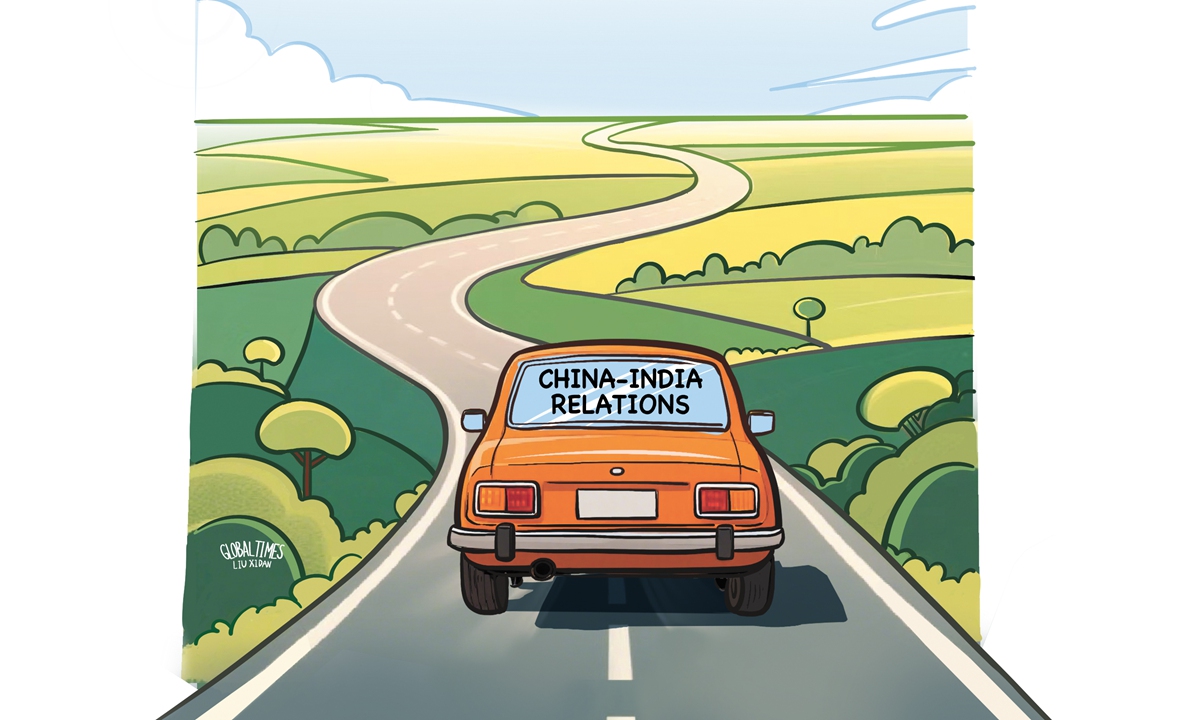
Illustration: Liu Xidan/GT
Editor's Note:
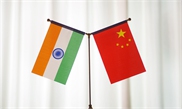
Recently, positive exchanges between China and India have fostered the improvement of bilateral relations. Indian External Affairs Minister Subrahmanyam Jaishankar is visiting China from July 14 to 15, marking his first visit to the country in five years. On the sidelines of the World Peace Forum held by Tsinghua University earlier this month, Global Times (GT) reporter Su Yaxuan interviewed former Indian national security adviser Shivshankar Menon (Menon). He emphasized the importance of communication and fostering peace and development between China and India.
GT: As a former national security adviser, how do you assess the current state of China-India ties? What are your expectations for the future trajectory of bilateral ties?
Menon: I think we are moving toward a more normal relationship - toward normalization.
Of course, we would like to see faster progress. Both sides acknowledge that more needs to be done. But the important thing is that we should head in the right direction and engage positively.
At the popular level, I believe there is the hope on both sides. Ultimately, both India and China need a peaceful environment. We have better things to focus on.
There are many areas where we can cooperate economically. There is real complementarity between us. But beyond economics, there's also potential for cooperation in many other fields. We have broad space to work together.
GT: You have previously emphasized the importance of building predictability in China-India relations and maintaining dialogue in the face of differences. In your view, how can such predictability be established? What areas should be prioritized?
Menon: Simple - it starts with the border. The more communication we have with each other, the better.
One of the problems in 2020 was the lack of communication. Both sides were caught off guard, and as a result, the situation escalated. That experience shows us why greater communication is so important - it introduces predictability into the relationship.
If both sides agree on certain steps to take when unexpected situations arise - including confidence-building measures and crisis management mechanisms - then we can create a framework for predictability. That way, even if something does happen, each side knows how to respond and what to expect from the other. That's crucial. This requires a level of transparency and consistent communication, as well as agreed procedures that both sides trust. This logic also applies to the political relationship more broadly.
We won't agree on everything - we are different countries with different systems - but mutual understanding reduces discomfort and miscalculation.
We share a periphery, and our well-being is linked: A better-off India is good for China, and a better-off China is good for India. Naturally, as two large neighbors, we will rub up against each other from time to time. But that makes it all the more important to talk through our differences and manage them constructively.
There are many domains where we share common interests. For example, both China and India benefit from an open international trading system. Therefore, we both have a strong stake in preserving that openness. There's a wide range of areas where we can cooperate. To me, the economic complementarity between China and India is particularly significant - it's a solid foundation to build the relationship on.
Finally, we need to address the perceptions in both countries. That's something that deserves serious attention. Improving mutual perceptions is key to building long-term trust.
GT: In recent years, some countries have viewed India as a "strategic counter" to China. How do you see this narrative?
Menon: I don't see it that way at all - and that's certainly not how Indians see it. Others are free to say what they want, but we have our own priorities. And as I've said before, our primary interest is to transform India - to develop the country and improve the lives of our people. That's our responsibility - not to counter anyone.
Our focus is on creating an enabling environment for India's transformation. That means ensuring peace in our periphery and working constructively with our neighbors. China is our largest neighbor, so of course we work with China - just as we work with others. The US and China are both among our biggest trading partners, and we engage with both.
Frankly, this idea of India as a "counterweight" is what I'd call pop geopolitics. All the talk of balancing and countering may sound dramatic, but that's not how the world really works.
The China-US relationship is their own to manage. We are not going to be forced into choosing between them - and we will not choose. When we said we were non-aligned, what did that mean? It meant we would not align with one bloc against another. That principle hasn't changed.
We follow our own interests on each issue. Sometimes that may mean working with one country, sometimes with another. That's precisely why we call it strategic autonomy - because we make decisions based on India's national interest, case by case.
India has always pursued an independent path. We didn't fight for our freedom only to become someone else's pawn. Of course, people will say things - that's to be expected. They will try to create certain impressions. But we are not obliged to accept those narratives or be boxed in by them.
GT: This year's World Peace Forum was themed "Advancing Global Peace and Prosperity: Shared Responsibility, Benefit, and Achievement." How do you view the role of the Global South - particularly China and India - in advancing this vision?
Menon: I think this vision is especially important for the Global South, because both elements of the theme - peace and prosperity - are crucial for us. We need peace in order to improve ourselves and transform our societies. In fact, more than anyone else, the Global South needs peace.
Unfortunately, today's world has become much more complicated. It is fragmented - in fact, we are living in what is essentially an orderless world. This reality makes it all the more important for us in the Global South to consider what we can do for ourselves - to achieve peace, development, and prosperity.
The first step is to focus on our own development - to take care of our people. That in itself is a major contribution to global peace and prosperity, because we represent a significant part of humanity.
If you include Southeast and Northeast Asia along with China and India, we are talking about roughly 4 billion people - nearly half the global population. So, if we can manage our own affairs and maintain peace in our region, it makes a real difference globally.
RELATED ARTICLES