SCO Foreign Ministers’ Council Meeting to uphold Shanghai Spirit, promote the building of a shared home

SCO Photo: VCG
Ahead of the Meeting of the Council of the Ministers of Foreign Affairs of the Shanghai Cooperation Organization (SCO) Member States to be held in Tianjin on Tuesday, a series of bilateral talks have taken place among China, Russia and India, which experts said reflect the importance they attach to such an inclusive and cooperative organization in today's volatile world.
The organization embodies the joint aspirations of the Global South, creating a collaborative atmosphere where every partner's voice is heard and valued, they said.
At the invitation of Member of the Political Bureau of the CPC Central Committee and Foreign Minister Wang Yi, foreign ministers of other SCO member states and heads of SCO's permanent bodies will attend the meeting. Parties will exchange views on SCO cooperation in various fields and major international and regional issues. In addition to attending the meeting, India's External Affairs Minister Subrahmanyam Jaishankar will also pay a visit to China, according to the Chinese Foreign Ministry.
Chinese Vice President Han Zheng on Monday met with Jaishankar in Beijing. Han said China and India are both major developing countries and important members of the Global South and it is the right choice for both sides to be partners contributing to each other's success and realize the "dragon-elephant tango."
Jaishankar said the Indian side stands ready to take the consensus reached by the leaders as guidance to maintain the momentum of bilateral ties, advance mutually beneficial cooperation, and enhance communication and coordination within multilateral mechanisms.
Chinese Foreign Minister Wang Yi also met with Jaishankar on Monday. Wang stated that the international landscape is undergoing profound changes, with unilateral protectionism and power politics practices posing severe challenges to the world. As two neighboring ancient oriental civilizations and major emerging economies, the essence of China-India relations lies in how to coexist harmoniously and achieve mutual success.
Both sides should aim high and take a long-term perspective, adhere to the path of good-neighborliness and friendship, and realize the "dragon-elephant tango." China and India must find a way to get along with each other based on mutual respect and trust, peaceful coexistence, joint development, and win-win cooperation, Wang noted.
In a post on X, Jaishankar said he noted improvements in bilateral relations, and expressed confidence that discussions during his visit "will maintain that positive trajectory."
The Indian Foreign Minister's visit to China, his first visit to the country in five years, comes in the context of the meeting between the leaders of China and India during the BRICS Summit in October last year, which has promoted the continuous improvement of bilateral ties. "Jaishankar's visit sends an important signal of ongoing detente in the two countries' relations," Qian Feng, director of the research department at the National Strategy Institute at Tsinghua University, told the Global Times.
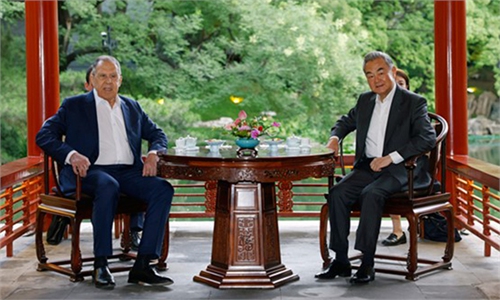
Russian Foreign Minister Sergey Lavrov also arrived in Beijing on Sunday to participate in the council meeting. During talks with Lavrov on Sunday, Chinese Foreign Minister Wang Yi said the China-Russia relations represent the most stable, mature and strategically valuable major-country relationship in the world today. The two sides have always viewed and advanced bilateral cooperation in various fields from a historical depth, strategic height, and long-term perspective.
Wang said the current priority is to jointly prepare for the next stage of high-level exchanges, deepen comprehensive strategic coordination, promote their respective development and revitalization, and work together to address the challenges posed by a turbulent and changing world, according to the release of the Chinese Foreign Ministry.
Li Yongquan, director of the Eurasian Social Development Research at the Development Research Center of the State Council, told the Global Times on Monday that the China-Russia partnership does not form an exclusive bloc, but rather aims to jointly uphold peace and development while creating a favorable external environment for both countries. This collaboration also represents the common aspirations and collective voice of the Global South, Li said.
Inclusive, win-win platform
Commenting on the upcoming event, Chinese Foreign Ministry spokesperson Lin Jian said on Monday that as the rotating president of the SCO for 2024-2025, China will host the SCO summit in Tianjin later this fall. The upcoming Meeting of the SCO Foreign Ministers Council will make political preparation for the Tianjin summit, and be chaired by Foreign Minister Wang Yi.
Through the upcoming meeting, China will work with all parties to act on the slogan of China's SCO presidency "Upholding the Shanghai Spirit: SCO on the Move," as well as President Xi Jinping's important proposal of building a common home of the SCO featuring solidarity and mutual trust, peace and tranquility, prosperity and development, good-neighborliness and friendship, and fairness and justice, Lin said.
"The keyword in the name of the SCO is 'cooperation,' which reflects the essence of the organization: it is a robust, open partnership ready to collaborate with all countries that share its principles," Former Secretary-General of the SCO Rashid Alimov said during a recent interview with chinanews.com.
The SCO connects a vast geopolitical space, extending beyond the Eurasian continent. Over the past 25 years, the SCO family has grown to 26 countries, expanding not only geographically but also in scope, with its activities now covering nearly all areas of cooperation, Alimov said.
"Notably, regardless of changes, the SCO remains steadfast. There is no distinction between large and small members or hierarchy among them; all decisions are made through constructive and friendly dialogue," Alimov noted. "The charm of the SCO lies not in its inclusion of global powers and economic giants but in its creation of a collaborative atmosphere where every partner's voice is heard and valued."
The fundamental reason for the SCO's widespread popularity is its "Shanghai Spirit," which serves as its core philosophy. In the current international landscape, the SCO embodies the aspirations of the vast majority of developing countries and the Global South, presenting a stark contrast between two systems of international relations and world orders, Li noted.
Cui Heng, a scholar from the Shanghai-based China National Institute for SCO International Exchange and Judicial Cooperation, said the SCO is a multilateral international cooperation mechanism characterized initially by its major focus on security cooperation, which has now expanded comprehensively into other areas. Most SCO member states are located on the Eurasian continent, where the security deficit has become increasingly evident since the Russia-Ukraine conflict. However, Eurasia lacks a robust security architecture, and the SCO effectively serves as a complementary framework, Cui told the Global Times.
Refuting claims by foreign media portraying the SCO as a "counterweight to US-led institutions," Li said this view stems from Cold War thinking and a zero-sum game perspective. However, this narrative fundamentally contradicts the Shanghai Spirit and the SCO's developmental practices, which are built on a spirit of equal and mutually beneficial relations that respect national sovereignty, territorial integrity, and civilizational diversity.
Some Western media have also been hyping up the divisions among SCO members including India and Pakistan. Li noted that these differences, which are largely historical issues, cannot diminish the organization's value. On the contrary, the organization provides an excellent platform and communication mechanism for managing differences and preventing them from escalating, playing a positive role in addressing disputes among its member states.
RELATED ARTICLES