China is leading global climate governance – is EU willing to abandon its ‘green bias’?
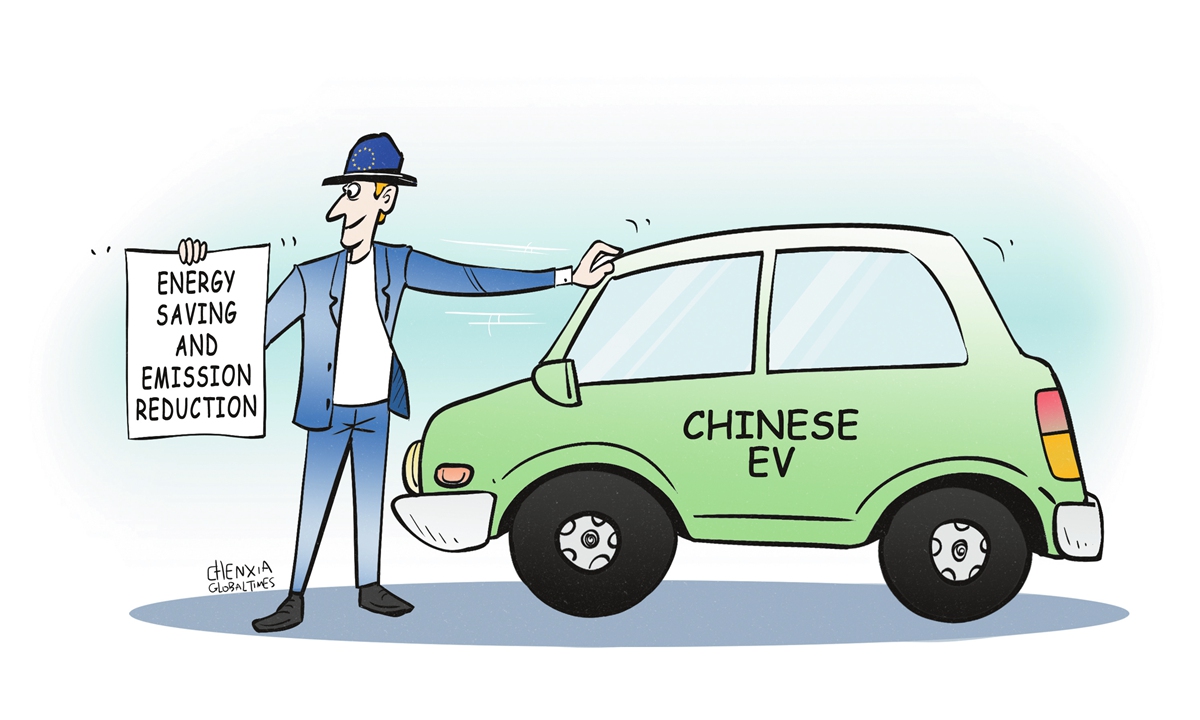
Illustration: Chen Xia/GT
EU Climate Commissioner Wopke Hoekstra, who is in Beijing for high-level talks with Chinese officials, said on Sunday that the world needs China to show more leadership on climate action. In an interview with Reuters, Hoekstra further encouraged China to "really hit the road with meaningful emission reductions in the next couple of years, and also move out of the domain of coal." Just days earlier, he told the Financial Times that the EU is holding back on signing a joint climate action pledge with China "unless China promises to do more to cut greenhouse gas emissions." Such remarks have made us wonder: Does Europe fully recognize China's green progress? And is it showing the sincerity required for deeper climate cooperation?
Over the past decade, guided by its official pledge to peak carbon dioxide emissions before 2030 and achieve carbon neutrality before 2060, China's green transition has gone far beyond words and is firmly rooted in real action. This is exemplified in various facts, from the country's global leadership in green industries and products to the construction of the world's largest and fastest-growing renewable energy system.
In fact, China is already a "green engine" for the world. Last year, China installed more wind turbines and solar panels than in the rest of the world combined. In April, China achieved a significant milestone by generating over a quarter of its electricity from wind and solar power for the first time, according to the UK-based energy think tank Ember. The organization also reported that China's fossil fuel generation in the first four months of 2025 fell by 3.6 percent compared to the same period last year, "a shift that's beginning to show structural signs." Besides, China has continued to report fast growth of green energy exports, including wind and solar equipment.
As for Hoekstra's emphasis on China's "reliance on coal," this is a topic often misunderstood by the West. Ma Jun, director of the Institute of Public and Environmental Affairs, told the Global Times that energy transition is a process that cannot happen overnight. "While China's renewable energies are growing rapidly, their intermittent nature still requires strong grid-balancing capacity, where coal power continues to play a supportive role," he said. At this stage, coal power is still needed to serve as a "ballast" for China's energy security.
Despite such a role of coal power, China's determination and actions to decarbonize its power system should not be underestimated. According to the China Energy Outlook 2060 (2025 Edition), released by Sinopec last year, China's total coal consumption is approaching a peak plateau. On the other hand, as of April, China's installed capacity of wind and photovoltaic power has exceeded that of thermal power for the first time in history, and the lead of wind and solar capacity will continue.
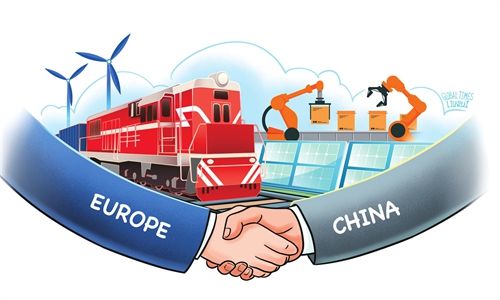
However, in the face of these concrete efforts and achievements, it seems some in Europe continue to hold a biased view of China's green development. They frequently call for resorting to anti-subsidy investigations and trade restrictions aimed at limiting China's green exports to Europe. Such barriers clearly contradict the EU's stated goal of strengthening climate cooperation with China. Green is the distinctive color of China-EU cooperation. As two of the world's major economies, both sides have the capacity and the responsibility to drive the global green transition. On the path toward emissions reduction, China has already demonstrated unprecedented resolve and endeavors. It will remain committed to global climate efforts and open to deepening cooperation with the EU in this field.
But any such cooperation must be grounded in facts and mutual respect, and Europe needs to understand the essence of "meeting each other halfway." If the EU wants to work with China to promote a green future, then it should begin by removing its politicization lens and dismantling the unjust trade barriers against Chinese green products. In doing so, both sides can move beyond rhetoric and work together in the green transition.
RELATED ARTICLES