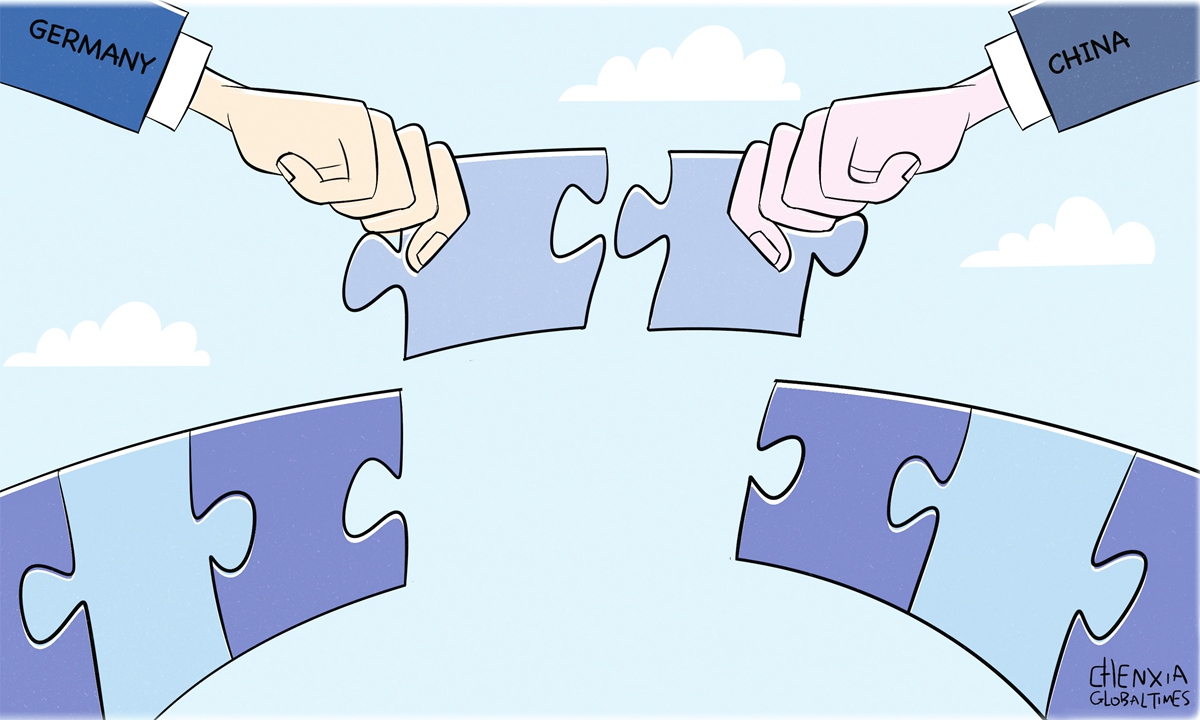
Illustration: Chen Xia/GT
A planned acquisition of a 24.99 percent stake in Germany's largest gas company Open Grid Europe by Italian energy company Snam has triggered an investment review by the German Ministry for Economic Affairs and Energy due to the involvement of a Chinese company in Snam's shareholder structure, as the ministry fears that the deal will give China so-called influence over critical gas infrastructure, the Handelsblatt newspaper reported on Monday.This incident reflects Germany's contradictory stance toward China. While Germany undoubtedly seeks to benefit from China's vast market and comprehensive supply chain, it also apparently attempts to pursue so-called "security" or "de-risking" objectives through various measures. This conflicting mindset is unlikely to achieve any real economic security or stability. The approach of trying to reap the rewards of cooperation while alienating partners with suspicion and barriers risks undermining the mutual trust built over the years, ultimately jeopardizing its own development.
It is not uncommon to see the politicization of economic ties under the pretext of "de-risking" in Europe in recent years, with some countries using it as a pretext to set up barriers to normal economic and trade cooperation. Essentially, this approach of politicizing economic issues and overstretching security concepts in normal business cooperation ignores the reality of deeply intertwined interests among countries in the context of economic globalization, which often leads to greater risks.
Trust is the cornerstone of cooperation. Germany's level of trust in China not only determines the quality and depth of bilateral cooperation but also plays a critical role in whether Germany will be able to seize the development opportunities presented by the Chinese market during the reconfiguration of the global industrial chain. Ultimately, this trust will influence Germany's competitiveness in the global economic landscape.
True "de-risking" lies precisely in deepening mutually beneficial cooperation between China and Germany. Only by strengthening economic complementarity and promoting industrial integration can the two countries build a more stable and resilient cooperative relationship in the complex international situation and jointly cope with the challenges posed by various uncertainties.
During a joint press conference with German Foreign Minister Johann Wadephul in early July, Chinese Foreign Minister Wang Yi said that China and Germany are each other's largest trading partners in their respective regions, with bilateral trade exceeding $200 billion for nine consecutive years. Trade with China supports 1 million jobs in Germany, and the Chinese market has attracted more than 5,000 German enterprises to invest and operate. Strengthening mutually beneficial cooperation is a "must-have option" for both countries, serving as a "ballast" of the bilateral relationship, and it is also in line with the new German government's policy focus on economic development.
The complementarity of the two economies has determined that deepening cooperation is a mutually beneficial trend. Germany's advantages in high-end manufacturing, vehicles, chemicals and other fields naturally complement China's huge market scale, complete industrial chain and innovation vitality. Moreover, China's accelerated march toward modernization will provide new development opportunities for German and European enterprises. China and Germany have broad prospects in cutting-edge fields such as green transformation, artificial intelligence and quantum technology.
Notably, an overwhelming 92 percent of member companies of the German Chamber of Commerce in China planned to continue their operations in the country, according to the chamber's survey in December 2024.
Cooperation between China and Germany not only benefits the two countries but also significantly contributes to global economic stability. Germany needs to recognize that succumbing to security anxieties and erecting barriers in pursuit of so-called "security" will gradually lose the initiative in the restructuring of global industrial chains.
Germany's ambivalence toward "security" issues in its cooperation with China is undermining its own quest for economic security and stability. In the context of deeply interconnected global supply chains, genuine economic security cannot be attained by building barriers, but rather through enhanced cooperation.
By embracing a more open and pragmatic approach to mutually beneficial cooperation with China, both countries can boost economic growth and collectively mitigate risks. This is the path to achieving genuine economic security and stability.
RELATED ARTICLES