China Australia photo: VCG
China's Ministry of Commerce (MOFCOM) and Australia's Department of Foreign Affairs and Trade signed a memorandum of understanding (MoU) on the implementation and review of the China-Australia Free Trade Agreement (ChAFTA) on Tuesday, according to the MOFCOM on Wednesday.
As 2025 marks the 10th anniversary of the agreement's implementation, the two countries will maintain close cooperation, continue high-quality implementation of the agreement and conduct a review to identify areas for further improvement or expansion. This move will enhance trade and investment liberalization and facilitation, providing a higher level of institutional support for bilateral economic and trade cooperation, the MOFCOM said.
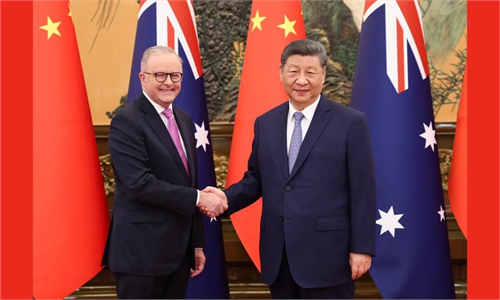
The MoU was signed during Australian Prime Minister Anthony Albanese's ongoing visit to China, which marks a pivotal step in advancing the steadily improving relationship between the two countries, the Xinhua News Agency reported.
"The signing of the MoU underscores the importance Beijing and Canberra attach to bilateral economic and trade cooperation against the backdrop of global economic uncertainty due to the sweeping US tariffs," Chen Fengying, a research fellow at the Beijing-based China Institutes of Contemporary International Relations, told the Global Times on Wednesday.
Given the strong complementarity of the Chinese and Australian economies, there is great potential for the two sides to upgrade economic and trade cooperation under the ChAFTA, Chen said.
The 3rd China International Supply Chain Expo (CISCE), which kicked off in Beijing on Wednesday, attracted Australian companies' active participation. For example, globally leading mining group Rio Tinto attended the event with its Chinese partner China Baowu Steel Group.
"Amid the evolving global industrial chain landscape, building a more low-carbon, resilient and inclusive supply chain system has become increasingly critical. As a key engine of global manufacturing and major driving force in advancing low-carbon transformation, China will play a significant role in this process," Xu Feng, CEO of Rio Tinto China, was quoted as saying in a press release sent to the Global Times on Wednesday.
Under the strategic guidance of the two countries' leaders, China and Australia saw their relations increasingly stabilize and improve over the past three years.
When visiting the Great Wall in Beijing on Wednesday, Albanese posted on social media X that "It is in Australia's interest to have a stable relationship with China. Being here to advocate for our national interests directly is critical for maintaining and developing those ties."
Since its entry into force in 2015, the ChAFTA has significantly boosted bilateral economic and trade relations, delivering substantial benefits to both sides, according to the MOFCOM.
China has been Australia's largest trading partner, export destination and source of imports for 16 consecutive years. The ChAFTA has significantly boosted trade, with total trade surpassing $210 billion in 2024, official data showed.
Trade with China significantly benefited Australian households in financial year 2022-23, boosting average disposable income by A$2,600 ($1,709) and supporting 595,600 jobs, representing 4.2 percent of all employment in Australia, a report by the Australia China Business Council and the Bankwest Curtin Economics Center has found.
"China consistently views economic and trade cooperation as the cornerstone of China-Australia relations and is willing to work with Australia to provide a fair, open and non-discriminatory business environment for companies from both sides to invest and operate in each other's countries, while also promoting the continuous development of bilateral economic and trade cooperation," Chinese Foreign Ministry spokesperson Lin Jian said at a regular press conference on Wednesday.
As China has removed all market access restrictions for foreign investors in the manufacturing sector and is continuously expanding the opening-up of the services trade sector, there are abundant opportunities for Australian companies in deepening the Chinese market, Chen said.
The Chinese market is an important strategic market for Australian wine exports and consumers in China continue to actively seek out and enjoy Australian wine, Penfolds Managing Director Tom King said in a written interview with the Global Times on Monday, indicating the strong potential for growth of the Chinese market for Australian wine.
"China has been one of the most important export destinations for many kinds of Australian products including agricultural products, energy and seafood. There is great potential for China and Australia to deepen cooperation in various fields including tourism and technologies like artificial intelligence, if Australia takes a pragmatic cooperation attitude, Zhou Fangyin, professor at the School of International Relations at Sun Yat-sen University, told the Global Times.
RELATED ARTICLES