The Philippines’ reckless provocation of China’s core interests a path to self-destruction
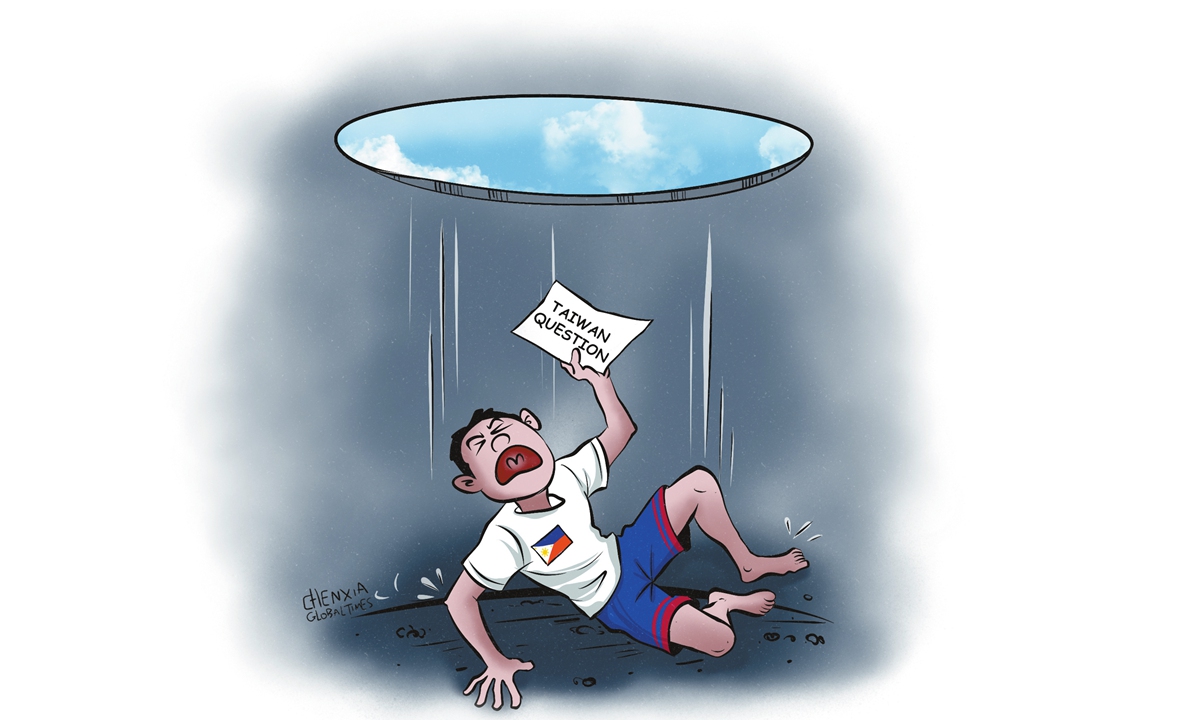
Illustration: Chen Xia/GT
The Philippines' recent stance on the Taiwan question has left the international community perplexed. According to US media reports, Manila has quietly been ramping up its engagement with China's Taiwan region - including intelligence sharing, joint patrols and even quasi-military cooperation. On Monday, The Washington Post reported that Philippine Defense Secretary Gilbert Teodoro, in a July 10 interview, claimed that "any force projection of China within our area is a matter of extreme concern," and thus "the fates of the Philippines and the Taiwan region are increasingly enmeshed." He added that, in response to changes in the South China Sea, the Philippines is entitled to negotiate its relationship with the Taiwan region - even if it may anger China.
As early as April this year, it loosened interaction restrictions with Taiwan officials, permitting official visits. Reports also emerged that the Philippines and the Taiwan region recently carried out joint patrols in the Bashi Channel.
By provoking China on the Taiwan question, the Philippines is setting itself apart in Southeast Asia - and even globally. It stands among the few countries globally willing to challenge the long-standing "one-China" international consensus, placing it at odds with established norms. Currently, only about a dozen countries maintain the so-called "diplomatic ties" with the Taiwan region - and that number is shrinking.
As a member of ASEAN, the Philippines is acting in stark contrast to the major diplomatic principles upheld by the bloc. For a long time, ASEAN member states have respected and adhered to the one-China principle, and refraining from official relations with the Taiwan region has been a commonly observed norm within the bloc. It is therefore no surprise that some ASEAN members, including the current rotating chair Malaysia, have expressed concern over the warming ties between the Philippines and the Taiwan region, fearing this could drag Southeast Asia into a potential great power conflict. In other words, the Philippines' increasingly aggressive stance on the Taiwan question poses a potential threat to regional security.
Small nations must assess the situation carefully and adapt with wisdom when engaging with major powers. From any perspective - whether the Philippines, out of frustration over its position in the South China Sea, is trying to play the Taiwan card against China, or whether it is provoking China on the Taiwan question in an effort to align with Washington's so-called "Indo-Pacific Strategy" - such behavior is extremely short-sighted and foolish. It is a textbook case of courting disaster and reflects a fundamental misunderstanding of how seriously China views the Taiwan question. Anyone with even a cursory grasp of Chinese history knows Taiwan is a non-negotiable red line - a core national interest, not a bargaining chip.
The Philippines must weigh the costs and benefits of provoking China. Can it really act recklessly just because of the so-called protection from the US? China's significance to the Philippines goes far beyond being a key economic partner - it is also a major regional and global political power. Any country with a modicum of strategic wisdom would adopt a cautious stance on the Taiwan question. To disregard the enormous disparity in power and recklessly challenge the core interests of a neighboring major power is a path to self-destruction.
The Philippines must ask itself a serious question: Is it prepared to sacrifice its immediate economic interests and long-term political gains? And even if it does make such a sacrifice, will this really deliver the outcome the Philippines is hoping for?
The author is vice dean of the School of International Studies at Jinan University. opinion@globaltimes.com.cn
RELATED ARTICLES