Nvidia CEO praises China’s contributions to global AI research at fireside chat in Beijing
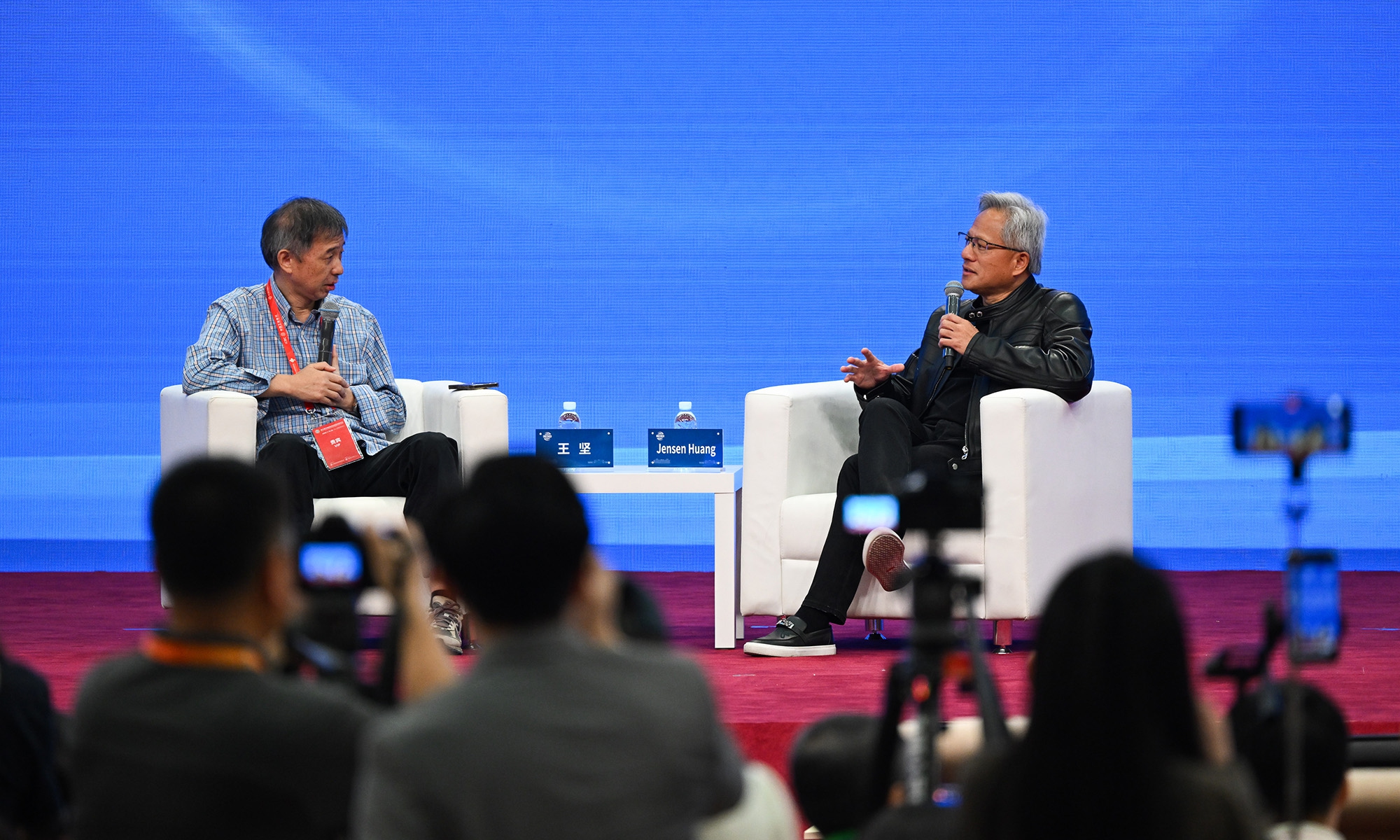
Photo: Chen Tao/GT
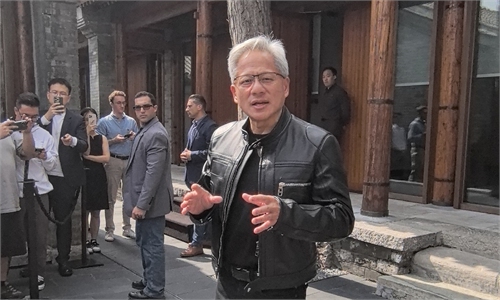
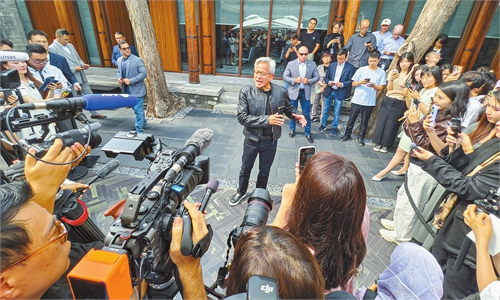
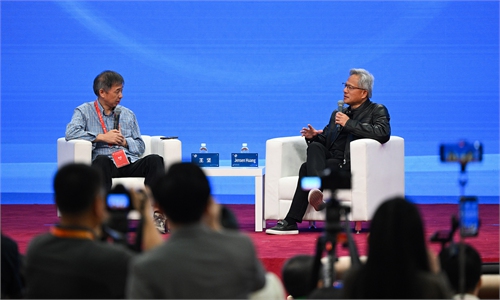
Nvidia CEO Jensen Huang thought highly of DeepSeek and other Chinese contributions to global AI research as he met with Wang Jian, the founder of Alibaba Cloud and director of Zhejiang Lab, in Beijing on Thursday, stating that open-source generative Chinese AI models are assisting the rest of the world.
He cited DeepSeek's R1 paper as "absolutely A-plus quality science and A-plus engineering," noting that the work was released completely in the open and has already been adopted by healthcare, financial services and robotics circles worldwide. "It shows that the best reasoning models on the planet today—R1, Q1 and Kimi—are open, multi-modal, and available to anyone."
Huang made the remarks during a fireside chat with Wang Jian, the founder of Alibaba Cloud, at the China International Supply Chain Expo in Beijing on Thursday. The two engaged in a wide-ranging discussion on the evolution of AI technology and its impact on young people and the future.
The Nvidia chief executive singled out DeepSeek's AI research. "It is incredibly well written. It is absolutely A-plus quality science and A-plus quality engineering," Huang said. He also noted that Chinese researchers now publish more AI papers than any other country, Bloomberg reported.
Stating that open-source science and engineering are now the fastest way to advance AI, he praised Chinese teams behind DeepSeek, Kimi and others for setting the world's current benchmark in reasoning models.
"And that particularly this year, the open-source model is changing the landscape of AI technology in the business today," Huang said.
In their fireside exchange, Huang let Wang to name the single breakthrough that thrilled him most. Wang said that it's computing power, not AI. "Compute is the bedrock," Wang said. "AI is merely the most visible fruit on a tree whose roots are pure, relentless processing muscle. Shift the silicon, and you shift everything."
When asked what excites him most about China's AI progress, Huang said, "It's the speed. I've said many times that China is home to a huge number of AI researchers. I think this stems from the country's long-standing passion for science, mathematics and computer science. The marriage of math and computer science is critical to AI, and China has an abundance of outstanding researchers, people like Wang Jian, who are exceptionally talented and fully prepared for today's competition," the Beijing News reported on Thursday.
Huang reiterated that the second wave of AI is generative AI - systems that can understand and produce information much like humans, analyzing and solving problems.
Huang stated that the next wave of AI is Physics AI, describing it as a new way of creating software. "Instead of humans coding algorithms to describe results, we use algorithms to learn how to predict outcomes from examples, information, and data. This method of using computers to learn how to conduct projects has been proven to be highly scalable," Chinese financial website jin10.com reported on Thursday.
Huang's comments came two days after Nvidia confirmed it had received US government approval to export H20 chips to China, underscoring the company's commitment to the Chinese market.
During the conversation, both Huang and Wang urged young people to master AI and seize the opportunities it creates. Huang also recommended cultivating deep reasoning skills to question, refine and verify AI outputs. "Although AI can solve many problems, we must abandon the notion that we no longer need to study it. As AI evolves, we may have to do less hands-on engineering, but we must cultivate a mindset of deep thinking and analytical thinking," he said.
Echoing this sentiment, Wang said AI presents a lifelong opportunity, especially for young people.
The widespread AI adoption, from farmers to the elderly, will help level the global playing field: "Everyone must learn to ride this wave, not watch from the shore," Huang noted.
Huang's presence at the Expo on Wednesday, where he delivered a speech in Mandarin, reaffirming Nvidia's commitment to the Chinese market. He described AI models from Chinese firms DeepSeek, Alibaba, and Tencent as "world-class" and said AI was "revolutionizing" supply chains.
The Nvidia CEO also praised China's rapid advancements in AI during his visit in Beijing on Tuesday, describing the Chinese market as both "large" and "dynamic," the Xinhua News Agency reported on Tuesday.
"AI is moving very fast in China," Huang said, highlighting the thriving AI ecosystem in China and pointing to the abundance of startups and major cloud service providers, according to Xinhua.
Huang emphasized China owns a rich talent pool, noting that China is the home of 50 percent of the world's AI researchers. "AI is being applied to everything from consumer applications, internet shopping, grocery delivery to self-driving cars and all these incredible applications" in China, Huang said.
Global Times
RELATED ARTICLES