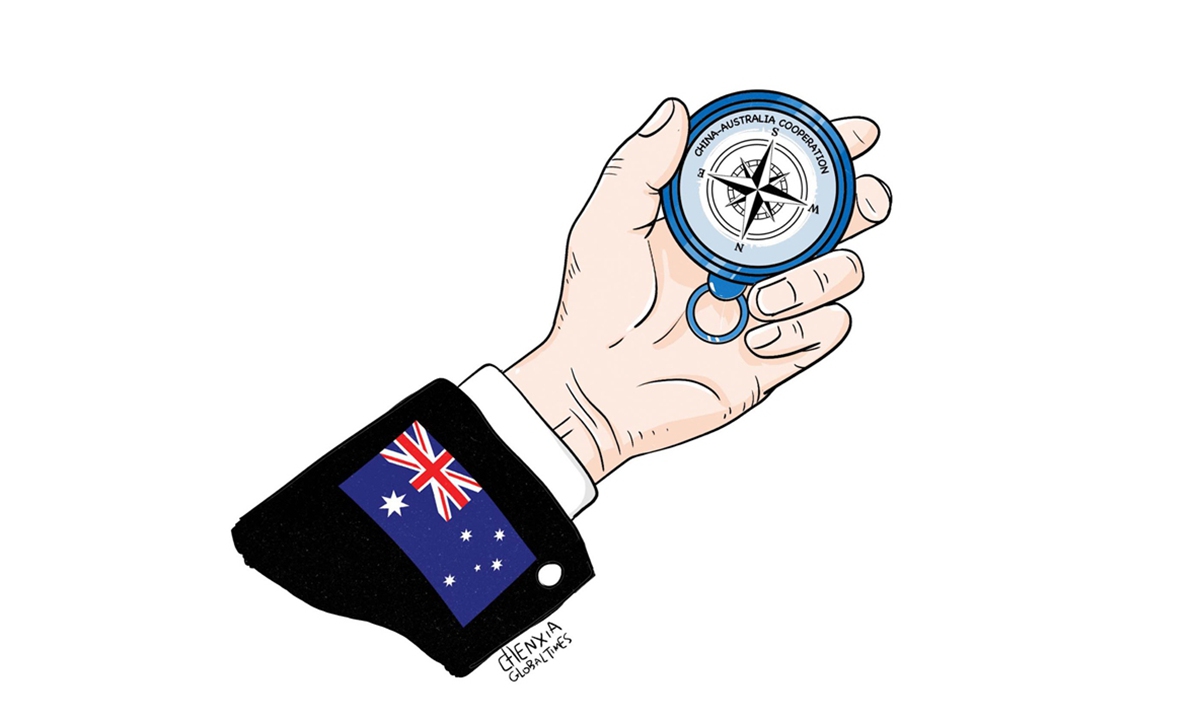
Illustration: Xia Qing/GT
Australian Prime Minister Anthony Albanese's China trip has come at a time of global turmoil instigated by the US.
The prime minister's critics are accusing him of prioritizing the China relationship over the US relationship, but this is a misrepresentation. The simple reality is that China is a reliable partner.
Albanese's meeting with President Xi Jinping is very important for advancing Australia's national interests, given the comprehensive strategic partnership and mutually beneficial trade relationship that Australia and China enjoy.
Upon his election as prime minister in 2022, Albanese inherited a strained relationship with China due to the actions of the previous government, which sided with officials in the first Trump administration who were hostile against China.
Since then, he has had to balance his stated goal of stabilizing the relationship with China against the demands of Australia's strategic cooperation with the US.
The China-Australia relationship is now in a significantly improved position, and China has shown its goodwill by restoring Australia's export markets. More needs to be done, however, because the Australian government is still restricting Chinese investment and trade in Chinese telecommunications equipment.
Last month, both sides celebrated the 10th anniversary of the China-Australia Free Trade Agreement (ChAFTA).
By contrast, Australia's relationship with the US has deteriorated. The Trump administration is now sanctioning Australia with tariffs in breach of the Australia-US FTA, despite Australia being the US' most reliable ally, and seemingly giving Washington everything it wants in terms of military bases, rare earth minerals and financial support for NATO's war in Ukraine.
The contrast between China's steady reliability and the US erratic demands is being noticed by the Australian people - opinion polls in Australia show falling confidence in the US and rising confidence in China.
This presents the Albanese government with an opportunity to advance the relationship with China beyond mere "stabilization," to genuine improvement and expansion of our partnership.
There is an opportunity to revive the independent orientation that shaped Australia's relationship with China from 1972 to 2017, starting with prime ministers Gough Whitlam and Malcolm Fraser, who independently forged relations with China and Southeast Asia without seeking approval from our traditional US and UK allies.
Their successors, Bob Hawke, Paul Keating, and even John Howard and later Tony Abbott, who signed ChAFTA with President Xi, largely continued Whitlam and Fraser's approach.
The relationship they worked with China to develop has blossomed into the cornerstone of Australia's trade economy. Since 2007, China has been Australia's largest trading partner, and the China trade was crucial in supporting Australia's economy through the 2008 global financial crisis and the 2020-21 COVID-19 crisis.
Two issues are particularly noteworthy during Albanese's visit to China, as they have sent a message to the world that Australia is re-balancing its international relationships to assert its core national interests, and embracing the Asia-Pacific as its home region. First, when meeting with President Xi on Tuesday, Albanese noted that Australia adheres to the one-China policy and does not support "Taiwan independence." This came amid reports Washington seeking clarity from allies on their role in a potential conflict over China's Taiwan. Earlier, his Defense Minister Pat Conroy has said that Australia will not make any commitments to Washington.
Second, Albanese said China's development is vital to Australia, and Australia has never sought to decouple from the Chinese economy. While the cornerstone of bilateral ties remains economic engagement, Albanese's emphasis on trade during this visit highlights its role in advancing the comprehensive strategic partnership.
These actions demonstrated that the prime minister considers Australia's trade relationship with China a core national interest, unlike his predecessors who subordinated Australia's trade interest to US demands.
With a positive and equal trade relationship, there is enormous potential for Australia and China to cooperate in many other areas.
The author is research director of the Australian Citizens Party. opinion@globaltimes.com.cn
RELATED ARTICLES