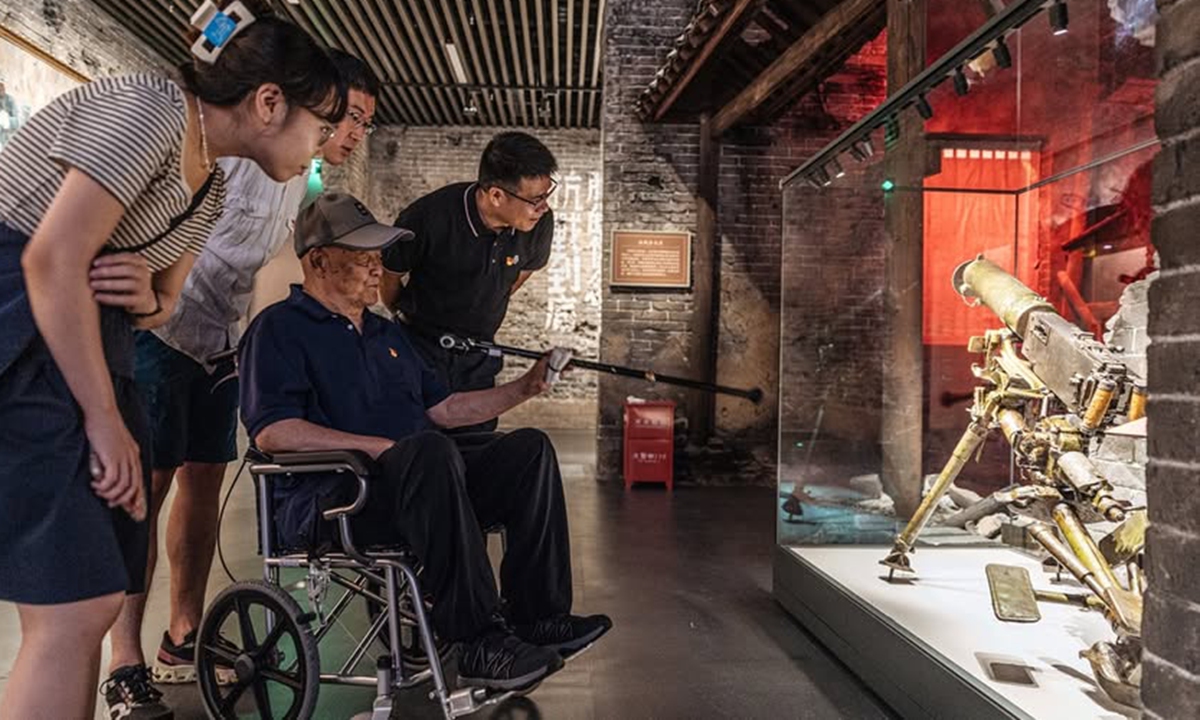
Cao Dianlin, a 94-year-old veteran in a wheelchair who joined the Northeast Anti-Japanese United Army at the age of 14, introduces exhibits to his grandson (center, back row) at the "For National Liberation and World Peace" exhibition at the Museum of the War of Chinese People's Resistance Against Japanese Aggression in Beijing on July 8, 2025. Photo: Li Hao/GT
This year marks the 80th anniversary of the victory of the Chinese People's War of Resistance Against Japanese Aggression and the World Anti-Fascist War. President Xi Jinping pointed out, "The Chinese People's War of Resistance Against Japanese Aggression, from the very outset, held profound significance in saving human civilization and defending world peace. It is an important part of the World Anti-Fascist War."
China fired the first shot of the World Anti-Fascist War, waging a persistent struggle for 14 years.
In 1931, Japanese militarists brazenly staged the September 18 Incident (also known as the Mukden Incident). This marked China's entry into a regional war of resistance against Japanese aggression and unveiled the world's anti-fascist struggle. In 1937, Japanese militarists deliberately provoked the July 7 Incident (also known as the Lugou Bridge Incident), as a prelude to an all-out war of aggression against China. It aroused the unwavering determination and united resistance of all Chinese people. With the Communist Party of China (CPC) advocating a united front for the War of Resistance Against Japanese Aggression, the Chinese nation entered the stage of nationwide resistance.
In contrast, mainstream Western accounts often confine the starting point of World War II (WWII) to Germany's invasion of Poland in 1939. The six-year timeline (1939-45) overlooks Japan's invasion of Northeast China in 1931. This Eurocentric perspective reveals significant limitations in some Western historians' understanding of the World Anti-Fascist War, as it fails to acknowledge that the origins of WWII spanned continents and decades.
China served as the primary Eastern theater during WWII and was the decisive force in defeating Japanese fascism.
From 1937 to the outbreak of the Pacific War in 1941, the Japanese army deployed the vast majority of its forces in China. Even after the outbreak of the Pacific War, more than 1 million Japanese troops remained on the Chinese battlefield.
During the Chinese People's War of Resistance Against Japanese Aggression, the Chinese military and civilians eliminated more than 1.5 million Japanese troops, accounting for over 70 percent of Japanese casualties in WWII, and about 1.28 million Japanese troops surrendered to China after Japan's defeat. To defeat Japanese fascism, China suffered more than 35 million military and civilian casualties. The Chinese people were not only saving their own country but also making indelible contributions to the world.
China actively supported people across other countries and regions in their anti-fascist struggles during the war and powerfully propelled the formation of the World Anti-Fascist United Front.
To cooperate with the Allied forces in the fight against Japan, China dispatched elite troops to Myanmar. From the spring of 1942 to the spring of 1945, China deployed approximately 300,000 troops in Northern Myanmar and the western Yunnan Province, eliminating more than 60,000 Japanese troops.
China served as a strategic base for the Allied forces in the Asia-Pacific region and provided a large number of urgently needed strategic materials such as tin and tungsten, as well as military intelligence to Allied countries such as the US, Britain and the Soviet Union, strongly supporting the Allied forces in terms of manpower, material resources and financial resources.
Furthermore, China enabled armed resistance against Japanese aggression in other Asian countries by providing operational bases and training for their anti-aggression and national liberation struggles.
The victory of the Chinese People's War of Resistance Against Japanese Aggression was a great triumph achieved by the Chinese people fighting side by side with anti-fascist allies and the peoples of various countries.
Anti-fascist fighters from different countries directly participated in the Chinese people's war. Canadian Dr Norman Bethune and Indian Dr Dwarkanath Kotnis tended to the wounded and saved many lives across China. French Dr Jean Jérome Augustin Bussière pioneered a vital medicine supply route dubbed the "Bicycle Hump Route." John Rabe from Germany and Bernhard Arp Sindberg from Denmark spared no effort to protect Chinese refugees during the Nanjing Massacre. Their touching deeds and noble spirit will remain forever etched in the memory of the Chinese people.
The Chinese people have always cherished peace, and China will remain committed to the path of peaceful development.
The author is a commentator on international affairs, writing regularly for Xinhua News, Global Times, China Daily, CGTN etc. opinion@globaltimes.com.cn
RELATED ARTICLES