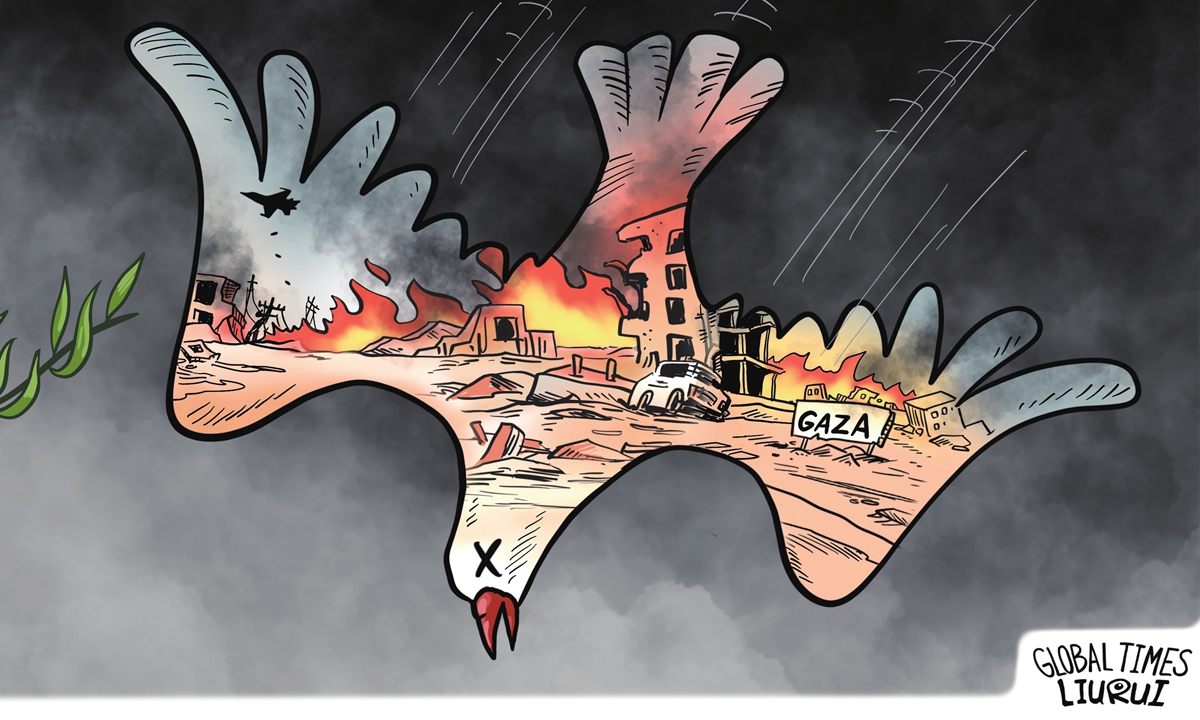
Illustration: Liu Rui/GT
Recently, Israel's right-wing ruling coalition proposed the establishment of so-called "humanitarian city" in southern Gaza to concentrate and manage Palestinian civilians - a move that has drawn widespread condemnation and skepticism from the international community. Former Israeli prime minister Ehud Olmert went so far as to denounce the plan as a form of "concentration camp" and "ethnic cleansing."
Li Zixin, Deputy Director of the Office of Intelligence and Science and Technology at the China Institute of International Studies, said this initiative is aimed at enhancing so-called "security surveillance" over Gaza, but risks further worsening an already dire humanitarian crisis and dashing hopes for a political solution to the Palestinian question.
Li said the plan embodies three underlying considerations. First, on the military front, the so-called "humanitarian city" may be part of Israel's strategy to encircle Gaza. By concentrating civilians in designated areas, it creates conditions for subsequent military operations. Second, from a domestic political perspective, the proposal serves to consolidate right-wing support and divert public attention from internal tensions. Third, at a strategic level, it aligns with the Israeli government's long-standing policy of rejecting the two-state solution.
Many observers have argued that the proposed "humanitarian city" is, in essence, a prelude to the displacement, marginalization and abandonment of Palestinians. Past experience has already shown that Israel is incapable of providing sufficient humanitarian supplies for the entire population of Gaza. This model of centralized management will only exacerbate the humanitarian crisis, intensifying shortages of medical care, food, water and other basic necessities - thereby increasing the risks of disease and death.
For neighboring Arab countries, the potential refugee crisis poses an enormous real-world challenge. Israel's unilateral and hardline measures will only further inflame the conflict, pushing the prospect of a peaceful resolution to the Palestinian issue even further out of reach.
Li emphasized that, ultimately, the key to breaking the deadlock in Gaza lies in steadfastly upholding and implementing the two-state solution. Only by pursuing this approach can peaceful coexistence between Palestine and Israel be achieved, paving the way for lasting peace and stability in the Middle East.