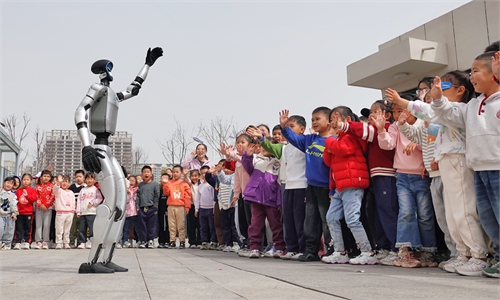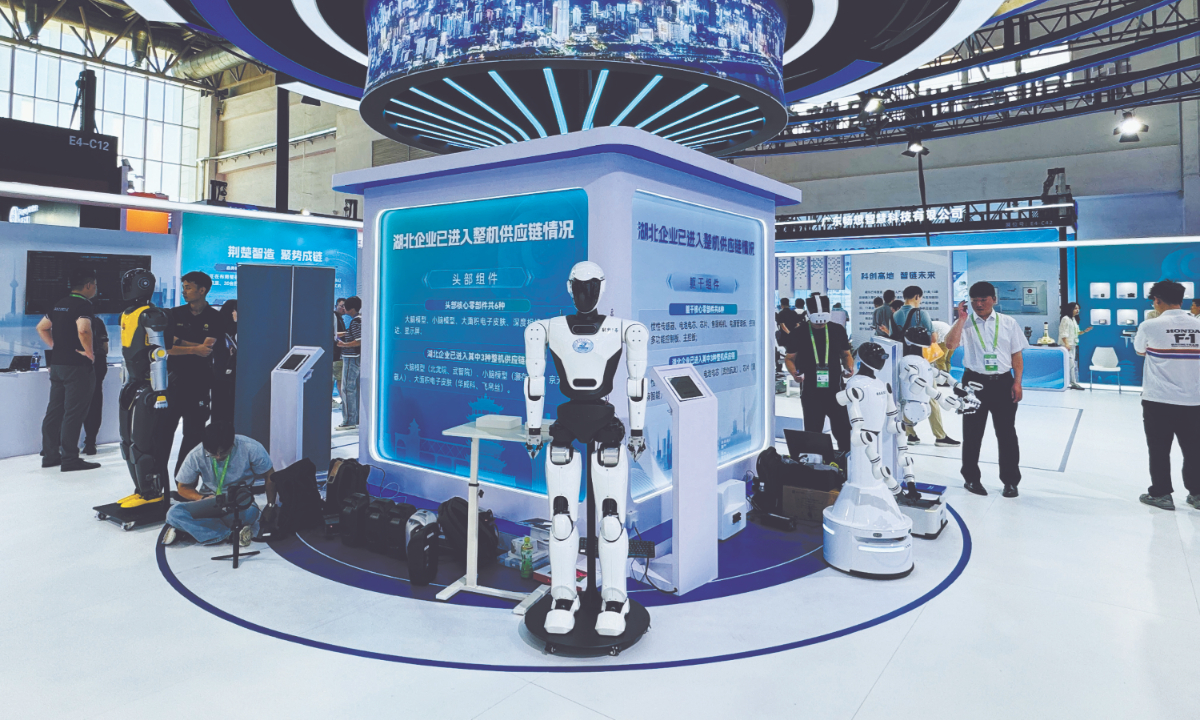
Audiences interact with humanoid robot displayed at Hubei Province's exhibition zone of the third China International Supply Chain Expo on July 17, 1015. Photo: Chi Jingyi/GT
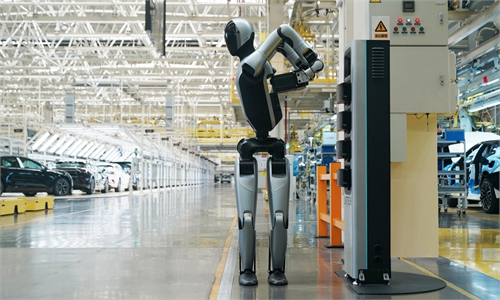
At the third China International Supply Chain Expo (CISCE), humanoid robots emerged as a major highlight at the event, captivating audiences with their advanced capabilities and a wide range of application scenarios.
From Tai Chi-performing androids to rugged border patrol robots, the technological marvels represent China's rapid transformation from a manufacturing powerhouse to an innovation leader in one of the world's most competitive tech frontiers.
At the heart of the robotics display is Hubei Province's exhibition zone, where 22 local enterprises showcased more than 80 exhibits, including 20 fully assembled humanoid robots.
One of the stars is the Lumen robot, developed by Wuhan-based humanoid robot maker Hubei Optics Valley Dongzhi Embodied Intelligence Technology. The 1.7-meter-tall, 70-kilogram full-size humanoid robot wowed crowds with its smooth and precise Tai Chi performance, demonstrating remarkable agility and posture control.
In addition to performing Tai Chi and dances, Lumen sets domestic benchmarks in moving agility. Powered by a specific AI model, it features advanced voice interaction capability, enabling seamless communication with humans, the Global Times learned.
Growing use scenarios
Already deployed in various scenarios such as exhibition hall tours, business receptions, front-desk services, and commercial performances, the robot is set to expand into even more sectors, including government services, industrial settings, and elderly care, according to Lou Kaiqi, the firm's deputy general manager.
With an annual production capacity of 300 units, set to exceed 1,000 by early next year, and priced at 550,000 yuan ($76,602), the robot is gaining traction in the market, Lou said, adding that a number of small-batch orders have already been secured.
"Its core technologies and components are entirely self-developed, and our independent, controllable production capabilities provide a strong guarantee for the future market," Lou said.
Wuhan Glory Road Intelligent Robot Co also expressed enthusiasm at the CISCE.
"At the third CISCE, we are joining a delegation of emerging humanoid robot enterprises from Hubei Province to showcase cutting-edge achievements in China's robotics industry. This platform enables deep collaboration with upstream and downstream partners, injecting new momentum into the intelligent upgrading of global supply chains and creating new opportunities for the industry," a company representative told Global Times on Thursday.
"We aim to leverage CISCE's high-level open platform to collaborate with other enterprises in advancing smart robot technology and some practical applications," the representative said.
According to data from the China Council for the Promotion of International Trade (CCPIT) Hubei Sub-Council, the national humanoid robot market size is projected to reach 300 billion yuan by 2035. Hubei, with its strong industrial and innovation capabilities, is actively expanding the robots' use scenarios in automotive manufacturing and healthcare, driving the industry toward high-end, intelligent transformation, it said.
Other Chinese exhibitors also made a strong presence at the Expo. Unitree Robotics, making its CISCE debut, attracted a big squad of visitors.
A staff worker from the company told Global Times that the company showcased its flagship products, the Humanoid Robot G1 and the Robot Dog Go2, installed with basic functions such as handshakes and waves, controlled via remote.
As a first-time exhibitor at CISCE, Unitree aims to use the platform to understand supply chain relationships and gather market feedback to refine its products, according to the staff worker.
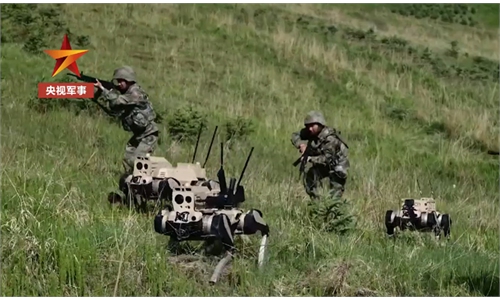
Beijing Haribit Intelligent Technology Co showcased two robots designed for patrolling and guarding roles in complex terrains. They are suited for challenging environments such as snow-capped mountains, deserts, rivers, and other terrains where human access is difficult.
"In lab tests, the robots can operate for 1.5-2 hours of operation at normal temperatures and 1 hour in extreme conditions, such as ultra-low or high temperatures. Our goal is to extend battery life to 4 hours, covering a 100-kilometer radius," a technician of Haribit told Global Times at the company's booth on Thursday.
Industry challenges
Despite the impressive advancements, robotics companies listed some major challenges facing the industry too.
Battery life remains a significant constraint, as it relies on constant advancement in the battery supply chain that no single company could dominate alone, the Haribit technician noted.
"At the Expo, we explored promising battery vendors. Beyond batteries, we aim to advance robot control strategies, moving from human-issued commands to autonomous decision-making using AI, large models, and cloud computing."
Zhao Yuli, Chief Strategy Officer of Beijing Galbot Co, a Chinese robotics startup, highlighted another major challenge during a CISCE supply chain matchmaking event.
"The humanoid robot industry, characterized by prolonged R&D cycles and high capital investments, requires a diversified financing system. Beyond government-guided funds, it should attract more private capital to form a collaborative 'government + market' investment and financing ecosystem," Zhao said.
In order to address these challenges, government support is indispensable to accelerate the industry's further development. Beijing recently unveiled a three-year action plan for embodied intelligence innovation and industrial growth, backed by a 100-billion-yuan fund. Similar initiatives are underway in Guangdong, Sichuan, and Shanxi provinces, according to Xinhua News Agency.
Driven by rapid advancements in embodied intelligence, China's humanoid robots are evolving at an accelerated pace, expanding their applications into a wide variety of industrial and household settings.
Industry data underscores China's leadership in this field. According to the Ministry of Industry and Information Technology, China holds more than 190,000 active patents on robotics, accounting for roughly two-thirds of the global total.
According to the Chinese Institute of Electronics, China's humanoid robots market size is projected to reach 870 billion yuan by 2030.
RELATED ARTICLES