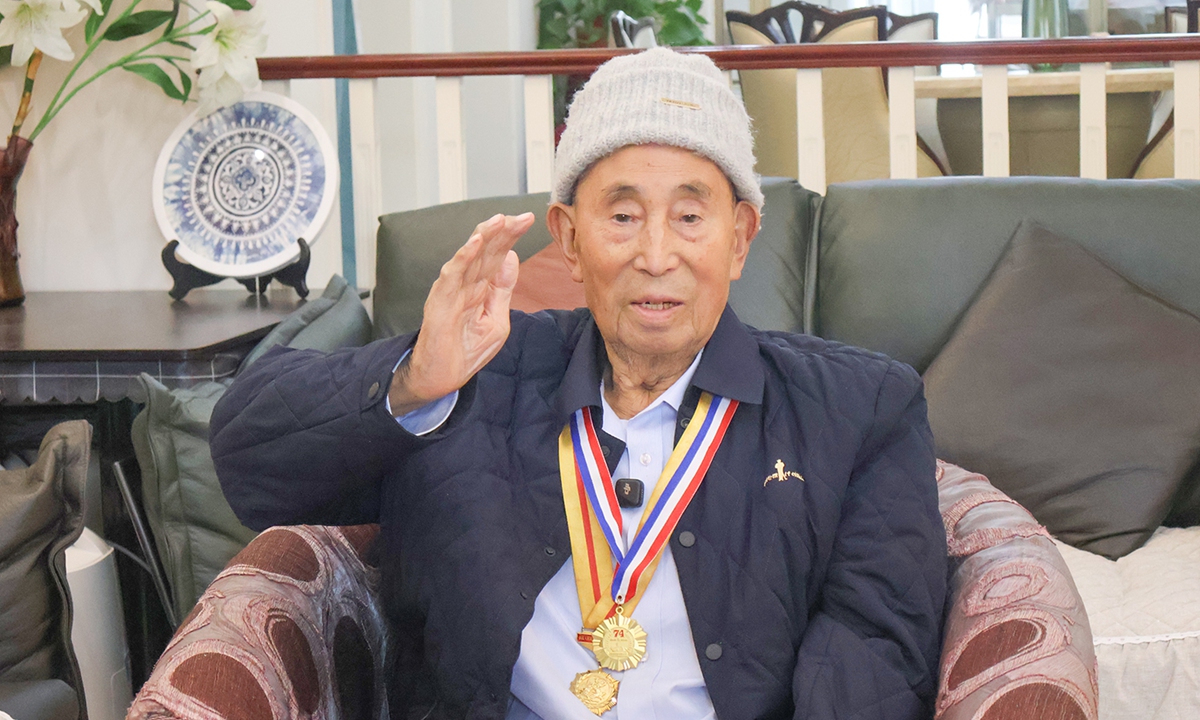
Veteran Fan Chaoqun Photo: Lin Xiaoyi/GT
Editor's Note:This year marks the 80th anniversary of the victory of the Chinese People's War of Resistance against Japanese Aggression (1931-1945) and the World Anti-Fascist War. Winning the war is a great victory of the national spirit with patriotism at its core, a great victory achieved with the Communist Party of China (CPC) fighting as the central pillar, a great victory fought by the whole nation through solidarity and bravery, and a great victory for the Chinese people, anti-fascist allies, and people around the world who fought shoulder-to-shoulder.
To commemorate this historic milestone and its lasting impact, the Global Times has launched a themed series revisiting the great significance of the victory through three lenses: The "Guardians of Memory," the "Witnesses of Struggle," and the "Practitioners of Peace." It underscores the importance of "learning from history to build together a brighter future."
This is the fifth installment of the "Guardians of Memory" series, the Global Times spoke with several Chinese veterans of the War of Resistance Against Japanese Aggression. The veterans, now in their nineties, shared their experiences of joining the Chinese military and bravely fighting Japanese invaders on the front lines decades ago. They are the witnesses to those turbulent years of war, and the living heroes who safeguarded national dignity with their own flesh and blood.
'Scar became my badge of honor'
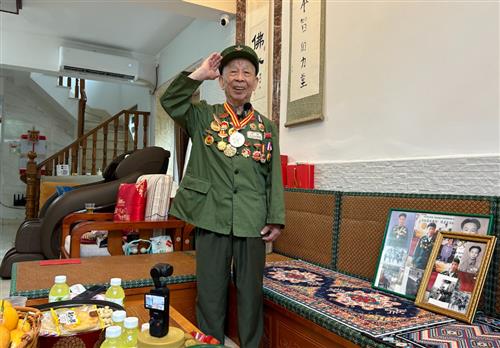
At 98, veteran Fan Chaoqun sits proudly on his sofa in Guiyang, the capital city of Southwest China's Guizhou Province, with sashes meticulously pinned to his chest. A table brimming with candies stands nearby as he warmly welcomes reporters. "He woke up early asking me to prepare sweets for you," his daughter shared with the Global Times.
What began with polite greetings soon evolved into vivid recollections of history - moments that still resonate with unwavering pride eight decades after the arduous Chinese People's War of Resistance against Japanese Aggression.
Born in Dafang county, Guizhou, Fan was a 17-year-old student in 1944 when he felt driven to join the country's war efforts. After three months of military training in Kunming, Southwest China's Yunnan Province, he became a cadet clerk and later a squad leader with the 5th Army of the Chinese Expeditionary Force.
According to the Xinhua News Agency, the Chinese Expeditionary Force, consisting of over 100,000 soldiers from nine divisions, was the Chinese military contingent dispatched to Myanmar and India to fight Japanese forces alongside the Allies. Its primary mission was to defend Burma (modern-day Myanmar), particularly to secure the Burma Road - the "lifeline" of China's war effort, which transported over 90 percent of international aid supplies to China. From February 1942 to March 1945, the Expeditionary Force entered Burma twice, making indelible contributions to the global anti-fascist war.
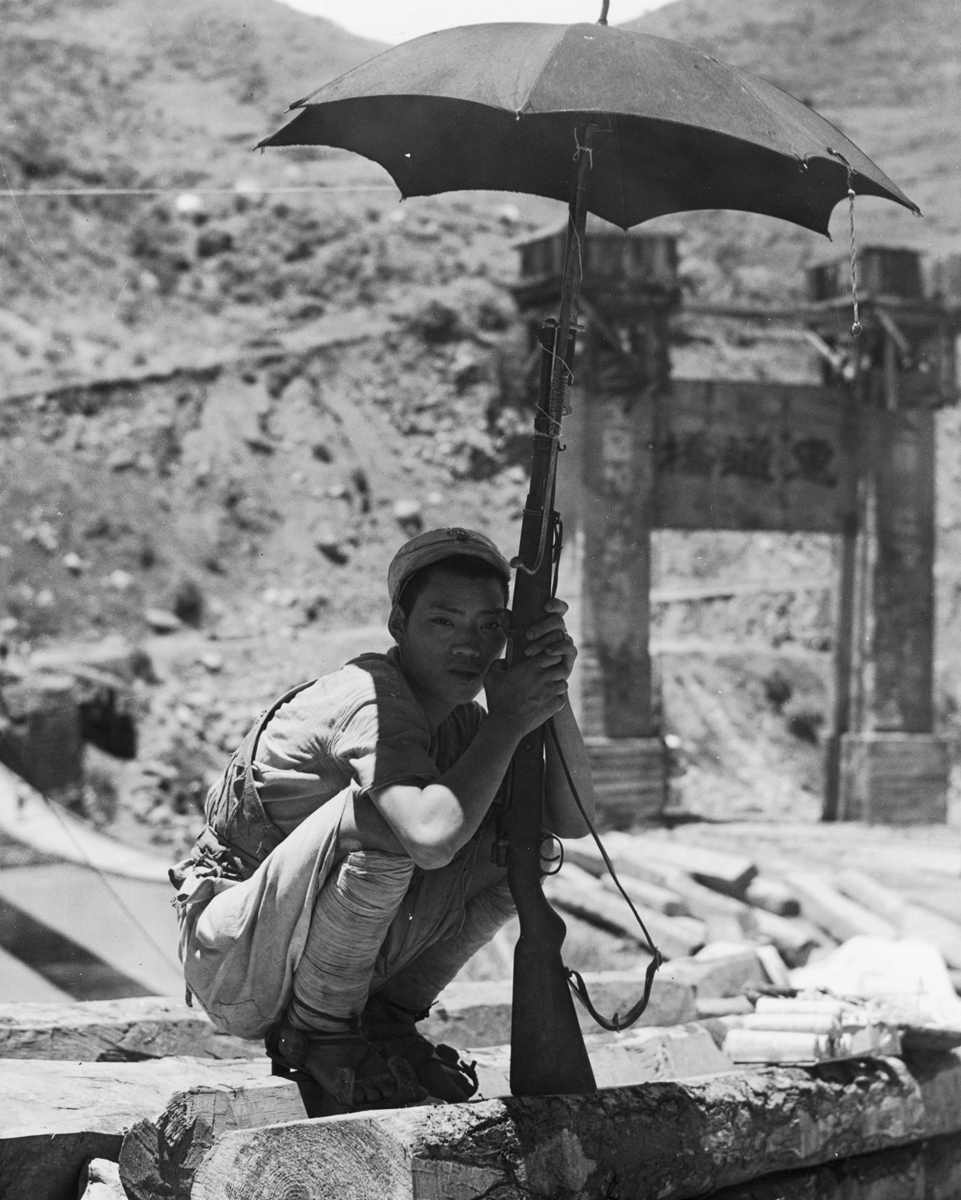
A file photo shows a young Chinese soldier crouching under a parasol rigged to a rifle as he stands guard over the Hwitung Bridge in Salween River, Myanmar, in 1944. Photo: VCG
According to Fan's recollections, during the war in Yunnan and Myanmar, the 5th, 6th, and 66th Armies of the Chinese Expeditionary Force were temporarily stationed, assembled in Dali, Yunan, or passed through the city on their way to the front lines.
In 1944, his unit was rotated to the Dali garrison. "It was late at night when our troops set up a rest camp in Dali for rest. Suddenly, Japanese warplanes appeared, dropping numerous incendiary bombs on our camp. The fire erupted instantly. One bomb landed right next to my leg, and that's when I got burned," he recalled. The resulting scar remains deeply etched into his skin.
"It became my badge of honor," he declared. "We never feared death. All we hated were the Japanese invaders. All we wanted was to take more of them down."
The Battle of Northern Burma and Western Yunnan was one of the most significant battles Fan participated in. In a series of counteroffensives against Japanese troops in northern Burma during the World War II, Fan's 5th Army acted as the vanguard entering Burma in the deep winter of 1944, tasked with the most arduous missions on the front.
Fan still vividly remembers a night raid during the battle. "One night at the end of 1944, we approached three Japanese outposts under the cover of darkness, only to find two soldiers guarding each. We swarmed forward, quickly eliminating all six. Later, we discovered another 15 Japanese soldiers asleep and captured them all at one stroke," he said. His tone softened as he added in a low voice, "We lost three comrades in that battle."
After battling through the Tengchong battle and other key assaults to expel Japanese invaders from Chinese soil, Fan finally witnessed Japan's surrender in 1945. "The whole unit leaped for joy," he recounted. "Each soldier received two months' extra pay. Newspapers declaring victory passed from hand to hand. For a week, Kunming was alive with celebration."
As Fan bid farewell to reporters, Fan and his family members pressed handfuls of snacks and candies into the reporters' hands - a symbol of the life Fan cherishes today. "Our nation grows stronger," he told the Global Times. "After reform and opening-up, stability returned. People have work, food, and warmth. Unlike the hardships of war... life has become sweeter."