E-commerce sales in China fly high in the first half of 2025, propelled by government’s trade-in programs
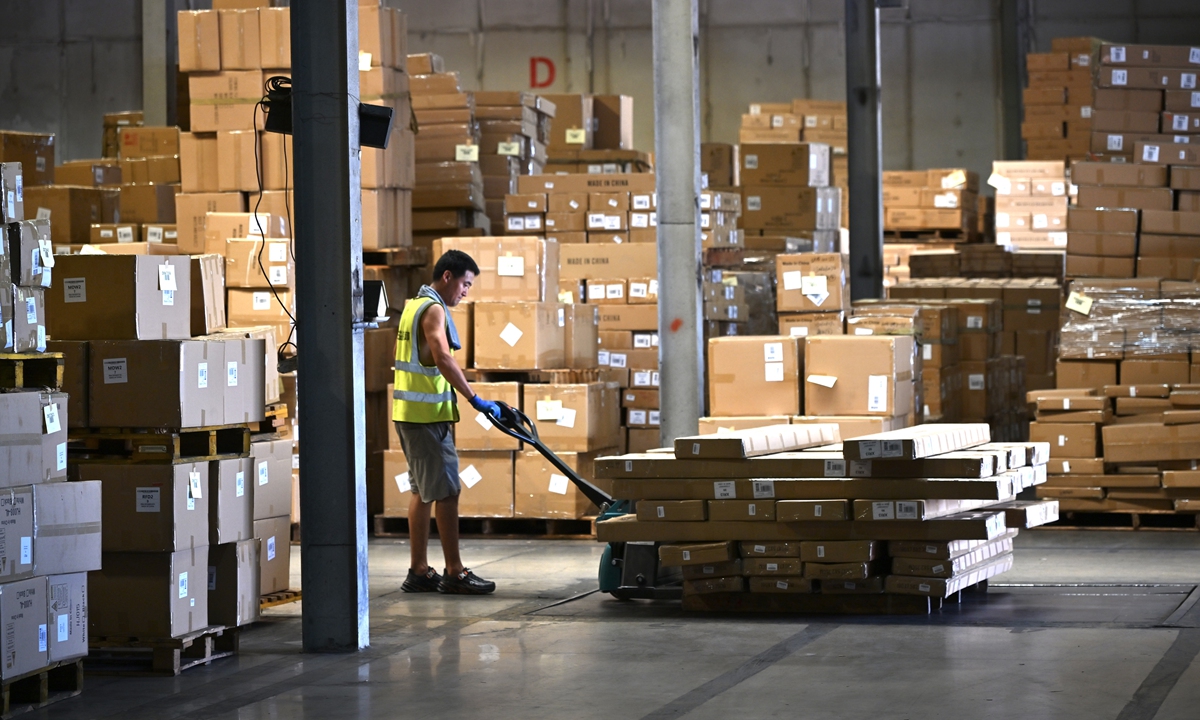
A worker moves packages at an international e-commerce goods warehouse near the Hairun Container Terminal on July 3, 2025. Photo: Tao Mingyang/GT
From January to June, China’s national online retail sales expanded by 8.5 percent, with 15 categories of home appliances and digital products covered by the government’s trade-in programs rising 12.7 percent and online services consumption growing 14.6 percent year-on-year, according to data released by the Ministry of Commerce on Monday.
It shows that the government policy to ramp up domestic consumption have helped strengthen the e-commerce sector, an official from the ministry’s e-commerce department noted, adding that new technologies such as artificial intelligence are being rapidly applied, enhancing the intelligence level of the entire consumption chain by improving efficiency, innovating new products and services, and optimizing business models.
And, the ministry has guided over 20 provinces and municipalities as well as major e-commerce platforms to hold more than 280 industrial match-making events, involving over 2,200 enterprises and achieving more than 20,000 cooperation intentions.
The effort has helped bring specialty products such as vegetables in East China’s Shandong Province, Korla pears in Northwest China’s Xinjiang Uygur Autonomous Region, and Songhua inkstones in Northeast China’s Jilin Province onto e-commerce platforms, said the official.
According to big data monitoring by the ministry, from January to June, e-commerce transaction volume for agricultural products, electronic products, and the textile products grew by 17.2 percent, 7.3 percent, and 6.2 percent, respectively. In addition, according to calculations by the ministry, online retail of goods contributed 29.6 percent to the total retail sales, with online catering accounting for a 1.9-percentage point increase in the share of overall catering sector revenues.
Also, cross-border e-commerce has contributed to the strong resilience of the country’s foreign trade, with preliminary statistics from the General Administration of Customs showing that cross-border e-commerce imports and exports reached 1.32 trillion yuan, marking a year-on-year increase of 5.7 percent, the official said.
The “Silk Road” e-commerce cooperation has expanded to 36 partner countries, with new agreements signed with Kenya, Bangladesh and Egypt. The commerce ministry has held industrial match-making events in Shandong, Hunan, and other provinces and regions, attracting participation from representatives of over 60 countries. Sales of Kazakhstani honey and Kenyan coffee beans on major Chinese e-commerce platforms surged by 180.7 percent and 37 percent, respectively, according to the official.
Global Times
RELATED ARTICLES