China releases 1st national standard for campus meal service providers in primary, secondary schools and kindergartens
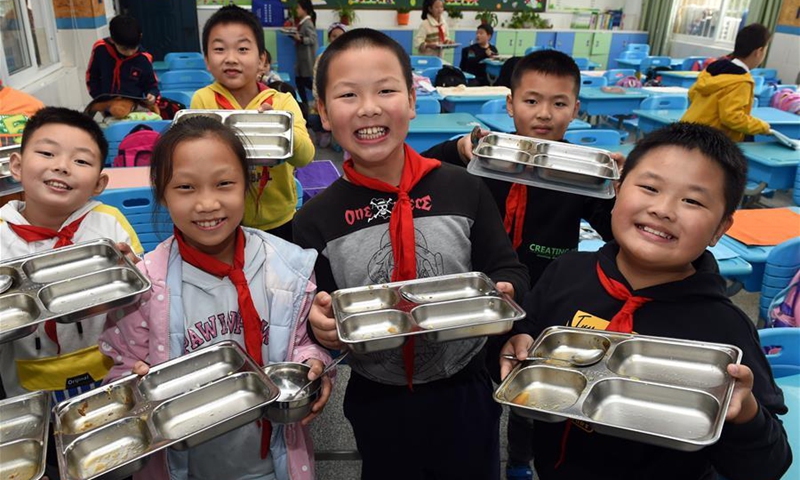
Students display their plates after having meals at Furong primary school in Hefei, east China's Anhui Province, Oct. 15, 2020. A number of primary schools and kindergartens in Hefei have promoted education campaigns to ramp up awareness of respecting food labor and valuing food among students and children ahead of the upcoming 40th World Food Day. (Xinhua/Zhou Mu)
Chinese authorities have approved and released the country's first national standard for the management of school meal service targeting providers, which will be officially implemented on December 1, as part of ongoing efforts to strengthen the regulatory framework for food safety in schools, according to CCTV News on Monday.
The newly issued guidelines by China's State Administration for Market Regulation apply to companies that prepare and deliver meals to primary schools, secondary schools and kindergartens across the country.
According to the guidelines, companies must appoint a chief food safety officer and assign full-time staff for food safety management and inspection. A dynamic risk control mechanism is required, including daily safety checks, weekly hazard identification and monthly analysis meetings.
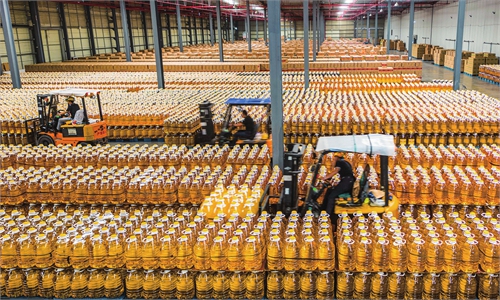
It also mandates centralized and fixed-point procurement for rice, flour and cooking oil. Each batch of the food should be accompanied by inspection and testing reports, and every major ingredient must undergo full-category testing at least once a year, with special attention to safety indicators such as pesticide residues, CCTV reported.
As food preparation is integrated into the "Internet + Bright Kitchen" system, schools, parents and students can see the key processing steps in real time. Food samples of each meal item delivered daily should be retained for no less than 48 hours, the guidelines said.
Meal transportation should also use sealed delivery vehicles appropriate to the scale and method of service, with all vehicles registered with supervisory authorities. Dedicated vehicles are recommended and must be equipped with GPS tracking systems.
In the event of any food safety risk, providers are required to immediately initiate a recall and report the incident to local regulators, according to CCTV.
After the illegal use of additives led to abnormal blood lead levels in some kindergarten children in Northwest China's Gansu Province, the local authority released investigation results on Sunday, which state that the lead content in the kindergarten meals severely exceeds standards. Six people have been arrested and 17 people are under investigation.
As of 12:00 on Sunday, all 247 children with abnormal blood lead levels have received either inpatient treatment or home nutritional intervention. Among the 235 hospitalized, 234 have completed the first treatment phase and have been discharged.
On July 12, Gansu authorities established an investigation team to conduct a higher-level investigation into the abnormal blood lead levels among children at Heshi Peixin Kindergarten in Maiji district of Tianshui city.
China currently has more than 460,000 primary and secondary schools and kindergartens, serving over 237 million students. With its vast scale and complex logistics, school catering has become a key focus of food safety regulation, according to CCTV.
Global Times
RELATED ARTICLES