The hype about ‘China filling aid gap in SE Asia’ a classic case of Western projection
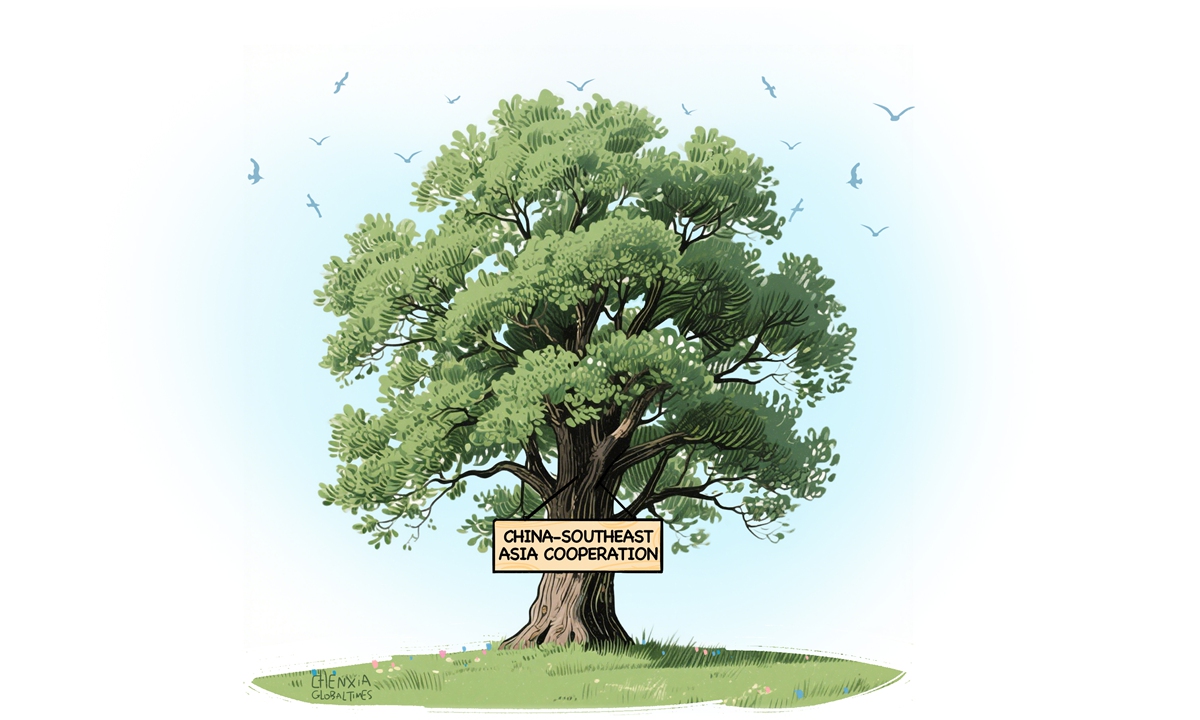
Illustration: Liu Rui/GT
The latest Southeast Asia aid map by the Lowy Institute presents a shifting picture of development across the region, Australian media outlet ABC reported on Monday. As the Lowy Institute's analysis claimed that "as the US retreats from funding aid programs in Southeast Asia, China is expected to fill some of the gap," it is important to note, however, that China's growing influence is not the result of the West's withdrawal, nor is it playing the role of a "substitute" filling a "gap." Rather, it is the natural extension of a clear and stable development cooperation roadmap that China has long pursued.
The Lowy study showed that total official development finance to Southeast Asia is projected to decline by more than $2 billion by 2026, with the primary reductions coming from Western donors such as the US and Europe. The report noted that the region is facing an "uncertain moment" in its development trajectory - on one hand, facing cuts in the West's official development financing, and on the other, suffering under the weight of "punitive" US trade tariffs. In short, the West is creating even more serious development challenges for Southeast Asia.
The retreat of US and European aid isn't occurring without a sign. US foreign assistance is often shaped by short-term political cycles, heavily influenced by changes in domestic administrations. This leads to frequent shifts in direction, scale and focus, undermining long-term commitment and making it difficult to sustain cooperation projects. In addition, capacity constraints have largely led to the contraction of European aid. For example, in 2024, Sweden announced the end of its assistance to Cambodia due to a shift in priorities, particularly related to the war in Ukraine - an illustration of how vulnerable Western aid mechanisms are to internal priorities and external shocks. Even more worrisome is that Western aid sometimes comes with overt political preconditions and is used as a tool for institutional intervention and geopolitical maneuvering under the guise of "development assistance."
However, this withdrawal of Western aid should not be misinterpreted as an opportunity for China to proactively "take advantage" and "fill in the gaps." China's development cooperation, whether with Southeast Asia or other regions, has never depended on the ebb and flow of Western involvement. The Western narrative that China is "exploiting the West's aid cuts to expand its influence in Southeast Asia" is purely measuring others' corn by one's own bushel - a projection of zero-sum thinking.
The foundation of China-Southeast Asia cooperation lies in mutual development needs. It is based on China's respect for ASEAN centrality and reflects the practical implementation of the principles of mutual benefit and common development. This type of cooperation fully considers the development priorities of regional countries, comes without political strings, imposes no governance preconditions, and does not use "aid" as a tool for influence. Simply put, China has always engaged in grounded, tangible collaboration in the region's development affairs.
Moreover, China does not oppose or exclude the participation of other countries in the region's development. However, such involvement must respect the autonomy and will of regional countries, refrain from interfering in their internal affairs and avoid harming their interests. China welcomes broader cooperation from all parties and encourages synergy and complementarity to foster a more resilient and inclusive development landscape in the region.
At present, the framework of cooperation in Southeast Asia is changing. The unreliability of Western aid systems is prompting regional countries to rethink their needs and increasingly seek partnerships that offer more stability, clearer project timelines and better-aligned cooperation goals. Thus, the issue is not "who is filling the gap left by Western aid," but rather "who is genuinely committed to equal, pragmatic and sustainable cooperation with Southeast Asian countries." That is the central question behind the Lowy study - and the answer is becoming increasingly clear.
RELATED ARTICLES