GT Voice: Victory of Chinese robots at RoboCup shows nation’s tech innovation edge
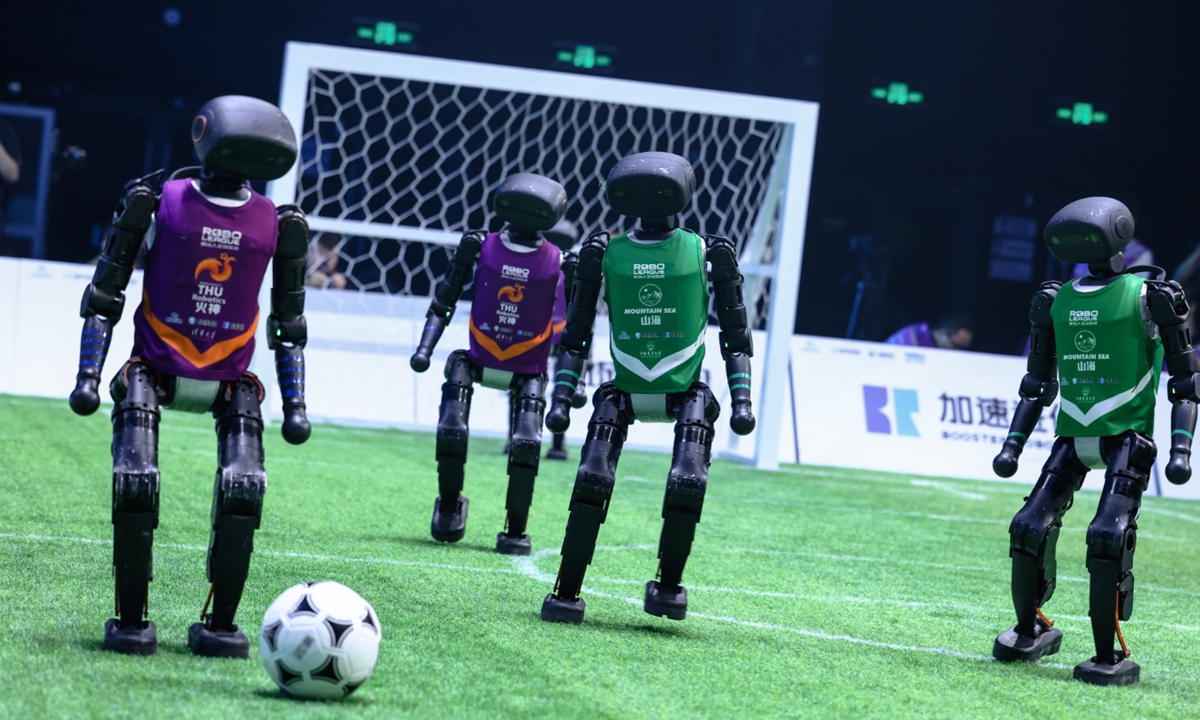
AI robot football match Photo: VCG
The RoboCup 2025 in Brazil, held from Thursday to Monday, witnessed a historic moment as two Chinese teams secured the top two positions in the humanoid category, China's first-ever victory in this category in the RoboCup, chinanews.com.cn reported on Monday.Both teams used Beijing-based Booster Robotics' T1 humanoid robots, which, with their stable motion control, precise environmental perception, and efficient capabilities to adapt to various interactions, showcased China's rapid progress in cutting-edge fields like artificial intelligence (AI) and robotics.
However, this victory represents more than just a technical achievement; it highlights the growth of China's innovation ecosystem and serves as a microcosm of the evolving landscape of global technology governance.
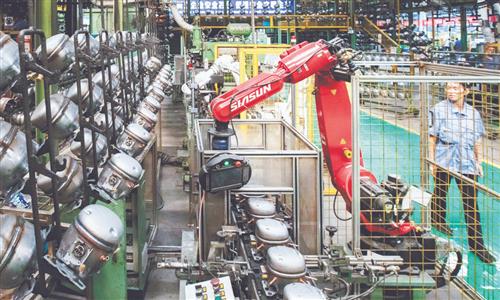
In recent years, China has witnessed a sustained increase in research and development investment in areas such as AI, high-end manufacturing, and automation, contributing to a carefully cultivated innovation ecosystem. Policies have consistently reinforced support for technological innovation, with the robotics industry identified as a key development area. This strategic focus has enabled China to gradually form a complete industrial chain in robotics core technologies, ranging from key components to complete machine development, establishing itself as a significant force in the global robotics industry.
Take industrial robots as an example. According to the National Bureau of Statistics, China's industrial robot production soared from 33,000 units in 2015 to 556,400 units in 2024, a more than 15-fold increase. Moreover, Wang Lingjun, deputy director of the General Administration of Customs, revealed at a recent press conference that China's industrial robot exports continued to grow by 61.5 percent in the first half of this year, cementing China's position as the world's second-largest exporter of industrial robots.
As to humanoid robots, the market in China reached about 2.76 billion yuan ($380 million) in 2024 and is expected to hit 100 billion yuan by 2030, according to Chinese media reports.
From a broader perspective, the outstanding performance of Chinese robot soccer teams is not merely a victory in sports competition but a vivid manifestation of China's high regard and strong support for technological innovation. China's innovation formula, including continuous technological investment, a well-established industrial ecosystem, and robust policy support, has not only provided strong impetus for the development of China's robotics industry but also spurred technological progress and the transformation and upgrading of Chinese manufacturing across various sectors.
Notably, there has been a continuous stream of major robotics-related events both domestically and internationally this year, from RoboCup 2025 to various robot games like the humanoid robot half-marathon. These events have attracted widespread attention, serving as vital platforms to showcase each country's technological prowess. While the precise movements and seamless coordination of robots on the field may appear to be mere technical competitions, they fundamentally reflect emerging trends in global technological rivalry.
For instance, as robots take on the role of players, what rules need to be established? The process of formulating and refining rules for robot soccer, as an emerging sport, directly reflects the cutting-edge advancements in technology.
As technology continues to evolve rapidly, we can expect an increase in such innovative tech events. Each competition will serve as a testing ground for making rules, and those who win technological recognition will shape the trajectory of future developments.
Events like RoboCup 2025 also serve as vital platforms for international technological exchanges, with robots playing a role in igniting public interest in and enthusiasm for technology while fostering a conducive social atmosphere for global innovation. In this context, the performances of Chinese robot teams on the international stage reveal the unique charm and resilient innovative spirit of Chinese technology to the world.
As we look to the future of high-tech development, such cultural exchanges are expected to become more frequent. With China's ongoing advancements in robotics and technology, it is well-positioned to make greater contributions to global technological progress and cultural exchanges.
RELATED ARTICLES