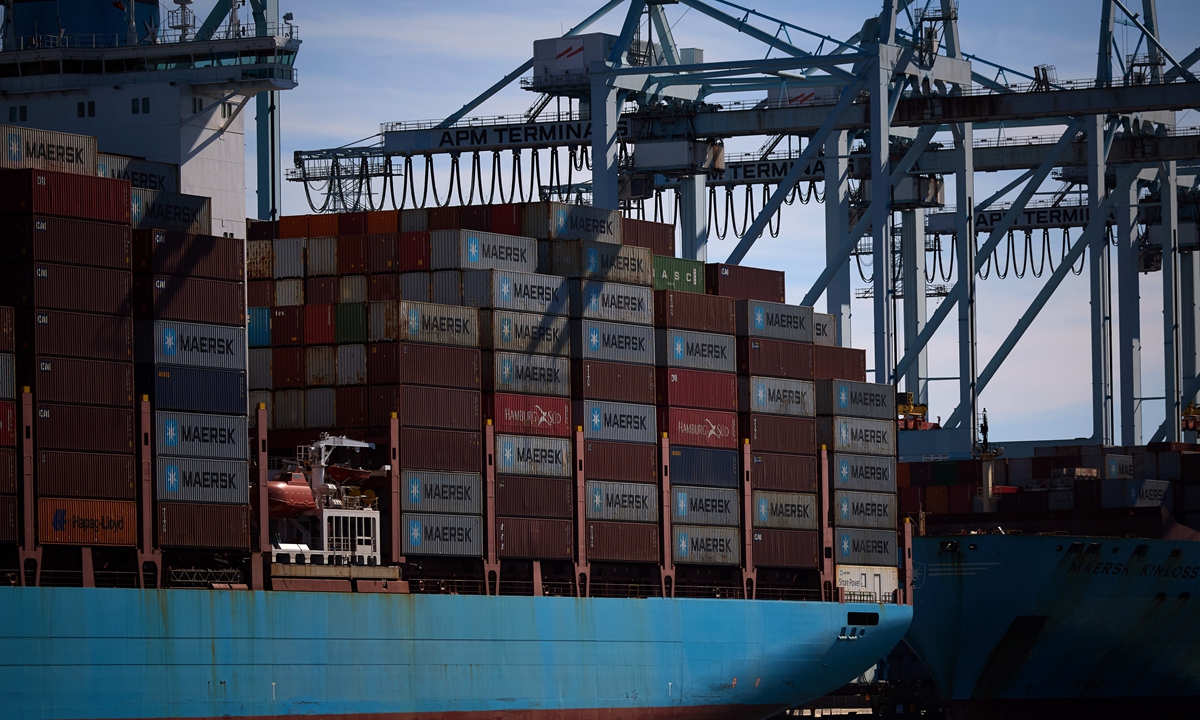
Shipping containers are loaded and unloaded onto ships at the Port of Los Angeles, California, on July 9, 2025. US President Donald Trump has sent letters to multiple countries dictating new US tariff rates on their countries' imports to the USA. Photo: VCG
In recent weeks, the unilateral and aggressive posture of US foreign policy has dramatically escalated. In the wake of the successful BRICS Summit in Rio de Janeiro, the US threatened a 10 percent tariff on products from countries aligning with what the US president called the "anti-American policies" of BRICS. He then launched a new phase of his global trade war, this time explicitly targeting Brazil under the pretext of alleged commercial irregularities and, more pointedly, to interfere in Brazil's domestic political process. Meanwhile, NATO Secretary-General Mark Rutte warned that Brazil, India, and China could face sanctions due to their ongoing diplomatic and economic ties with Russia.
What unites these moves is a desperate effort by US foreign policy - and that of its allies - to forcibly reshape global dynamics into a form that no longer exists. As Marx and Engels observed in The Communist Manifesto, reactionaries seek to "roll back the wheel of history." Yet, as the consequences of these efforts by US reactionary hawks clearly show, there is no doubt that they will fail in such an adventure.
Contrary to dire forecasts from Western think tanks and media outlets, the BRICS Summit in Rio de Janeiro defied predictions of fragmentation and stagnation. During its 17th high-level meeting, BRICS leaders approved over 120 joint commitments spanning global governance, finance, health, artificial intelligence, climate change and sustainable development. The declaration of this summit raised urgent concerns about global military spending at the expense of development in the Global South. In contrast with prevailing militaristic rhetoric, the bloc reaffirmed its commitment to multilateralism, poverty eradication and climate action. Among the adopted initiatives were the BRICS Leaders' Framework Declaration on Climate Finance and the BRICS Partnership for the Elimination of Socially Determined Diseases. Far from being irrelevant, BRICS emerged as a principal vanguard for a peaceful, multipolar world order.
The US has openly interfered in Brazil's internal affairs. By collaborating with Brazil's far-right forces, they seek to pressure the country into compliance by promoting policies that target and undermine Brazil's exports to the US. But this logic completely misfired. Instead, this has aroused a robust wave of national pride and pushback. Brazilian social movements and popular organizations mobilized on Avenida Paulista in São Paulo, occupying more than three blocks to defend national sovereignty. Simultaneously, broad sectors of the conservative opposition lowered their weapons and aligned themselves with the president to form a national unity front against imperialist aggression.
In response, the government invoked the Economic Reciprocity Law, announcing the imposition of symmetrical trade sanctions to protect national industry. Brazilian President Luiz Inacio Lula issued a public statement to the country, invoking the unity of broad forces in defense of national sovereignty, economic development and social justice.
What simply isn't understood by the US is how global power dynamics have shifted. While key Brazilian industries still rely on the US market, China has been Brazil's largest trading partner since 2009. Brazil's pragmatic, universalist foreign policy enables strategic diversification through agreements across Asia, Africa and Latin America. The Brazilian Ministry of Finance has announced that it has initiated efforts to redirect exports.
Even Brazil's most conservative elites remain unaligned with Washington's anti-China campaign and firmly reject interference in national affairs. Under these circumstances, Lula's reaffirmed leadership has gained renewed legitimacy under the banner of national sovereignty and social justice.
By brandishing his threatening "big stick" against Brazil, the US has inadvertently strengthened the very unity he sought to fracture. This approach mirrors the flaws of US global policy: Unable to prevent China's rise, the consolidation of BRICS, or the development of Latin America. In attempting to push Brazil - and the world - backward, it only accelerates history in the opposite direction. With Lula at the helm, Brazil's development, the revitalization of BRICS and the resurgence of South-South solidarity ensure that Brazil will not bow to blackmail - and that the wheel of history will keep turning forward.
The author is assistant professor in the Faculty of History and Research Fellow at the Center for Latin American Studies at Nankai University. opinion@globaltimes.com.cn
RELATED ARTICLES