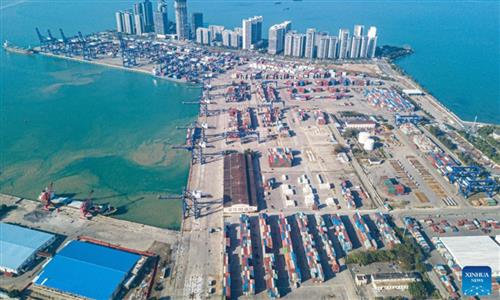
Hainan Free Trade Port to officially launch island-wide independent customs operation on December 18
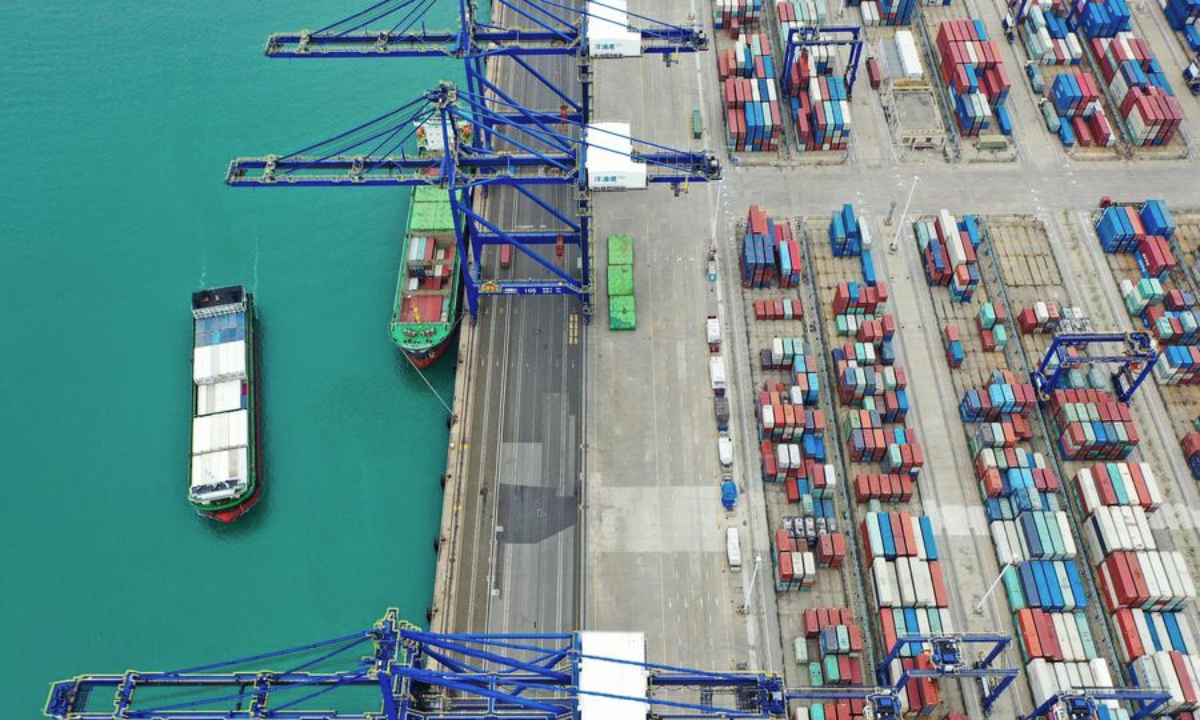
An aerial drone photo taken on March 13, 2024 shows the Yangpu international container terminal in south China's Hainan Province. (Xinhua/Guo Cheng)
China's Hainan Free Trade Port is set to launch island-wide independent customs operation on December 18 as approved by the Communist Party of China Central Committee, an official with the country's top economic planner said at a press conference on Wednesday.The proportion of tariff lines with zero-tariff products in Hainan Free Trade Port will increase from 21 percent to 74 percent.
Zero-tariff policies are a defining feature of Hainan Free Trade Port's institutional framework. Liao Min, Vice Minister of Finance, noted that compared to pre-closure policies, the coverage of zero-tariff goods has significantly increased.
After island-wide customs closure, zero-tariff imports will be managed under a “negative list” system and the zero-tariff scope will expand to around 6,600 tariff lines, accounting for 74 percent of all tariff lines—a nearly 53 percentage point increase from pre-closure levels—significantly enhancing the opening up level, Liao said.
Beneficiary entities will also expand substantially, covering nearly all enterprises, institutions, and non-profit organizations on the Hainan island with actual import needs, according to Liao.
Officials also noted that no additional documents are required for business trips or tourism in Hainan after customs closure.
Wang Changlin, deputy minister of the National Development and Reform Commission, said that after customs closure, Hainan's international exchanges will become smoother and freer, while its connectivity with the rest part of China remaining efficient.
Under the current design, except for some categories of goods entering the mainland from Hainan that require inspection, most goods, as well as personnel, items, and transport vehicles entering or leaving Hainan, will continue to follow existing regulations without changes. Business trips, tourism, and other visits to Hainan will remain unchanged, with no additional documents required, Wang said.
Global Times
RELATED ARTICLES