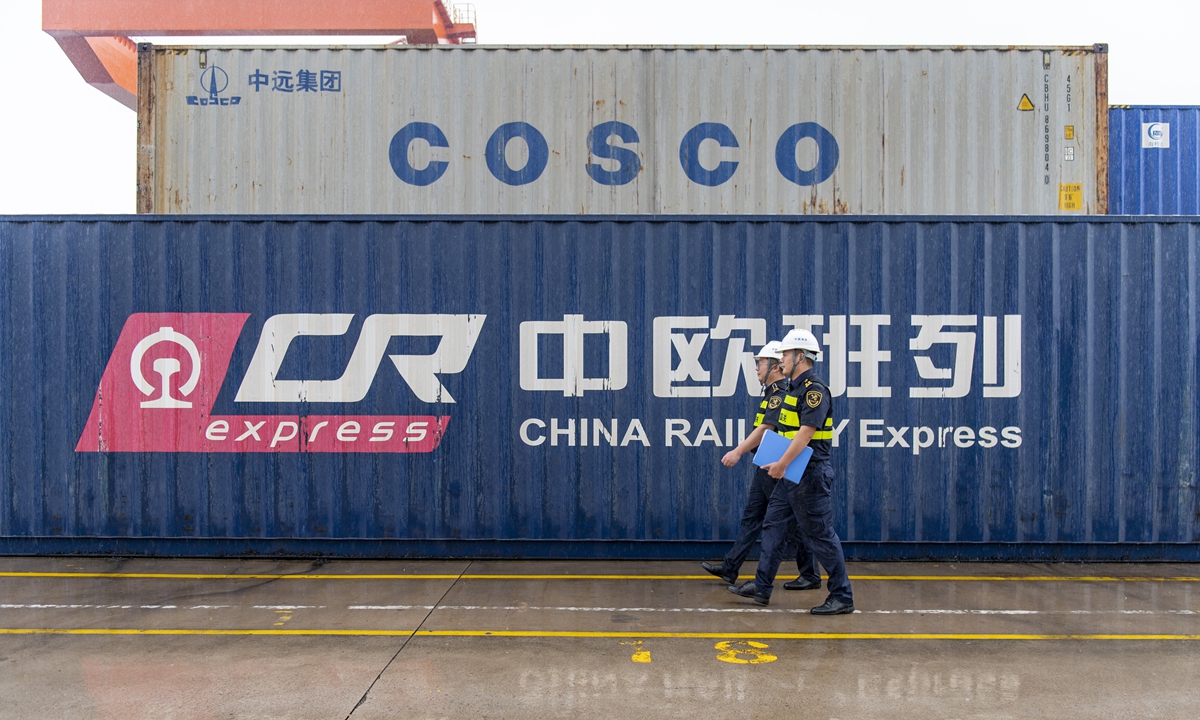
Customs officers inspect China-Europe freight train containers at the Huadong International Intermodal Port in Jinhua, East China Zhejiang Province. Photo: VCG
Editor's Note:
According to China's Ministry of Foreign Affairs, President of the European Council António Costa and President of the European Commission Ursula von der Leyen will visit China on July 24 to attend the 25th China-EU Summit in Beijing. As the two sides mark the 50th anniversary of diplomatic ties, the world is watching closely. How should Europe view cooperation with China rationally? How can mutual trust be strengthened? And what does the world expect from the future of China-EU relations?
To explore these pressing questions, the Global Times invited three scholars from China and Europe to share their insights and expectations for this landmark summit.
Dong Yifan, associate research fellow of Belt and Road Academy of Beijing Language and Culture University
The 25th China-EU Summit itself has already demonstrated the shared willingness of both sides to strengthen cooperation, especially in terms of high-level consultations and political leadership. This is essential for injecting momentum into China-EU relations amid today's turbulent and transformative global landscape.
As for some skeptical voices prior to the summit, China has approached these comments with an objective and impartial attitude. We look at the differences from a problem-solving perspective and strive to find solutions that are acceptable to both sides.
At the same time, we hope all sides can view the broader China-EU relationship from a more comprehensive and historically informed perspective. If one chooses to generalize from specific problems or replace consensus with division when assessing or handling the relationship, it will only harm the interests of both sides. We also aim to convey our stance to the EU side through concrete policy engagement and practical cooperation.
For the European side, a pragmatic approach is needed - one that acknowledges the necessity of cooperation and treats historical experience as a solid foundation for bilateral ties. Furthermore, in light of today's global geopolitical shifts and rapid economic and technological transformation, only by deepening China-EU cooperation can both sides hope to break through and find new paths forward.
Both sides uphold the principle of mutual benefit and focus more on pragmatic cooperation across various fields. We should objectively assess the potential and depth of China-EU cooperation - for example, in areas such as trade, green development and climate change - as there is still much that we can accomplish together.
As China and the EU mark the 50th anniversary of their diplomatic ties, this historical milestone provides an opportunity to carry forward past achievements, review the course of cooperation, and inject fresh momentum into future development. Let history illuminate the road ahead, and guide China and Europe toward shared contributions to global progress - this is a goal we both strive toward.
Pierre Picquart, PhD in geopolitics and specialist in China-European relations
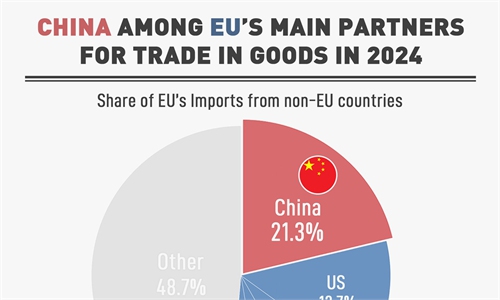
The 25th EU-China Summit will be held in Beijing on July 24. With $785.8 billion in trade recorded in 2024, the EU and China form one of the main engines of the global economy. Yet tensions - tariffs on electric vehicles, technological rivalries - now threaten this momentum. This summit is not just another diplomatic meeting; it is a critical opportunity to build a more just world, united by cooperation.
In recent years, China and the EU have seen broad prospects for cooperation in areas such as green energy. As two major civilizations, they have also achieved remarkable results in people-to-people exchanges. Differences between China and the EU should not become barriers, as they are the ground on which productive dialogue can emerge.
France, with its deep diplomatic expertise and strong partnerships with China (in aerospace, nuclear energy and healthcare), can play a constructive mediating role, advocating for ambitious agreements on climate, trade and digital governance.
Past summits, including the Comprehensive Agreement on Investment, laid the groundwork despite political setbacks. The 2025 summit must deliver concrete outcomes: renewed commitment to carbon neutrality by 2050, a secure framework for cross-border data flows and a structured dialogue on global governance. Such progress would show that the EU and China can rise above their differences to serve their people.
As a long-time observer of China, I have seen how the country has transformed millions of lives through its development. But progress cannot be pursued in isolation. In a fragmented world, this summit must be an act of political courage - the beginning of a China-Europe pact for inclusive multilateralism, where cooperation prevails over confrontation.
I call on leaders: Seize this historic opportunity to lay the foundation for a future that is sustainable, equitable and shared.
Héctor Gomez, Spanish geopolitical analyst and translator based in China
As leaders from China and the EU prepare to meet in Beijing for their landmark summit on Thursday and Friday - marking 50 years of diplomatic relations - the stakes could not be higher. Will Europe engage with strategic clarity, or continue down the path of wishful thinking and short-term calculation?
For too long, the EU has oscillated between viewing China as a partner, competitor and systemic rival, often all at once. This ambiguity has not strengthened Europe's hand. On the contrary, it has made the bloc reactive, fragmented and susceptible to external pressure, particularly Washington.
Meanwhile, China has demonstrated what strategic clarity looks like, setting an example that others are beginning to follow. When the US reignited tariff hostilities against China earlier this year, China responded with composure and resolve: proportionate countermeasures, clear messaging, no bluffing. The result was a return to the negotiating table.
Inspired by this example, some countries are now asserting their interests with growing confidence, demanding reciprocity and fairness. Brazil's recent move under its Economic Reciprocity Law is a telling case, signaling a broader shift among emerging economies that are no longer willing to accept structural asymmetry as a given.
The EU, by contrast, tried to avoid confrontation: de-escalate, accommodate, remain silent... And yet, the result came anyway: a 30 percent US tariff on European industrial goods and autos, starting August 1.
Ahead of the summit, and against this backdrop of rising tensions, China is extending a hand of partnership. On July 2, Chinese Foreign Minister Wang Yi told European Council President António Costa that better communication and mutual respect for each other's core interests are essential. China doesn't ask Europe to pick sides. It asks for mutual respect and constructive engagement - two pillars that are entirely compatible with European interests and its own stated goal of "strategic autonomy."
This upcoming summit is not a formality. It is a test. Europe must shed cold war reflexes and embrace real strategic thinking. China should not be seen as a "risk" to be managed, but a force to be understood. Cooperation on climate, innovation and global recovery isn't a favor to Beijing - it's a necessity for Europe's future and the world's stability.
RELATED ARTICLES