Illustration: Liu Xidan/GT
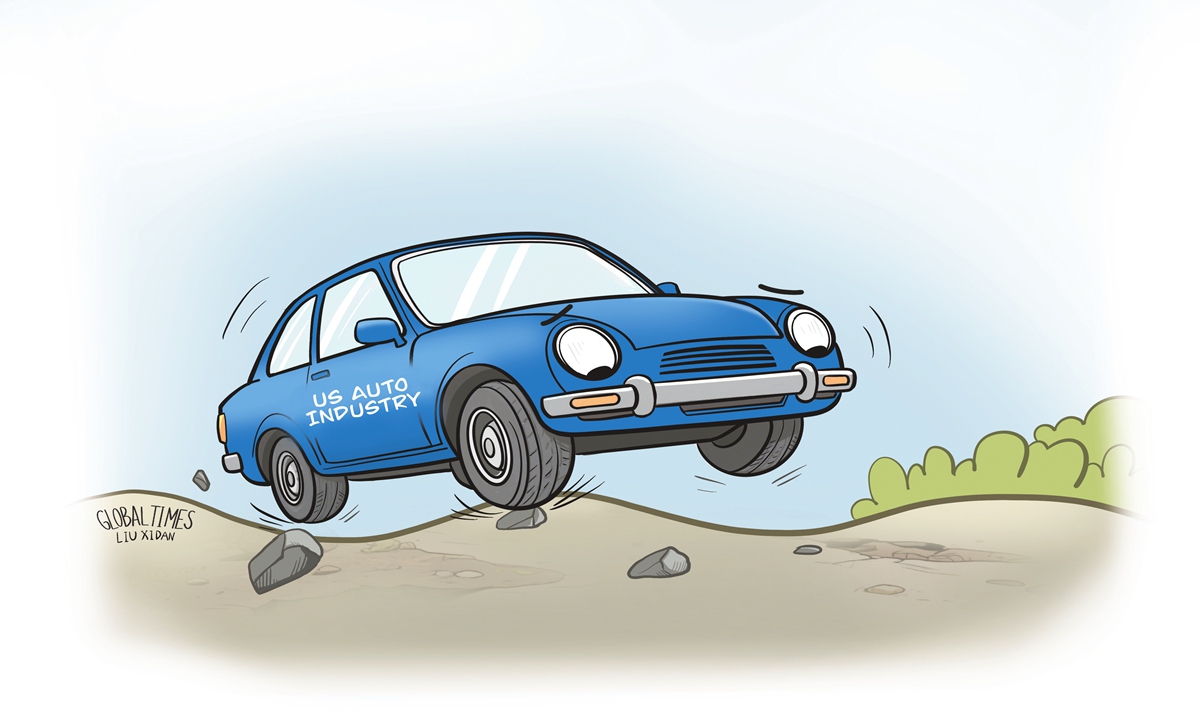
With major American automakers releasing their earnings this week and next, a critical question emerges: Do the tariff barriers erected in the name of "protecting domestic industries" truly serve as a "shield" for these sectors, or do they instead exacerbate imbalances in the industrial chain and undermine corporate competitiveness?US auto giant General Motors reported on Tuesday that its second-quarter profits dropped by about 35 percent year-on-year to $1.9 billion, with a $1.1 billion hit from US-imposed tariffs, the Associated Press reported.
GM is not the only American automaker that has felt the tariff pain. Stellantis, which owns the Chrysler, Jeep, Dodge and Ram brands, reported on Monday that it paid about $387 million in tariffs over the second quarter, and that production pauses - a strategy to avoid paying tariffs - contributed to a 6 percent year-on-year decline in the number of vehicles the company shipped to dealers.
Also, Ford Motor in May suspended its annual guidance because of uncertainty surrounding tariffs, saying the levies would cost the company about $1.5 billion in adjusted earnings before interest and taxes.
These numbers collectively paint a troubling picture of an industry caught in the crossfire of trade protectionism, revealing the heavy toll that tariffs are taking on this vital sector.
The situation is set to worsen as the US has threatened to impose new tariffs on various countries starting August 1, which means domestic automakers will not only have to digest existing costs but also potentially face the cumulative impact of new levies. Faced with soaring costs, companies are being forced to make adjustments. GM CEO Mary Barra said in a letter to shareholders on Tuesday that the automaker is attempting to "greatly reduce our tariff exposure," citing $4 billion of new investment in its US assembly plants. But still, the company expects the impact of US tariffs to take a bigger toll in the third quarter because of indirect costs related to the duties.
What makes this predicament particularly noteworthy is its timing. The global vehicle industry stands at a pivotal moment of transition toward electrification and intelligence, with technology evolving at an unprecedented pace. This demands massive research and development (R&D) investment and international collaboration.
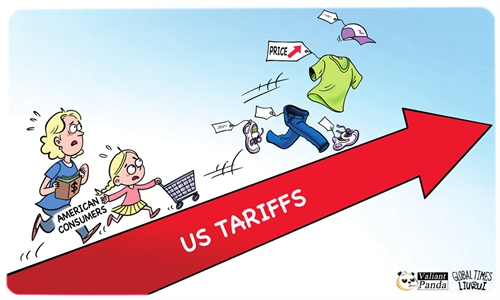
Yet, American automakers are constrained by trade policies that contradict their needs. This is because the rise in costs for imported components due to tariffs directly increases the production costs of complete vehicles. Given the buyer-oriented nature of the US auto market, manufacturers struggle to fully pass these costs onto consumers. Industry-wide data has suggested that, at least so far, car manufacturers have mostly absorbed higher tariffs as a hit to their profits, rather than passing them along to customers.
This squeeze on profits could lead to a reduction in R&D funding, potentially leaving them at a disadvantage in the technological competition. The irony is striking: the tariff policies intended to bolster the domestic industry are, in fact, undermining companies' ability to compete in the technologies that will shape the future of the automotive sector.
Moreover, the production chain could also be severely disrupted. US automakers' supply chains span borders, but tariff barriers disrupt these chains. High import tariffs on components raise procurement costs, while strategies like production halts to avoid tariffs, as seen with Stellantis' delivery decline, disrupt production schedules. Meanwhile, the threat of new tariffs may trigger a global industrial chain reconfiguration, prompting other countries to adjust cooperation models and seek alternative partners, further weakening US automakers' supply chain competitiveness.
Chinese-made parts are also one of the primary targets of US tariffs on auto parts. According to China Automotive News, China exported auto parts worth a total of $17.15 billion to the US in 2024. Consequently, American automakers have had to bear high tariff costs because they are unable to swiftly source alternatives to Chinese supplies.
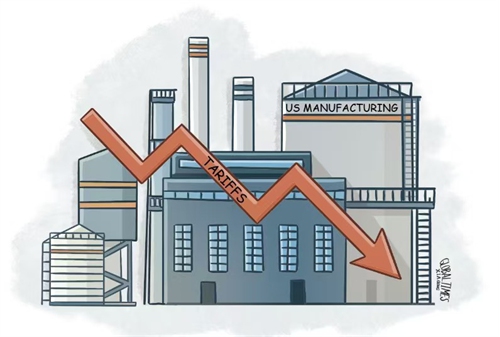
Washington's approach of using tariff barriers to "protect domestic industries" runs counter to the fundamental principles of automotive industry development. History has consistently demonstrated that genuine industrial competitiveness does not thrive behind barriers. Without international competition, companies tend to lose their drive for technological innovation and efficiency improvements, which leads to the loss of global market share. When protectionism becomes a hindrance rather than a help, the US auto industry moves further away from the goal of "revitalizing manufacturing."
The key to breaking this impasse lies in returning to the fundamental principles of industrial development. Only by embracing openness and fostering competition can the US auto industry regain its competitive edge in the electrification wave and achieve true manufacturing revitalization. This is the only viable path for industrial upgrading.
RELATED ARTICLES