The threshold for Indian visas for Chinese citizens remains too high: Global Times editorial
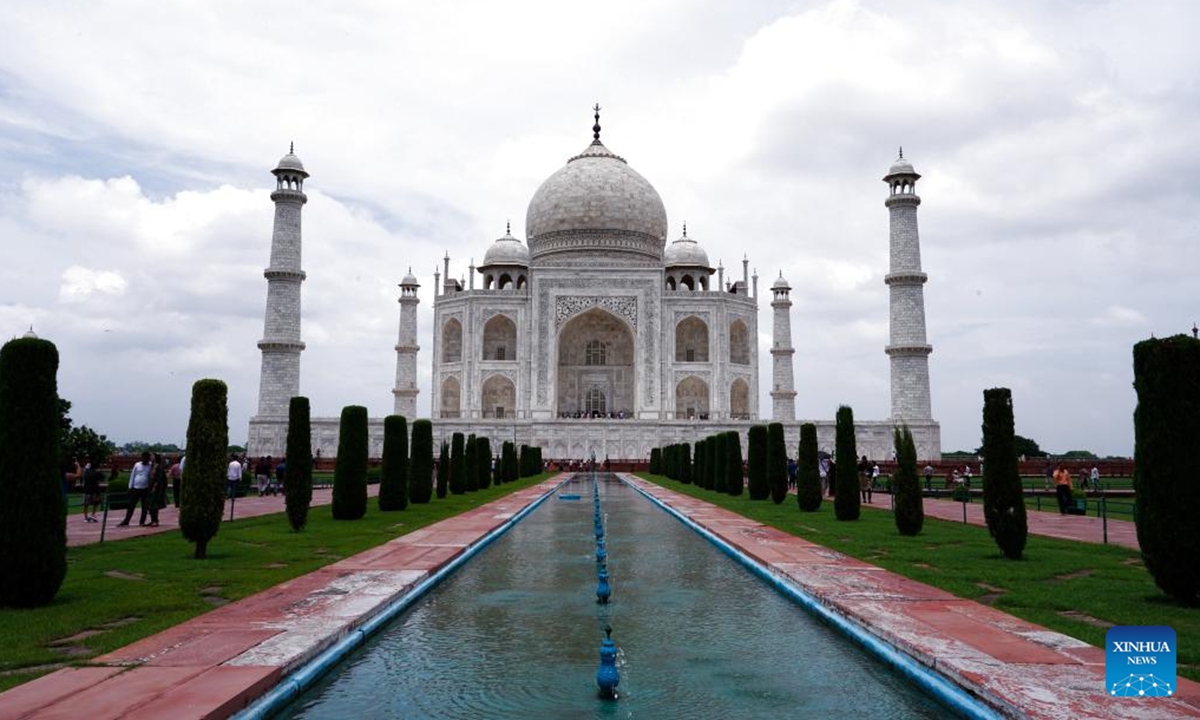
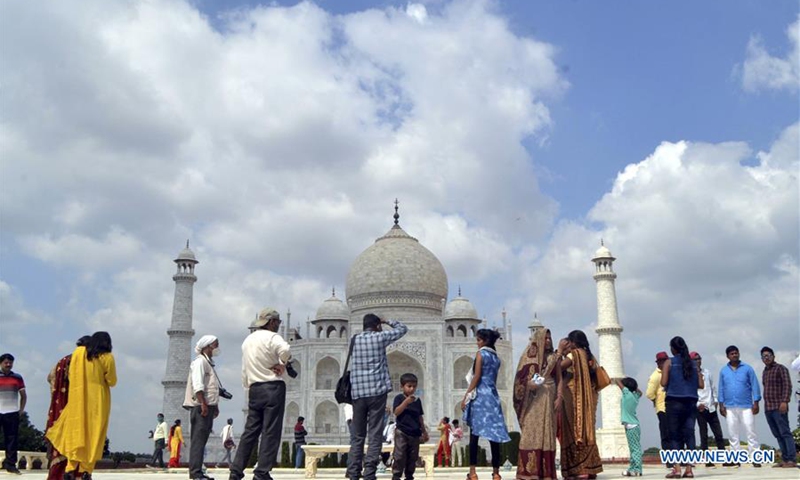
This photo taken on Aug. 3, 2024 shows the Taj Mahal in Agra, Uttar Pradesh, India. Photo: Xinhua
On Wednesday, the Embassy of India in China announced via its Sina Weibo account that "from July 24, 2025, Chinese citizens can apply for a tourist visa to visit India." China's Foreign Ministry said it has taken note of this positive move, stating that "easing cross-border travel is widely beneficial." Indian media widely described the change as occurring "after a five-year hiatus." Under posts by China's Foreign Ministry and the Global Times on overseas social media, many Indian users commented, "nice step toward normalization of our bilateral relationship," and "welcome Chinese and have some best memories of India." While this is undoubtedly a positive development, there is still a lot that the Indian side can do.
Since the bilateral summit in Kazan last October between the leaders of India and China, the relationship between the two countries has shown signs of returning to a cooperative main track. In the subsequent period, China and India engaged in intensive consultations and negotiations to reach solutions on border-related issues. This year, officials from various levels in India have successively visited China; both the Indian foreign minister and defense minister traveled to China again after five years, sending consistent positive signals of a bilateral thaw. The resumption, in June, of Indian pilgrims visiting Xizang Autonomous Region's "sacred mountain and lake" reflects the goodwill and reliability of the Chinese side. India's easing of tourism visa restrictions is also a natural, reciprocal step. Official sources indicate that relevant departments in both countries are working toward the resumption of direct air links, and we hope the routes will reopen soon. Lifting unreasonable restrictions on Chinese students, scholars and journalists, as well as removing investment and operational barriers for Chinese companies in India, must also be prioritized without delay by the Indian side.
Many have noticed that India imposes relatively high thresholds for Chinese tourists applying for visas. For example, applicants are required to submit bank statements of last six months showing a minimum balance of 100,000 yuan, and must apply in person in Beijing, Shanghai, or Guangzhou. These requirements not only fall short of the visa standards from five years ago but also clearly lag behind the global trend of streamlining visa policies and facilitating cross-border travel. Moreover, when compared with the 280,000 visas China issued to Indian nationals in 2024, India's move is only a starting point. Therefore, while this "progress" is welcomed, it remains important to watch whether India will take more substantial steps in areas such as visa approval rates, tourist services and safety, and the possible relaxation of visa requirements going forward. India should do more to build mutual trust, bridge perception gaps, and foster goodwill among the two peoples.
On Wednesday afternoon, data from a Chinese travel platform showed a sudden surge in searches for travel to India's New Delhi. Chinese tourists traveling to India could significantly boost the local tourism sector and even the broader economy, just as India envisioned when it introduced e-visas for Chinese citizens 10 years ago. However, 10 years later, the resumption of visa issuance is not just a technical issue; the optimization of relevant policies must focus on bridging the gaps caused by the disruption of exchanges between the two countries' peoples. In this regard, New Delhi needs to consider the bigger picture. Many of the development opportunities India missed over the past five years can be traced back to the overly calculative mind-set of some within the Indian side - acting as "accountants" in international relations, overly fixated on gains and losses and hesitant to take decisive steps. India should recognize that opening and facilitating tourist visas is in its own interest, rather than a "favor" to Chinese tourists. In competing for the Chinese tourist market, India has already fallen far behind neighboring countries like Nepal, Sri Lanka, and the Maldives.
Issuing tourist visas should be seen as a new starting point for the renewed flow of people-to-people exchanges between the two Eastern powers. It presents an opportunity for the people of both countries to rebuild mutual trust and should also serve as a catalyst for deepening cooperation in areas such as trade, technology, and education. As the two largest developing countries in the world, development is currently the greatest common ground for both China and India. Both countries have significant market sizes and development potential. If cooperation projects that were previously shelved due to communication disruptions can be restarted in the near future, they will provide an engine for mutual benefit and win-win outcomes between the two countries, as well as contribute to economic growth in Asia. As important members of the Global South, China and India play significant roles in frameworks such as the SCO and BRICS, and they should contribute more Eastern wisdom to promote a multipolar world and the democratization of international relations.
Recently, the Indian side has expressed intention to improve relations with China multiple times. How to make Chinese society feel New Delhi's sincerity rather than calculation is very important. For China-India relations to achieve sustained, healthy, and stable development, both countries must work toward a common direction. This tests India's ability to abandon geopolitical game-playing thinking and adhere to the important common understandings, including that China and India are each other's development opportunity rather than threat, and cooperation partner rather than competitor. It also assesses whether India can translate the practice of "restoring tourist visas for Chinese citizens" into ongoing policy optimization and concrete actions. This is a matter concerning 2.8 billion people - a "dragon and elephant dance." India should deeply recognize the weight and significance of this, adopting a more proactive stance and pragmatic measures to work hand in hand with China to embark on a mutually beneficial cooperation path.
RELATED ARTICLES