Illustration: Chen Xia/GT
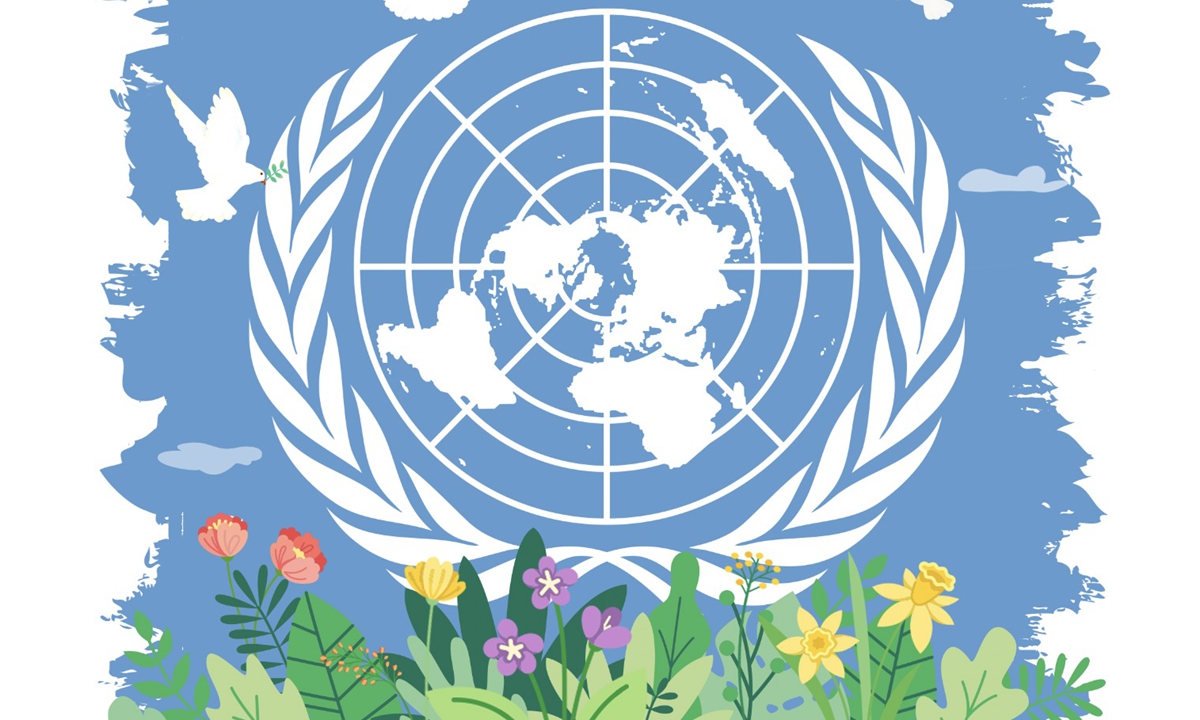
The year 2025 marks the 80th anniversary of the establishment of the UN. Views on the UN's journey and its role across different historical periods may vary, but one widely shared sentiment remains: While the UN is not all-powerful, the world would be in far worse shape without it.
Over the past 80 years, the global landscape has undergone profound changes, and international dynamics have shifted dramatically. Through continuous reform, the UN has made significant contributions to maintaining international peace and security, advancing global development, promoting and protecting human rights, providing humanitarian aid and upholding the rule of law. It has become the most universal, representative and authoritative international organization.
Now, amid the unprecedented changes unfolding in the world, the UN is embarking on a new and unprecedented round of reform to more effectively address global challenges. As a key advocate, supporter and contributor to UN reform, China is injecting both hope and momentum into building a stronger and more effective UN.
Looking back over the past 80 years, it is evident that reform has been one of the UN's enduring themes.
Not long after the UN was established, the world entered the Cold War era. Great power confrontation replaced great power coordination, severely constraining the UN's ability to fulfill its role. At times, the UN itself even became an arena for rivalry among major powers. When the UN Security Council was frequently paralyzed or dysfunctional, the UN innovatively launched peacekeeping operations to prevent the escalation and spread of regional conflicts. These operations were both a reform and a supplement to the UN's collective security mechanism. Peacekeeping has since undergone continual evolution and reform, becoming a central pillar of the UN's efforts to maintain peace.
The war in Ukraine, climate change, geopolitical tensions and great-power rivalry - these overlapping and compounding crises have cast a deep shadow over the future, placing humanity at a new crossroads.
In September 2021, UN Secretary-General Antonio Guterres released the report "Our Common Agenda," outlining a vision for strengthening global cooperation and addressing the challenges of the 21st century. At the heart of the report is a call to reinvigorate a more inclusive, networked and effective multilateralism in order to address both current and future global challenges.
In September 2024, the UN held its first-ever Summit of the Future, where world leaders adopted the "Pact for the Future." It is a document containing 56 action items designed to address global challenges and strengthen international cooperation. It covers areas including sustainable development, peace and security, science and technology, and the role of youth.
In March of this year, Guterres launched the UN80 Initiative, officially kicking off a sweeping reform of the entire UN system. At the heart of UN80 are three major workstreams. The first is focused on improving internal efficiency and effectiveness, cutting red tape, and optimizing the UN's global footprint by relocating some functions to lower-cost duty stations. The second is a mandate implementation review, which involves examining nearly 4,000 mandate documents underpinning the UN Secretariat's work. The third workstream explores whether structural changes and program realignment are needed across the UN System.
In the face of unprecedented resource constraints and financial difficulties, the UN is poised to undertake what may be the most ambitious and far-reaching institutional reform since its founding. Planned measures include the creation of shared administrative platforms, significant budget cuts, agency mergers and staff reductions.
"There is only one international system in the world, namely, the international system with the UN at its core. There is only one international order, which is the one underpinned by international law. And there is only one set of rules, namely, the basic norms governing international relations based on the purposes and principles of the UN Charter." This is China's consistent and firm position, and it represents a clear affirmation of the UN's status, significance and value. China actively supports all necessary reforms that help strengthen the UN's authority and effectiveness and enable it to better fulfill its role.
On the issue of UN Security Council reform, China's position has been clear and consistent: genuinely increasing the representation and voice of developing countries, and to ensure that small and medium-sized countries have more opportunities to participate in Security Council decision-making.
China has also set an example by engaging in practical cooperation with the UN development system. By aligning the Global Development Initiative with the 2030 Agenda for Sustainable Development and providing support through the Global Development and South-South Cooperation Fund and the China-UN Peace and Development Fund, China has taken concrete steps to support the reform of the UN development system and contribute to global and regional development. China actively supports management reform within the UN. The functioning of UN agencies and the implementation of their work rely heavily on the financial contributions of member states. China's contribution to the UN budget has significantly increased, with reports showing that China is expected to cover over 20 percent of the UN's 2025 spending plan. It is also the second-largest contributor to the peacekeeping budget.
By paying its assessed contributions and peacekeeping dues in full and on time, China offers the most direct and concrete support for UN management reform.
The author is director of the Center for the Study of the United Nations and International Organizations of the Institute of International Studies at Fudan University. opinion@globaltimes.com.cn
RELATED ARTICLES