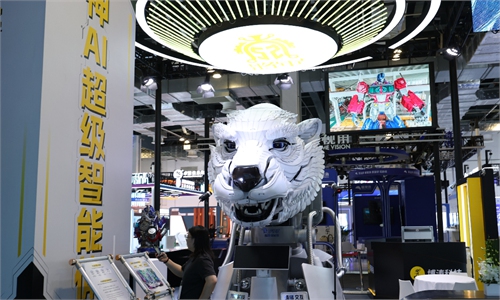
AI robot toys are on display at an event. File photo: VCG
From education to entertainment, AI toys and smart robotic pets are emerging as a hot category of interactive consumer gadgets in China.
New technologies are sweeping and changing the traditional toy industry. Around this year's Spring Festival in January, the sudden rise of DeepSeek sparked an AI toy craze across the country.
Recently, a robotic dog named Sirius went viral online. Capable of understanding and responding to voice directives, Sirius can perform actions like sitting, jumping and dancing with ease.
Developed by Hengbot Innovation Co in Southwest China's Chongqing Municipality, Sirius is an intelligent quadruped robot, weighing just 1 kilogram. Based on multiple AI models and latest robotics technology, the high-performing robotic dog is very popular amongst tech-savvy and children who pre-ordered. The $1,299 robot dog can play soccer, dance and easily evolve backed up by AI.
The Sirius robot has a total of 14 axes across its legs and head along with independently-developed proprietary joints named Neurocore which let it move more naturally.
"Sirius transcends the notion of a robot; it emerges as a sentient life companion. Designed to deliver emotional support and interactive experiences, it features a highly personalized nurturing system that allows each unit to develop a unique bond with the end user. Every Sirius is one of a kind," Ren Biyue, the company's COO, told the Global Times.
According to Market Research Future, the global entertainment robot market size is expected to surpass $18 billion by 2032, driven by demand for emotionally intelligent, programmable companions.
AI pet waves
China's technological capability sharpens with the rollout of a long list of AI models, as toy makers are increasingly leveraging AI as a powerful tool to enhance product interactivity and product appeal. Many companies have ventured into this competitive landscape.
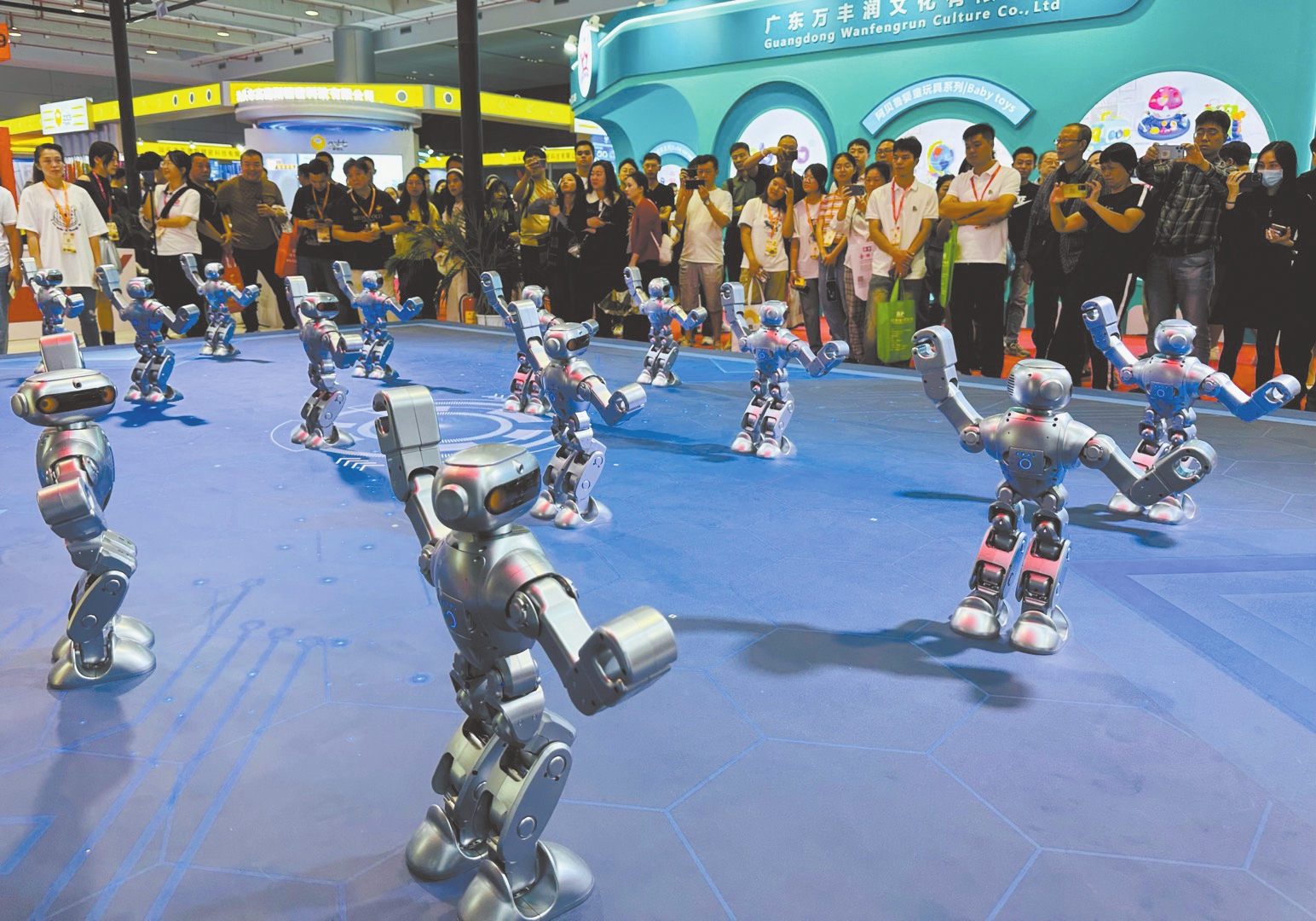
At 2025 China (Shenzhen) International Cultural Industries Fair, 18 small robotic performers captivated children and students with a choreographed Yingge dance. Following the performance, enthusiastic onlookers expressed interest in purchasing the robots.
Developed by Guangdong Qunyu Interactive Technology Co, the robots are improved this year aided with large AI models. "In the past, the robots followed pre-programmed routines. Now, they can adapt in real time to the atmosphere and audience feedback, giving each character a sense of expression and vitality," Chen Ruifeng, the company's CEO told the Global Times.
"It's a novel high-end tech toy designed to both educate and accompany children," he said.
Chen said the robots respond to voice commands like "crouch" or "do a Yingge dance." Two blocky mecha-style robots holding Yingge hammers quickly followed the instructions, performing fluid, dynamic moves with expressive choreography.
He added each robot character responds in a distinct voice, tone, and personality—creating what Chen described as an "interactive dialogue across time and space."
With strengths in voice recognition, Hefei-based iFlytek launched Alpha Egg reading robot, an educational robot a couple of years ago. Using 7-billion-parameter distilled iFlytek large AI models and 600+ patents on child-speech recognition, the screenless companion robot can identify 30,000 picture books and generate weekly literacy reports for parents. The company has shipped 1.8 million units in the first six months of 2025, 45 percent of them being exported, the company told the Global Times.
In addition to mainstream AI learning toys, AI-powered robotic pets are quickly gaining traction too, especially among tech-savvy young consumers and overseas buyers.
One notable example is Chinese AI pet robot start-up Ropet, which made waves at CES 2025 in the US with its debut product. Designed to resemble a plush toy with animated OLED eyes and a body that stays warm at human body temperature (around 37°C), the robot attracted global attention and quickly went viral on international social media. Priced at $299, the product appeals to both young adults.
"The robot integrates an AI-driven emotional engine capable of recognizing and responding to human emotions through voice, expressions, and movement," the company said. "It also features personality-building functions, allowing users to shape the pet's behavior via an app. Current user engagement exceeds 83 percent."
He Jiabin, CEO of Ropet, told the Global Times that the company received around 10,000 preorders within one month after the product launch. "Demand is surging across markets including North America, Europe, Japan, and South Korea. We're working to scale up supply and expect continued strong sales in the months ahead," he said.
Booming market
A surging tide of market demand is catapulting China's AI toy sector into rapid development. According to an industry insider, the tipping point is no longer on the horizon—it is here, and the momentum is set to accelerate during the next 12 to 24 months.
Behind the boom lies a virtuous cycle of maturing chips, clever algorithms, and ever-more-capable models—exemplified by breakthroughs like DeepSeek—that are collectively injecting momentum into China's AI toy industry's boom.
It is estimated that AI toys can reach a market scale of more than 100 million yuan ($13.7 million), according to a statement e-commerce platform Taobao sent to the Global Times.
At present, the number of toy models, which include AI or smart functions as a product's feature, exceeds 1,000 across Taobao. Some typical categories of products include plush companion AI toys, AI toys for preschool education, intelligent AI board games, and AI-powered smart speakers for children, said Taobao. According to statistics sent from another Chinese e-commerce platform JD.com to the Global Times, the market for AI preschool education toys for children aged 3 to 6 years old has experienced an explosive growth, with sales of related products jumping sixfold in February on a monthly basis.
The AI companion market is growing rapidly, fueled by continuous innovations in AI, robotics, and ever-growing consumer appetite for emotionally engaging tech, Wang Peng, an associate research fellow at the Beijing Academy of Social Sciences, told the Global Times, adding that as an extension of traditional pets, AI companions offer stickiness and sustainability.
Industry data show that the global market scale of AI toys has already reached $18.1 billion in 2024, and it is projected that the market scale could increase to reach $60 billion in 2033, state broadcaster CCTV News reported.
In the Chinese market, assuming that the domestic AI toy penetration rate reaches 20 to 25 percent in 2028, the AI toy market size is expected to reach 30 billion yuan to 40 billion yuan, according to an analysis by Founder Securities.
RELATED ARTICLES