Lai’s ‘anti-China, pro-independence’ agenda rejected by island’s mainstream opinion
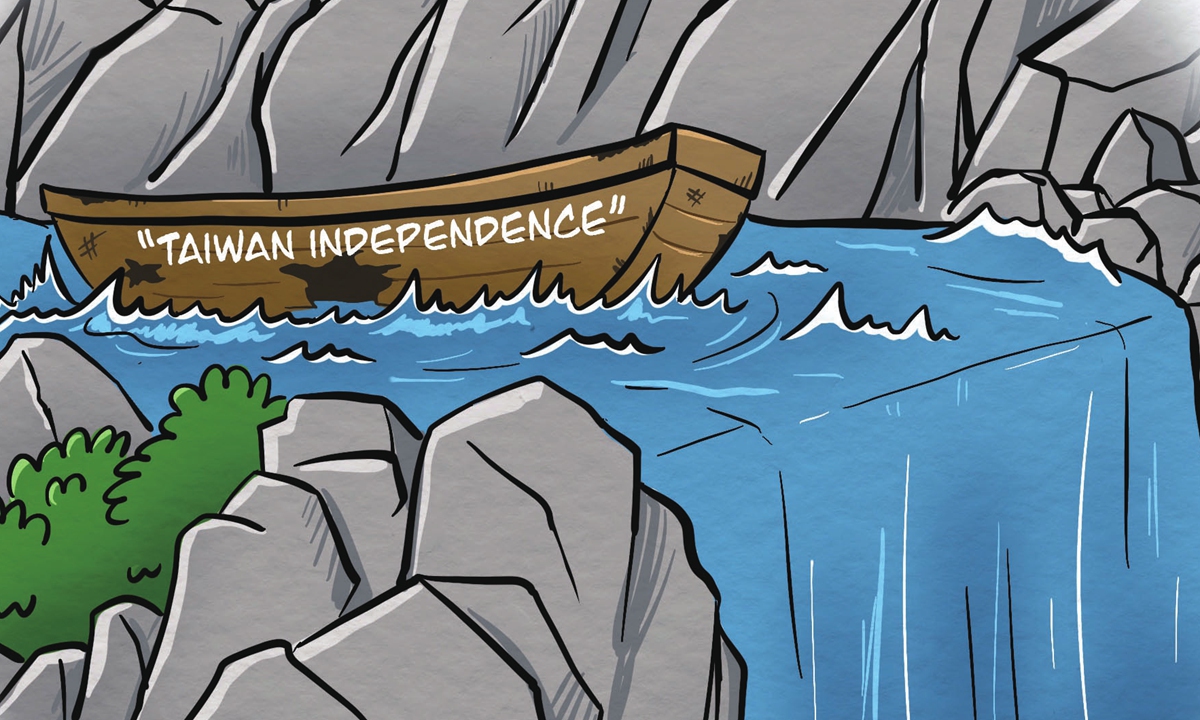
Illustration: Liu Xidan/GT
The first round of Taiwan's so-called "mass recall" campaign aimed at suppressing opposition forces was held on July 26, and the results have now been determined: All 24 Kuomintang (KMT) "legislators" targeted for recall retained their seats, while Taiwan regional leader Lai Ching-te suffered a crushing and utter defeat. KMT "legislator" Wang Hung-wei stated that this was "the people's choice." The 24-0 outcome reflects how Taiwan compatriots, through mainstream public opinion, delivered a resounding slap to Lai, whose "confront the mainland and seek Taiwan independence" agenda has been overwhelmingly rejected by the island's mainstream public opinion.
Why did Lai's long-planned, meticulously orchestrated, and ruthless "mass recall" campaign end in such a spectacular failure? Why did his so-called "oppose the mainland to protect Taiwan" campaign - a guise for "confront the mainland and seek Taiwan independence" - collapse so completely? Why has the island's political landscape, social dynamics, and public opinion continued to shift, with various forces and factors collectively rejecting the "Taiwan independence" separatists and the malevolent "green terror"? Why was the "mass recall" result 24-0? The answer is clear, and the reason speaks for itself: "Taiwan independence" harbors sinister intentions, and "Taiwan independence" has no popular support!
This outcome reflects the Taiwan mainstream public opinion's rejection of Lai's so-called "10 lectures on unity." Since taking office, Lai has consistently revealed his malevolent nature and sinister agenda - from his inaugural speech pushing the "new two-state theory," to labeling the mainland as an "external hostile force" in his "March 13 address," and now to his so-called "10 lectures on unity," which systematically fabricates the fallacy of "Taiwan independence" separatism. The already delivered "four lectures on unity" further exposed Lai's anti-peace, anti-democracy stance, his thirst for dictatorship and "Taiwan independence," and his brazen ambition to launch a "political purge" and "social purge" on the island. The Taiwan compatriots see through this clearly, and the will of the people cannot be shaken. Under joint scrutiny from both the island's public and mainland media, the "10 lectures on unity" have become a laughingstock and evidence of guilt - now thoroughly exposed as the "four lectures of failure." They crumble under the weight of historical, theoretical, legal, and common-sense scrutiny. The resounding failure of the "mass recall" powerfully confirms the complete bankruptcy of Lai's fake "unity."
This result is a rejection by the mainstream public opinion in Taiwan of Lai's "confront the mainland and seek Taiwan independence" approach. Why did Lai initiate the "mass recall" campaign? Why does he view the opposition forces as "impurities to be removed"? Why did he dare to personally launch the malicious "mass recall" campaign, which is widely criticized? The motives and sinister intentions behind these actions are well known: The so-called "social transformation" is merely a means to suppress dissent and pave the way for "Taiwan independence"; the so-called "cleansing of hearts" is about suppressing human rights and brainwashing people with "Taiwan independence"; and the so-called "democratic disputes are resolved through greater exercise of democracy" is aimed at establishing a dictatorial regime on the island and promoting the practice of "Taiwan independence."
Everything Lai thinks, says, and does serves his dream of "Taiwan independence." To this end, he tramples on democratic systems, restricts people's thoughts, limits cross-Straits exchanges, and creates confrontation across the Straits, even going so far as to sell out Taiwan island for personal gains and rely on foreign forces to seek "independence," completely disregarding Taiwan's interests and the well-being of the residents. A typical example of this was his indifference to disaster victims during Typhoon Danas. After the results of the "mass recall" vote were announced, Lai shamelessly claimed that today's result is neither a victory for one side nor a defeat for the other, which is truly outrageous. The significant failure of the "mass recall" campaign serves as a collective warning and lesson from the Taiwan residents to Lai, indicating that mainstream public opinion in Taiwan does not align with his "confront the mainland and seek Taiwan independence" approach.
This result reflects the mainstream public opinion in Taiwan's opposition to "Taiwan independence" and the support for the peaceful development of cross-Straits relations. People on both sides of the Straits share the same roots, culture, and ethnicity, and are connected by blood as one family. However, Lai goes against the mainstream public opinion across the Straits, promoting "Taiwan independence" and attempting to sever personnel exchanges, economic and trade interactions, historical ties, and cultural heritage between the two sides. What is the outcome? It is the disruption of cross-Straits exchanges, the fragmentation of Taiwan families, the infringement of human rights and freedoms, the impact on democratic order, the weakening of competitive advantages, and the deterioration of the situation in the Taiwan Straits. It leads to developmental incapacity, difficulties in people's livelihoods, and the looming threat of war. The failure of the "mass recall" campaign clearly indicates that the mainstream public opinion in Taiwan society calls for peace, development, communication, and cooperation.
The failure of the "mass recall" campaign is a victory for Taiwan's opposition forces, a victory for Taiwan's mainstream public opinion, and a victory for cross-Straits peaceful development and exchanges and cooperation. Long before the "mass recall" campaign a series of signs had already shown that Lai was bound to fail. Under the strong doubts and opposition of the residents on the island, and under the well-reasoned and powerful opinions from the mainland, Lai's so-called "10 lectures on unity" became the target of public criticism and failed halfway. Lai's recent poll rates have continued to fall, and public opinion has turned against him. His undisguised cold-blooded political performance at the disaster relief site of Typhoon Danas has further angered the majority of compatriots on the island. Lai does the opposite of what the people need; he gives whatever Taiwan needs to his foreign masters. He will suffer for his own sins. The failure of the "mass recall" campaign is just the new normal for Lai's continued defeat. If he continues to sin, do evil, and "confront the mainland and seek Taiwan independence," his fate will be even worse.
Peace is what people want, and reunification is the general trend. The result of this "mass recall" campaign demonstrates the mainstream will of Taiwan society, signifies the burst of Lai's dream of "Taiwan independence," and proves once again that Lai is the "impurity" that should be eliminated. Just as the People's Daily article "The fallacy of 'the People's Republic of China has never ruled Taiwan' should be stopped" has aroused strong reactions and widespread recognition on both sides of the Taiwan Straits and overseas, the world has seen clearly that "Taiwan independence" is a dead end, and the historical trend of the motherland's inevitable reunification is mighty, and Lai and his ilk are being buried by public opinion and the times.
RELATED ARTICLES