Foshan launches citywide campaign to combat chikungunya by clearing mosquito breeding grounds
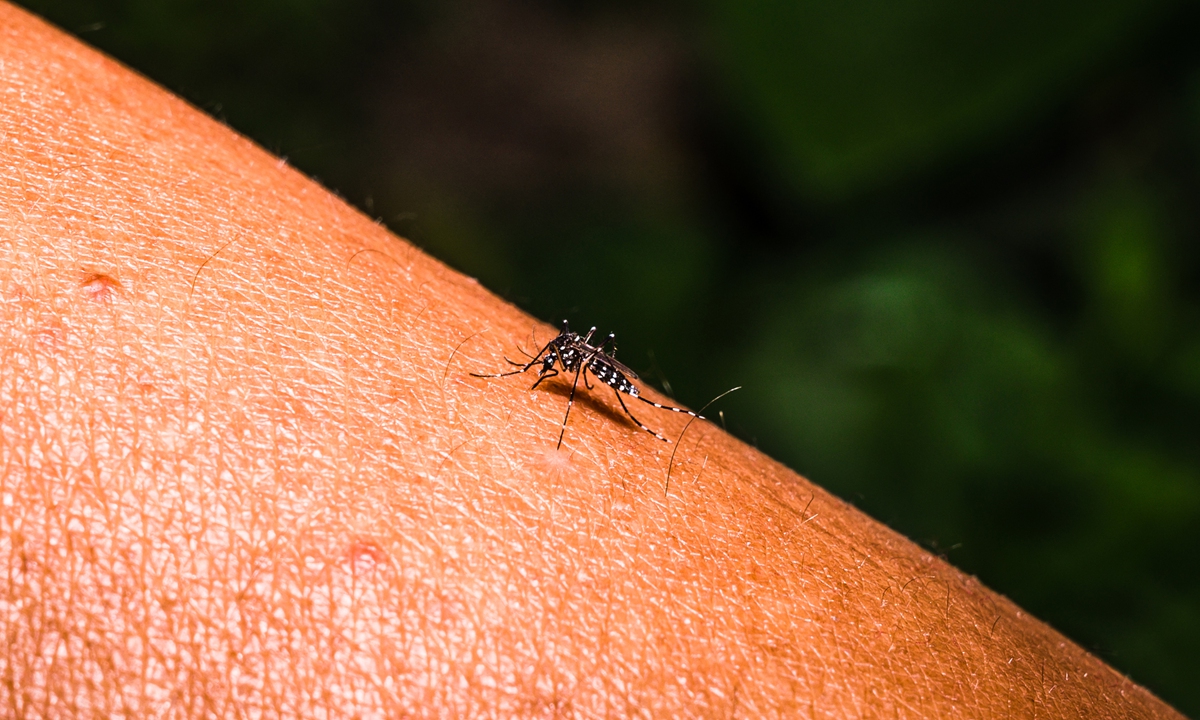
Photo: VCG
Foshan in South China's Guangdong Province has mobilized its citizens to combat chikungunya, aiming to cut off the virus transmission chain by making strong mosquito prevention efforts.
Foshan reported 351 new confirmed cases of chikungunya on Friday, according to the statistics released by the health bureaus of the five districts in the city. All these new cases were mild cases. Shunde district, the epicenter of the outbreak, confirmed 273 new cases on Friday, the Nanfang Daily reported on Sunday.
All five districts of Foshan had reported a combined total of over 4,000 cases of chikungunya, with Shunde district confirming 3,627 cases.
Cases have also been reported in other Guangdong cities, including Guangzhou, Yangjiang, and Zhanjiang.
Like dengue fever, chikungunya is transmitted by Aedes mosquitoes. These mosquitoes lay eggs and breed in various small containers with standing water, where larvae develop. Without standing water, mosquitoes cannot breed, and the spread of chikungunya and dengue will be contained. Therefore, the primary prevention and control measures for chikungunya and dengue are eliminating standing water, eradicating mosquitoes, and avoiding bites, according to Nanfang Daily.
In response to the recent surge and spillover of chikungunya cases in some southern regions of China, Zhang Wenhong, director of the National Medical Center for Infectious Diseases and director of infectious diseases department at Huashan Hospital affiliated with Fudan University, explained that since China had never previously experienced a large-scale chikungunya outbreak caused by imported cases, the population lacks baseline immunity, allowing the virus to spread faster than in other endemic regions, Yicai reported on Saturday.
Nevertheless, Zhang believes that with timely and effective measures, the affected areas in southern China remain within the optimal window for outbreak control. A broader surge in infections can still be prevented, and the virus's spread to surrounding regions can be contained.
According to Zhang, humans also be sources of infection, contributing to its transmission - from person to mosquito, and then from mosquito to another person. Modern transportation facilitates leapfrogging of transmission patterns, as infected individuals can bring the virus to new areas where Aedes mosquitoes exist - expanding the spread of chikungunya.
Therefore, efforts should focus on thoroughly eliminating mosquito breeding grounds, while surrounding areas must closely monitor suspected cases, Zhang said.
Zhang added that after the outbreak, seroepidemiological studies must be promptly conducted in affected areas to assess how widely the population was infected and evaluate the risk of a future resurgence.
On Saturday, Chancheng district in Foshan conducted a grid-style inspection focusing on high-risk areas for mosquitoes, such as old residential communities and farmers' markets, by removing standing water, clearing debris, and eliminating mosquito breeding grounds.
Beyond the citywide campaign, various sectors in Foshan have joined epidemic prevention efforts. On Friday, representatives from state-owned enterprises in Foshan donated the first batch of supplies worth over 400,000 yuan ($55,808) to support the city's mosquito-borne disease prevention efforts.
Additional supplies are being prepared by relevant enterprises, with a second round of donations planned. The total value of donated materials is expected to reach approximately 1 million yuan.
Global Times
RELATED ARTICLES