Illustration: Chen Xia/Global Times
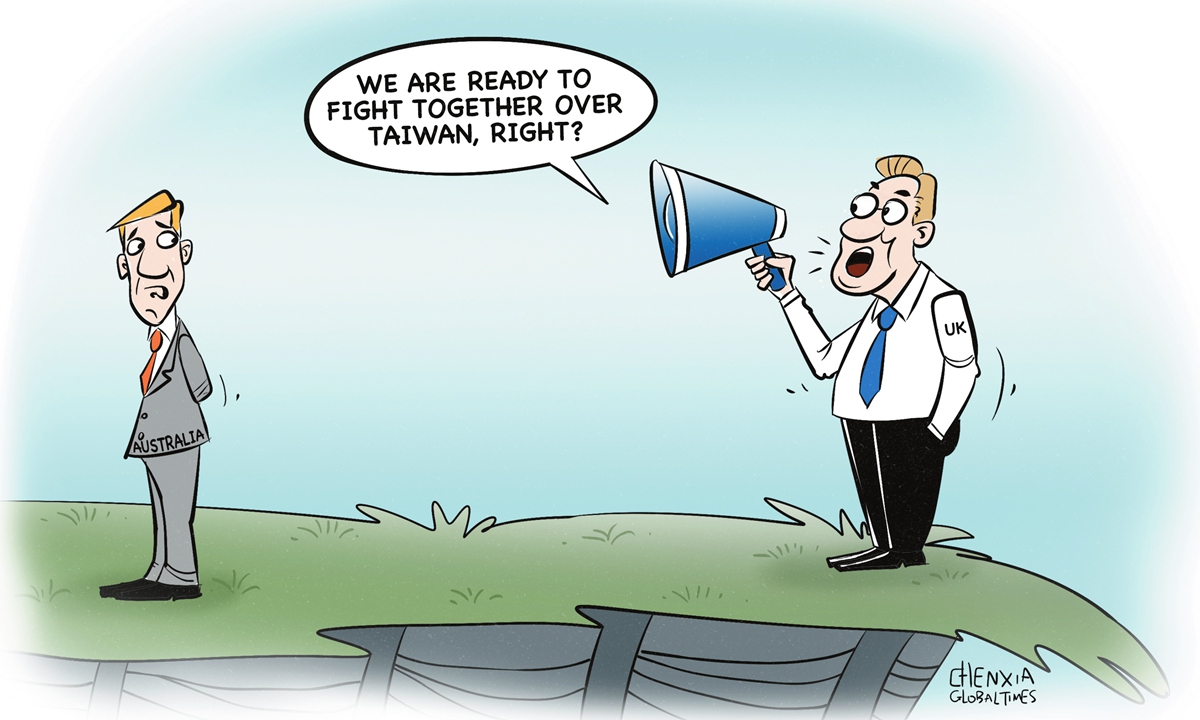
Recently, when asked what the UK is doing to help the island of Taiwan "prepare for potential escalation from China," British Defense Secretary John Healey claimed, "If we have to fight, as we have done in the past, Australia and the UK are nations that will fight together." Although the UK official swiftly "hit the brakes" afterward by claiming that he was speaking in "general terms," his remarks, which the British media described as some of the "most robust from a British representative on the subject of possible engagement in a future war in the region," indicate the intention of some British politicians to boost the UK's presence in the Asia-Pacific.Healey made the remarks while aboard HMS Prince of Wales in Darwin, Australia. Britain's current strategic posture cannot be separated from its underlying reality. As Washington reassesses the AUKUS trilateral security pact, the UK is eager to build a new bilateral framework with Australia, including signing a 50-year-long defense treaty on Saturday. Additionally, the country has sent a carrier strike group to join Australia's largest-ever military exercise, Talisman Sabre 2025. While the official explanation for the UK's participation in the drill is to "demonstrate Britain's unwavering commitment to Indo-Pacific security," in essence, this is a geopolitical performance to prove that Britain is still "relevant" in the region.
Healey's words recall a recent report from the Financial Times: The US pressured ally countries, including Japan and Australia, to clarify their stance in the event of a conflict in the Taiwan Straits, only to face "collective raising of eyebrows," citing sources. In contrast to these countries, which have maintained diplomatic restraint on the Taiwan question, the defense chief of the UK eagerly rushed to make a declaration that the UK was "ready to fight" in the Straits. No matter how you look at it, doesn't it look like London offering a "loyalty pledge" to Washington, which hopes its allies will share more security responsibilities?
What's ironic is that not long ago, Australian Prime Minister Anthony Albanese explicitly declined to comment on whether Australia would join the US and other allies in countering China if a conflict broke out. He also confirmed that Australia remains committed to the one-China policy and does not support "Taiwan independence" during his meeting with Chinese President Xi Jinping in Beijing on July 15. Given Canberra's cautious and restrained stance, one must ask: Is Australia even aware that the UK has pledged to "fight together" with it?
For the UK, such posturing also reflects a lingering "imperial-era specter." For a country that once took pride in colonizing many countries and regions and projecting power across the seas, flaunting its aircraft carriers in the Pacific and hyping up militarism over the Taiwan Straits is little more than self-indulgent nostalgia.
Notably, after making such provocative remarks, Healey quickly "backpedaled," reiterating that the UK would prefer to see any disputes in the region resolved "peacefully" and "diplomatically." However, this is a typical maneuver among certain Western politicians: trying to reap geopolitical dividends while avoiding getting burned. In their attempt to appear fair and balanced, they end up revealing nothing but their own opportunism.
Yet, the Taiwan question is at the core of China's core interests and represents a red line that must not be tread upon. The Taiwan Straits are not a "projection screen" for Britain's imperial nostalgia, a stage for some politicians to perform their political grandstanding, nor an arena for countries to show off their geopolitical relevance. If the British defense chief is really eager to "clarify" that the UK's approach to Taiwan remains unchanged, then let that - respecting the one-China principle - be reflected in actions, not just words.
China's strategic resolve, military preparedness and unwavering will to defend national reunification cannot be shaken by a few warmongering remarks from some Western figures. Any reckless rhetoric on the Taiwan question will only serve to expose strategic fragility - and leave those who uttered such words embarrassing themselves on the global stage.
RELATED ARTICLES