Stabilizing relations with China requires sincerity, not limit-testing from Japan
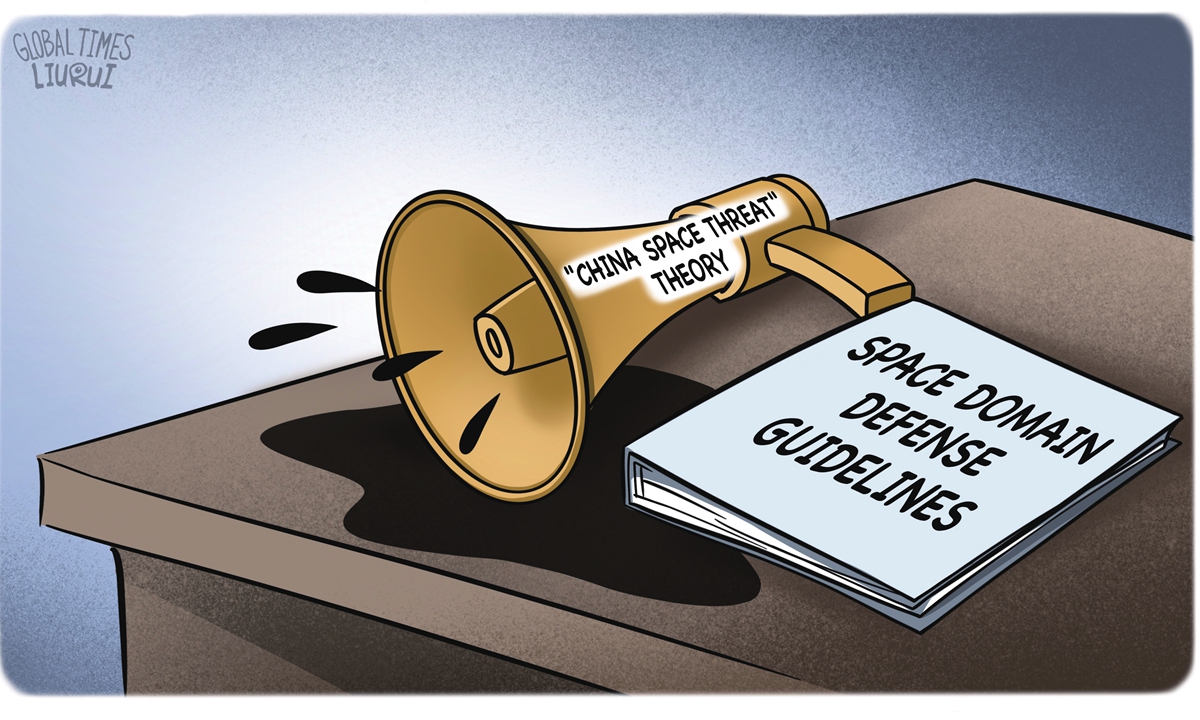
Illustration: Liu Rui/GT
Recently, some negative signs have emerged from the Japanese side regarding China-Japan relationship. Japan unveiled its first guidelines aimed at bolstering its defenses in outer space on Monday, exaggerating the so-called "China threat" by misrepresenting China's normal satellite development as a move toward the "militarization of space." Not long ago, Japan allowed Lin Chia-lung, the head of Taiwan region's so-called foreign affairs department, to make a "private" trip to Japan and meet with Japanese politicians, openly challenging the one-China principle despite prior warnings from Beijing. These seemingly "small choices" risk undermining the momentum of China-Japan relations. The stabilization and improvement of China-Japan relations requires both sides, especially the Japanese side, to engage sincerely.The newly published guidelines by Japan regarding space outline plans to develop so-called "bodyguard satellites" constellations to strengthen Japan's space-based military capabilities. This move reflects an attempt to justify military expansion by hyping up external threats. China's space program adheres to peaceful principles and has made notable achievements in international collaboration. Japan's distortion of these advancements into "threats" not only misrepresents China's intentions but also increases strategic distrust in East Asia. Space should be a frontier of cooperation for all humankind, not a stage for deepening geopolitical divisions.
In addition, Japan's recent handling of Lin Chia-lung's visit - allowing him to engage in political activities - violates the principles of the four political documents between China and Japan and challenges the international consensus on the one-China principle. Taiwan is an inalienable part of China's territory and the Taiwan question is at the core of China's core interests. Any attempt to blur this red line or to test it politically will seriously erode the foundations of bilateral trust. The Ministry of Foreign Affairs of China has urged Japan not to harm China's sovereignty in any way and not to send any wrong signals to "Taiwan independence" separatist forces.
Since the current Japanese administration under Prime Minister Shigeru Ishiba came to power, it has repeatedly expressed its willingness to build a "mutually beneficial relationship based on common strategic interests" with China. In January 2025, the two sides held the 9th Meeting of China-Japan ruling parties exchange mechanism, marking the resumption of this meeting after a gap of over six years. Both sides engaged in in-depth discussions on enhancing mutual trust, expanding people-to-people and cultural exchanges and deepening mutually beneficial cooperation. According to Ministry of Commerce statistics, bilateral trade between China and Japan has exceeded $300 billion annually for several consecutive years, with cumulative Japanese investment in China surpassing $130 billion. A major Japanese business delegation visited China earlier this year and voiced strong confidence in China's economic prospects, expressing a clear intention to deepen cooperation.
"Amid this momentum, the Japanese side's negative moves toward China are a cause for concern. This suggests a 'two-faced' approach in Japan's China policy," Da Zhigang, director of the Institute of Northeast Asian Studies at the Heilongjiang Provincial Academy of Social Sciences, told the Global Times on Tuesday. "On one hand, Japan wants to benefit from economic cooperation with China, especially given the size of China's market and its central role in global supply chains; on the other hand, Japan actively aligns itself with the US and the West in their strategic containment of China, including pressure in geopolitics and narrative framing. It seeks to benefit from China's economic growth, yet remains unable to break free from the constraints of the US-Japan alliance," Da added.
To stabilize China-Japan relations, Japan must show genuine sincerity through concrete actions instead of fluctuating between provocation and cooperation. It should adopt a rational and objective perspective on China's development, while also respecting China's core interests - particularly by exercising restraint on critical issues like the Taiwan question. True stability is achieved not by testing limits, but through rationality and sincerity.
RELATED ARTICLES