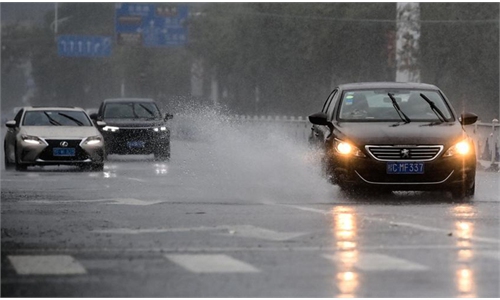
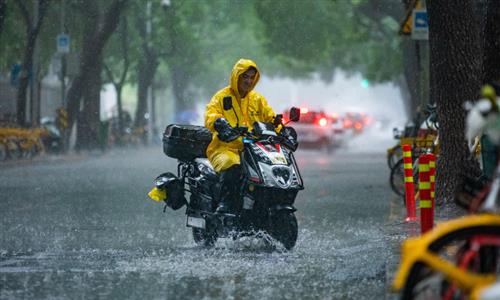
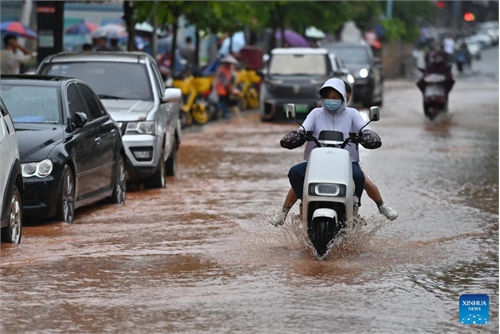
Destructive, rare rainfall claims 30 lives in Beijing; yellow alert lifted
By Published: Jul 29, 2025 11:22 PM

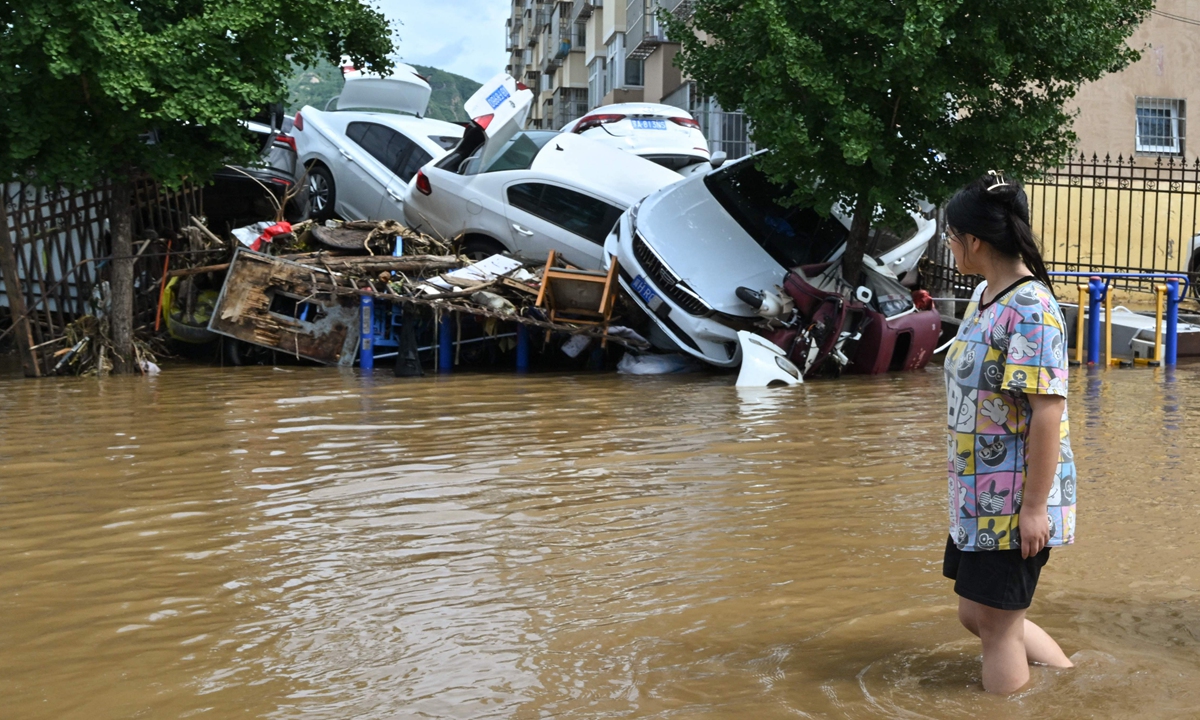
A woman plodges past piled damaged cars in a flooded neighborhood in Miyun district, northern Beijing, on July 29, 2025. Photo: VCG
In recent days, extreme and severe convective weather brought by warm, moist air from the edge of the subtropical high has occurred in Miyun and other areas in Beijing.
The latest round of heavy rainstorms has left 30 people dead in Beijing as of midnight Monday, the Beijing municipal flood control headquarters said Tuesday. The deaths occurred in Beijing's northern mountainous districts, with 28 in Miyun and two in Yanqing, Xinhua News Agency reported.
On Tuesday afternoon, the heavy rainfall system affecting Beijing moved out of the area. The Beijing Meteorological Observatory also lifted the yellow alert for rainstorms Tuesday afternoon. Scattered thunderstorms are still expected in the city this afternoon and evening, according to the Beijing Emergency Management Bureau.
Yet in the face of danger, many ordinary people stepped forward with extraordinary courage. Local villagers spontaneously mobilized excavators to assist firefighters in rescuing trapped residents and relocating them to temporary shelters.
These acts of rescue became heartwarming moments shared across the internet, offering a powerful reminder of the solidarity and compassion that shine through in times of natural disaster.
All-out efforts
Since the onset of this round of heavy rainfall and as of midnight on Monday, the city's average precipitation has reached 165.9 millimeters. The highest recorded rainfall occurred in Miyun's Langfangyu and Zhujiayu, reaching 543.4 millimeters. The peak rainfall intensity was observed in Dongyu, Huairou district, with 95.3 millimeters falling between 10 pm and 11 pm on Saturday.
Some 80,332 people have been relocated across Beijing. The three districts with the highest number of evacuees are Miyun, Huairou and Fangshan.
In Miyun district, 16,934 people were relocated from 19 townships; in Huairou district, 10,464 people were relocated from 15 townships; and in Fangshan district, 9,904 people were relocated from 21 townships.
In the urgency of the rescue operation, a villager from Miyun's Taishitun town told media they organized ourselves and started rescuing people. One person used a boat to carry three loads of people from the area - 17 people in total. Another person used an excavator bucket to make over 10 trips, saving more than 80 people.
A local resident surnamed Yu from Pengheyan village of Miyun shared with the Global Times on Tuesday some videos of firefighting and rescue efforts. "We were hit by a rare-scale rainstorm and flash flood. Roads were destroyed, and water, electricity, and communication were all cut off. But thankfully, the firefighters helped us get out of danger. The government also arranged buses to take us to the Miyun theater. We're truly grateful to them," Yu said.
Chinese People's Liberation Army (PLA) and the People's Armed Police Force (PAPF) troops, along with militia members, responded swiftly to orders and were immediately mobilized for flood control, emergency rescue, and disaster relief operations, the People's Liberation Army Daily reported in an article published on Tuesday.
The PAPF Beijing Corps has mobilized over 1,800 officers and soldiers to deliver supplies to Fengjiayu Township in Miyun district, evacuate residents from Mujiaoyu Township, reinforce embankments along the Chaohe River, and set up emergency shelters in Yanqi Township and Liuli Temple Township in Huairou district. As of press time, over 4,000 residents had been relocated, more than 2,000 boxes of emergency supplies delivered, and over 30,000 sandbags filled.
While heavy rainfall continued to batter northern China, including Beijing and surrounding regions, on Monday and Tuesday, advanced technologies - such as satellites and drones - have been deployed for rescue and relief operations.
The Ministry of Finance and the Ministry of Emergency Management have urgently allocated 350 million yuan in central government disaster relief funds, focusing on supporting emergency rescue and disaster relief efforts in nine provinces and regions, including Beijing, Hebei, Jilin, and Shandong, according to an announcement on Tuesday.
The Red Cross Society of China announced that it had dispatched a working team to Miyun district in Beijing to carry out disaster relief efforts, Xinhua reported. It urgently allocated 2,000 relief family kits to the affected areas in Beijing to support the local Red Cross in relocating and resettling disaster-affected residents.
Rare, destructive rainfall
Beijing meteorological department said that the city has experienced continuous heavy rainfall since July 23, according to the WeChat account of the Beijing municipal government. The extreme weather in Miyun was described as "rare in history and extremely destructive."
The causes of this extreme heavy rainfall are closely related to recent weather and meteorological conditions, some experts said.
There has been frequent typhoon activity in the southern part of the East China Sea recently. Although these typhoons are not particularly strong, they have brought highly active outer circulation. At the same time, the outer circulation on the northern side of the typhoons has interacted with the edge of the western Pacific subtropical high, together forming a "moisture transport corridor" that channels large amounts of water vapor to the North China Plain, Ma Jun, director of the Institute of Public and Environmental Affairs, told the Global Times on Tuesday.
"This type of rainfall event is often accompanied by what is known as the 'train effect,' where a series of intense convective weather systems repeatedly affect the same area, resulting in frequent occurrences of extreme heavy rainfall," Ma said.
According to historical meteorological records, such phenomena were relatively rare in the past, but have been increasing in recent years, which also aligns with the broader global trend of more frequent extreme weather events under the influence of climate change, Ma added.
RELATED ARTICLES