Are US political processes well set up to get California’s high-speed rail built quickly, efficiently?
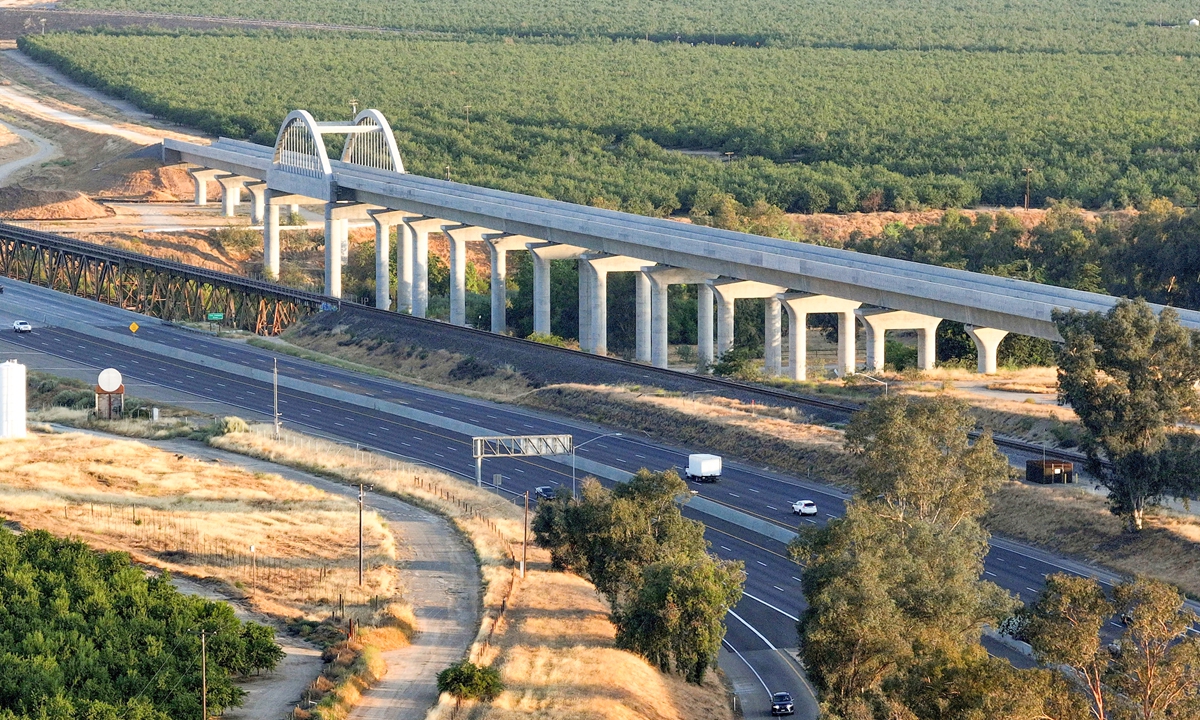
A drone view of the California High-Speed Rail bridge in Fresno, California, US, on June 8, 2025. Photo: IC
Editor's Note:
Earlier this month, the US federal government revoked its funding for California's high-speed rail project, casting a shadow over the already long-delayed bullet train project that would link Los Angeles to San Francisco. California announced a lawsuit against the federal government following the cancellation of funds. Voters first approved the project in 2008 and it was supposed to be operational by 2030. However, cost estimates have consistently increased, and its timeline has been pushed back. In her I-Talk show, Global Times (GT) reporter Wang Wenwen talked to two experts from California - Ethan Elkind (Elkind), director of the Climate Program, the Center for Law, Energy and the Environment of UC Berkeley School of Law, and Lou Thompson (Thompson), former chairman of the Peer Review Group reporting to the California Legislature on the high-speed rail project - about the fate of the US' first high-speed rail program.
GT: The California high-speed rail system was supposed to be the first truly high-speed rail system in the US. If it can be successfully built, how would it benefit California and the US?
Elkind: For California, what the high-speed rail would bring would be a huge amount of economic benefits, because it would link Los Angeles to San Francisco in a more sustainable way than flying. It could potentially save time for people to travel because you can eliminate a lot of the hassle of getting to the airport. But even more importantly than connecting Los Angeles and San Francisco, it would also connect some of the cities in between that have not shared in the prosperity of the coastal cities in California. Additionally, it would provide extra capacity as our population is growing. We don't really have room to expand our airports or highways, so this system provides a much more sustainable way to absorb increased travel between southern and northern California and vice versa.
More broadly, beyond California and the economic and environmental benefits, it would also demonstrate successful high-speed rail in North America. There hasn't been a high-speed rail line built in North America, and at this point the California system is so bogged down that it's likely some other high-speed rail systems that are privately funded and being developed are probably going to come online before California's system does.
GT: US Transportation Secretary Sean Duffy said, "17 years were gone, $16 billion spent, with no track laid." Why has this project been so complicated?
Elkind: It got off to a very bad start. It was being built in an area far from where the voters are. So it's not something that's really visible to a lot of people in the state. It took the state a long time to figure out how to get their workforce together, and learn how to build this pretty difficult linear infrastructure project. It's not difficult technically, but it's challenging legally and politically in California. Basically, any large project in California is quite complicated because there are so many veto points. Governance is so decentralized.
Even if we didn't have this challenge between the state and federal governments, we'd still have a tough time building high-speed rail. More recently, we have seen that the federal government, once controlled by Republicans, is very hostile to funding high-speed rail. There are battles over funding, however, the big issue with high-speed rail is that it's only partially about funding. Most of it concerns how quickly you can get approvals to build this kind of long-distance linear infrastructure. Government is not very efficient at building high-speed rail. There are so many governments involved - counties, cities, multiple agencies, and state processes, including state environmental reviews, which can cost over $1 billion.
It's not like this is brand new infrastructure. This isn't a question of whether this is a difficult or new technology. It's really just a matter of how well our political processes are set up to get this kind of infrastructure built as quickly and efficiently as possible for taxpayers and residents of the state.
Thompson: The promoters of the project convinced the people of the state that it could be built for an amount of money and within a timeframe that was simply impossible. It could never be done. Additionally, they did not establish a firm funding plan. The discussions at the time called for one-third of the funding to come from state sources, one-third from the federal government, and one-third from the private sector. The problem was that there were no federal programs at that time to finance high-speed rail, and the private sector rapidly made it clear that except for station area and related aspects, they would not invest in the project until it had been completed and until the demand had been successfully demonstrated. What that meant was that as soon as the project started, the managers didn't have the money they needed to actually conduct it.
The second element is that in California, the process of acquiring and taking private property is very complex. There are restrictions on how property can be taken and what the procedures are. And we also have several environmental quality acts at both the national and state levels that make it very time-consuming and expensive to do something like this. It was very painful to see these delays caused by various environmental and property restrictions.
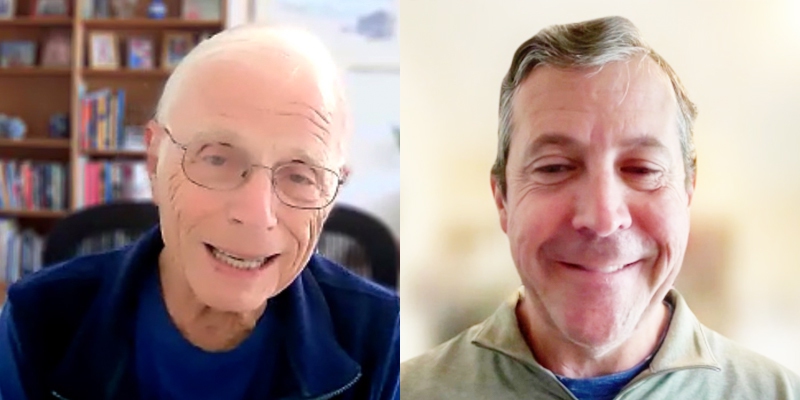
Lou Thompson (left) and Ethan Elkind (right) Photos: Interview screenshot
GT: There is a lot of comparison between China and the US regarding the construction of high-speed rail systems. Just last year, newly built high-speed railways measuring more than 2,000 kilometers were inaugurated in China. How do you view the comparison?
Elkind: It helps if you only have one party in control. We have different political parties and actors, which makes the situation more complicated. When it comes to things like infrastructure deployment, it's much more difficult because you have to get buy-in from all democratically elected local officials.
The other difference, based on my discussions with various experts in China, is that there's also a cultural difference. In China, there's not really a tradition of one person standing in the way of a project that benefits the whole region. But in the US, we have a strong tradition of individualism and individual rights. This empowers individuals to file lawsuits if they have an objection to a project and feel that they're being harmed in some way. Culturally, there might be a price to pay if you stand in the way of a project like this as an individual. But it happens a lot.
Thompson: I know that in China, a lot of the funding come from local governments as well as the central government. But the leadership and responsibility clearly rest at the national level. That is not what happened in California, and it's probably not what would happen with any other high-speed rail project in the US. And also in our government, it's very hard to have a stable policy over a long period of time. Governments change, policies change, and it's similar to the UK government with HS2 - one government wants to build it, while another wants to shut it down. If you're a manager, you can't manage this under this circumstance. It just doesn't work.
China has the advantage of stable policy. Chinese railways had the resources it needed. It didn't have to go begging every year looking for a new set of money. They knew what the money was and they had and managed it.
GT: Thompson, in your presentation to the World Bank in April regarding California's high-speed rail, you argued that "visions are not projects." Can you elaborate on this?
Thompson: A vision is the grand idea while the project is how we get this done. The real challenge lies in transitioning from the vision to the project. Until you have physical plans for what you're going to do, until you have the authority to do it, until you have a funding plan in place that makes sure you can do what you're trying to do, until you have the political coalition in place to agree on it and support you when you get in trouble, which you will, and you keep going, then you don't have a project, you have a vision. At least in the high-speed rail area, China's ability to convert ideas into projects is very strong.
GT: To avoid another "California high-speed rail," what advice would you give state governments and the US federal government?
Thompson: The first thing to do is to think before you act and make sure that you've done the best job possible to estimate the costs and schedule for what you're about to undertake. I don't think that, in the history of any high-speed rail project, the costs or schedules have ever been overestimated. It always costs more and it takes longer. That's part of the game, but they could certainly do a lot better at estimating costs and schedules.
The other thing is, inherently high-speed rail projects are a combination of commercial activity and public activity. For example, you have ticket prices and profits from operating the railway, but you also reduce congestion, pollution, and accidents, among other things that you can't charge for, but they provide real benefits to the public. Figure out what the balance of benefits is between the public and the private sector or the operator, and then each side should pay what it wants to get. In the case of China, I think it's very clear. The high-speed railway is uneconomic in the sense that the revenues generated by the railway will never cover the cost. But that wasn't what the government was trying to accomplish. There were other objectives that the government had in mind for which it was willing to pay. And that's fine.
We need to streamline litigation and lawsuits to make the process faster. I have a lot of experience with environmental analysis for projects. I didn't object to it, because I think it makes the project better. It costs a little bit of money. That's fine, but there should be a point at which it's over. You can't litigate endlessly.
RELATED ARTICLES