Independent decisions matter: Spain’s rational choice amid ‘security risk’ hype over Huawei cooperation
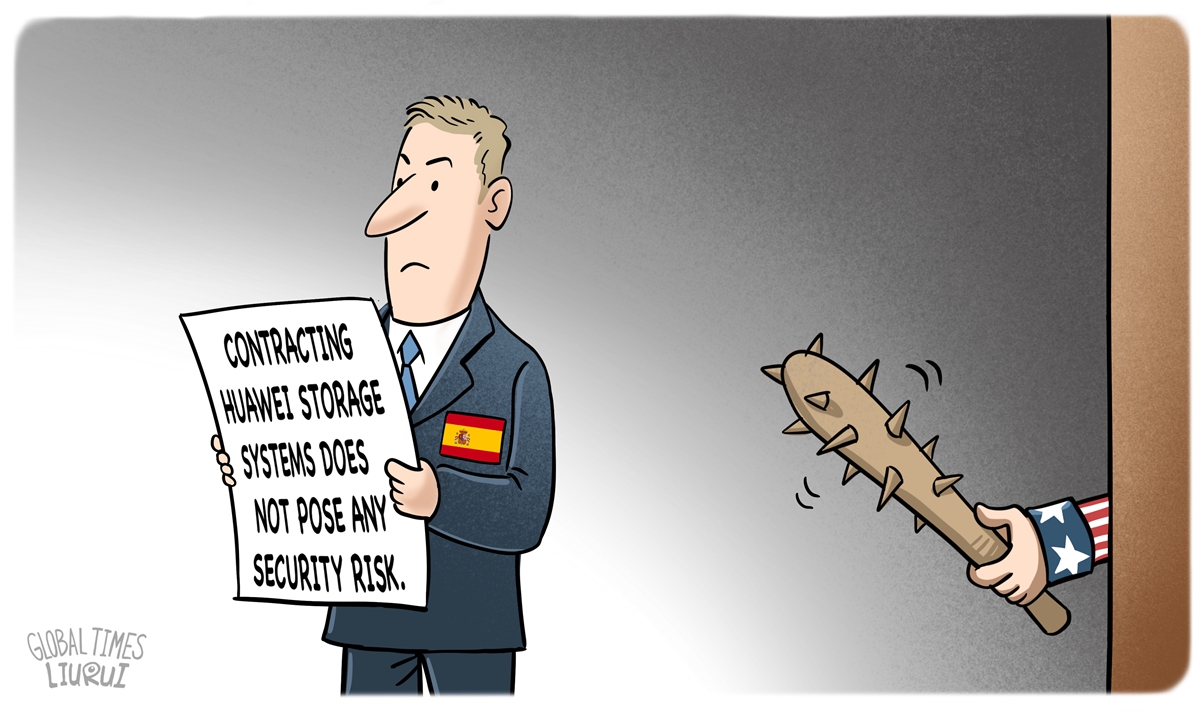
Illustration: Liu Rui/GT
Spain's recent decision to sign a 12 million euros ($12.96 million) contract with Chinese tech company Huawei for the storage of judicial wiretap data has made headlines. This move came despite mounting pressure from the US and the EU, both of which have claimed that Huawei poses "security risks." Rather than bowing to this pressure, Madrid insisted on proceeding with its cooperation with Huawei in accordance with laws and regulations. Spain's practical and rational choice once again reminds the world, especially European countries, of the importance of making independent decisions.In comments to the European media outlet Euractiv, the Spanish Interior Ministry confirmed on Tuesday that "contracting Huawei storage systems does not pose any security risk. The contract complies with the levels required by the National Security Scheme by independent certification authorities."
Spain has been one of Europe's fastest movers in 5G deployment, and such rapid progress requires access to reliable, cost-effective and high-quality equipment, which brings the cooperation with Chinese tech giant Huawei into the spotlight. Huawei, already a major supplier in the radio networks of some Spanish operators, not only supports critical telecom infrastructure but also, according to the company, contributes to education, smart city development, SME innovation and eco-friendly initiatives in Spain. Huawei's presence provides Spain with tangible benefits that no politically motivated "security risk scare" can replace.
Still, Spain's stance has clearly irked some in the West. Some voices warned that Spain is risking a "full review of US-Spain relations by holding onto Huawei card" and even called on Washington to use various tools in its "punishment toolbox": travel restrictions, asset freezes, limited military cooperation, you name it. They argued that "whatever policy pathway is selected by the Trump administration, there is bound to be support for imposing harsh consequences on the Government of Spain within the US Congress." This kind of threat depicts the "control freak" side that some want to see in Uncle Sam: Those who do not follow the US' script must pay the price. European countries are no strangers to such coercive tactics.
The problem is that the so-called "security risks" cited by the US have never been backed by any substantive evidence, yet they continue to be used as a pretext to suppress Chinese companies, with Huawei as the primary target. In reality, as a spokesperson for Huawei Europe said, all Huawei products available in the Spanish market fully comply with local laws, regulations, and applicable product admission criteria and standards, while all the information stored in hardware belongs to and is at the exclusive disposal of the customer. What Washington fears most is not a "security breach," but Chinese technology breaking the US' long-held monopoly in the tech sector.
Noticeably, European countries that have blindly followed the US' Huawei ban have paid a steep price. The UK is a prime example. When announcing the ban on Huawei in 2020, then-UK culture secretary Oliver Dowden admitted the move would mean "a cumulative delay to 5G rollout of two to three years." The total cost to the country's economy could exceed 7 billion pounds ($9.35 billion), according to experts. And what is the current status of British 5G development? According to Opensignal, the UK ranks 22nd out of 25 European countries for 5G download speeds and availability. Who ultimately loses from it? Domestic businesses and consumers.
The Huawei issue should not be turned into a pawn in geopolitical games, nor should it be a tool for Washington to control its allies. More European countries need to realize that sovereignty and national interests cannot be dictated from across the Atlantic. To remain competitive globally, European countries should have the courage to make independent, fact-based judgments instead of dancing to the tune of US "security risk scare" tactics. Otherwise, what Europe truly risks is sacrificing its own industrial competitiveness and future development opportunities on the altar of someone else's political agenda.
RELATED ARTICLES