Why experience of Potsdam Conference still matters
By Published: Jul 31, 2025 09:22 PM

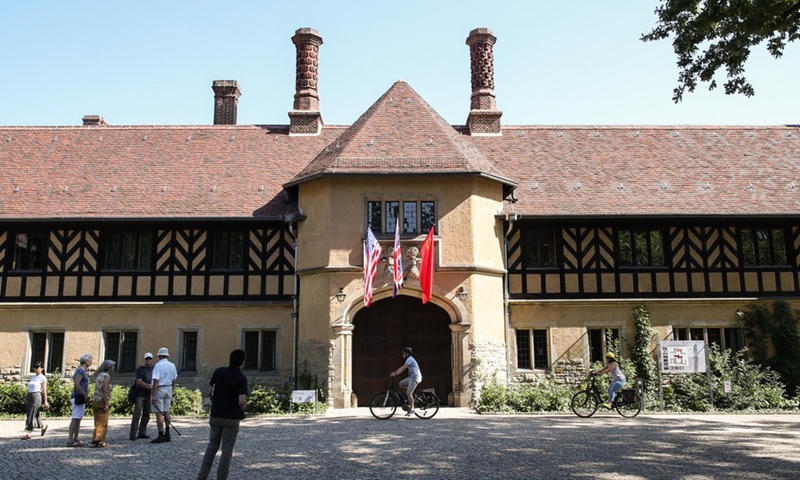
Photo taken on Aug. 17, 2020 shows an entrance of the Cecilienhof Palace in Potsdam, Germany. (Xinhua/Shan Yuqi)
In July 1945, 80 years ago, when World War II (WWII) in Europe was finally over, leaders of the three victorious powers - the Soviet Union, the UK and the US - gathered in the Berlin suburb of Potsdam to decide the future of Germany, the fate of its allies and satellites, redraw the new European borders, and discuss future security arrangements for the war-torn continent.The geopolitical environment around the conference was complicated and volatile. The Potsdam Conference took place amid significant leadership changes and shifting power dynamics in the US and the UK. In Asia, Imperial Japan remained a formidable military opponent for Allied forces - an unfinished business they had to address together. Most importantly, the brotherhood of arms among the victorious powers was rapidly and irreversibly eroding, giving way to suspicions and rivalries that would lead to the Cold War.
However, historians commonly consider the Potsdam Conference to be a success story. The participating parties managed to agree on how to prevent a new wave of German revanchism, settle long-standing territorial disputes in Europe and consolidate European nation-states that had proven to be so fragile and shaky during the interwar period.
Some of the decisions made in Potsdam were quite tough and arguably even unfair. It is worth noting that Charles de Gaulle, leader of the Free French, was not even invited to Potsdam, nor were heads of other European nations. Still, all shortcomings notwithstanding, the conference helped to establish a relatively stable European order that lasted for almost half a century until it began to collapse in 1989.
Why was Potsdam a geopolitical success? The most evident explanation is that following the bloodiest and most destructive military conflict that ever descended upon Europe in its long history, nobody was willing to repeat this tragic experience. The leaders who came to Potsdam shared a sense of historic and moral responsibility to prevent another continental catastrophe.
Europe is very different from what it was 80 years ago. Today, Europe's future cannot be decided by a "troika" or even by a dozen major players; to be legitimate and resilient, a new security system must be inclusive and democratic rather than exclusive and elitist. Moreover, European security problems cannot be separated from the global security agenda. And yet, the experience of the Potsdam Conference should not be forgotten. This experience should teach modern leaders the uneasy art of political compromise, self-reflection and even empathy. In the foreseeable future, any European arrangement should imply well-calibrated balances between Russia and the West, between the "old" and the "new" Europe, between the quest for European value-based universalism and the realities of the European political particularism.
The broad political consensus that emerged at the conference allowed the victorious powers to agree on important matters beyond the European settlement. In particular, on July 26, 1945, the Potsdam Declaration, or the Proclamation Defining Terms for Japanese Surrender, was issued. As a strong and unambiguous ultimatum for Japan, the Declaration defined the terms of the post-war occupation of Japan and subsequent political and economic reforms in the country. It also underscored the inviolability of what later became known as the one-China principle.
The Declaration reads that "We call upon the government of Japan to proclaim now the unconditional surrender of all Japanese armed forces, and to provide proper and adequate assurances of their good faith in such action." In real terms, the post-war settlement for Japan was much softer than for Germany. The country was not partitioned, the national civil administration continued the day-to-day governance, the old Meiji Constitution remained in power until May 1947, and the Tokyo Trials' rulings turned out to be generally softer than those of the Nuremberg Trials.
Under a different set of circumstances, Japan could have been transformed into a neutral and completely disarmed state, open for cooperation with all its neighbors. However, with the Cold War looming on the horizon, the US preferred to monopolize the collective authorities and responsibilities of the Allied Powers outlined in the Declaration. It was the American occupation led by General Douglas MacArthur that not only defined the fundamentals of the post-war Japanese political and social systems, but also molded Japan into a convenient tool of the US strategic posture in the Pacific. In this sense, the implementation of the Potsdam Declaration fell short of the expectations that its signatories could have had in late July 1945.
The author is a member of the Russian International Affairs Council. opinion@globaltimes.com.cn
RELATED ARTICLES