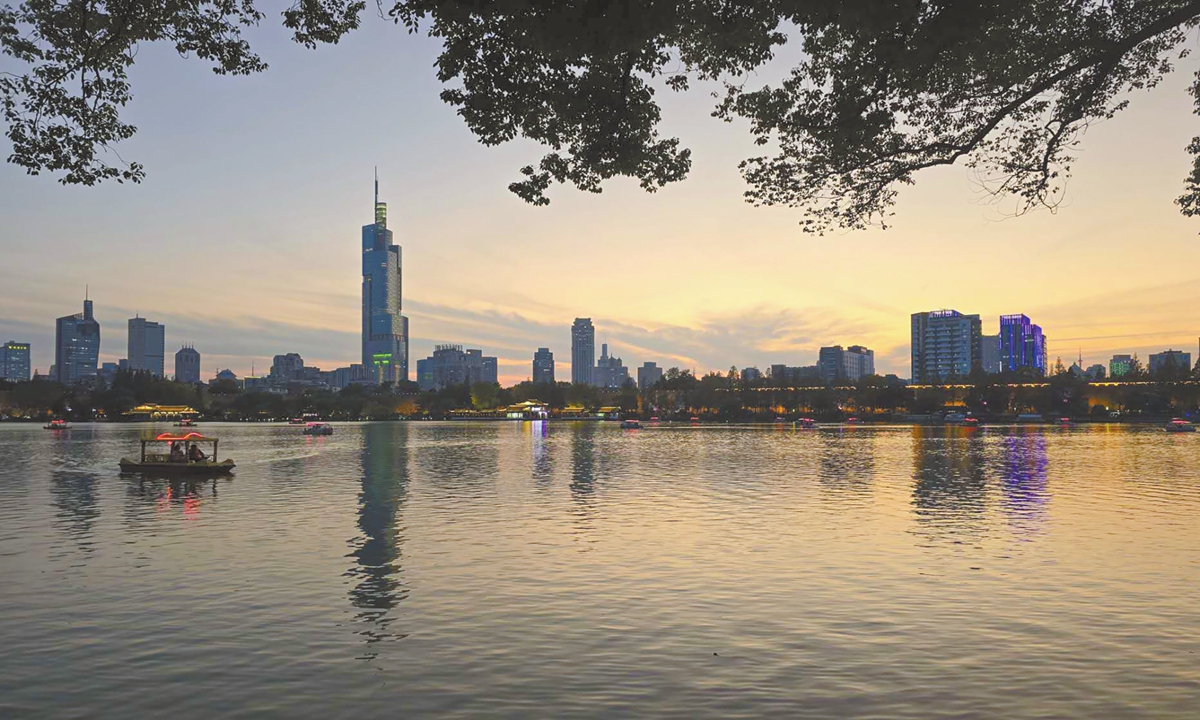
A sunset scene in Ningbo, Zhejiang Province Photo: Courtesy of Kocsis
Editor's Note:"China in Photos" is a series featuring foreign photographers who have explored China through their lenses. With cameras and curiosity, they capture the country's landscapes and people, revealing a China that is raw, intimate and deeply human. Each interview offers a unique perspective on China's diversity. Join us as we see China through their eyes.
In the fourth article of this series, Global Times (GT) reporter Wang Wenwen interviewed Hungarian writer and publisher Andras Kocsis (Kocsis) whose new photo album showcasing contemporary China was recently unveiled in Budapest. His connection to Chinese culture began in his childhood. A fan of Confucius, Kocsis believes that the insights and teachings of Confucius reflect eternal values and a positive outlook on life that also serve as guidance in our turbulent world today.
GT: Your photo album, titled China with a Hundred Faces, was published recently. Can you describe two or three of the 100 China faces that impress you the most through your lens?
Kocsis: Today's China is practically unknown to many ordinary people in Europe and other continents. China's rise in recent decades and the rapid growth of its international economic and political role are incomprehensible to many. It is a human habit to fear the unknown. The main goal of publishing this photo album was to make cultural differences a little more understandable and visible.
I have been waiting for a long time to see the magnificent and legendary Shanghai skyline from the top of one of the tallest buildings in the world. A Hungarian lecturer accompanied me to the top of the magnificent building. I was certainly moved by the majestic sight I encountered as the extremely fast elevator took me up. Knowing the international importance of Shanghai, it was good to look around and see the vibrant life of the city from above. It was an unforgettable sight and I took many photos.
Talking about another photo - since I was young, I have been extremely interested in the story of Admiral Zheng He, who discovered "half the world" before Christopher Columbus. I read with awe about his inventive imagination, with which he built the largest fleet in the world at the time. Between 1405 and 1433, he made seven great voyages of discovery with about 20,000 sailors. He concluded trade agreements without armed conflicts and eliminated the pirates of the region to ensure safe trade. His flagship was almost five times larger than Columbus' legendary Santa Maria. When I asked my Chinese colleagues about it in Nanjing, they said that we would go to the Treasure Ship Park that afternoon to see the 1:1 replica of the legendary ship and the statue of the admiral. With this, a youthful wish of mine could be fulfilled.
GT: How did your connection to Chinese culture begin?
Kocsis: My interest in Chinese culture began when I was in high school when I read a book about the history of the Great Wall. According to UNESCO, the more than 21,000-kilometer structure was built from the third century BC to the 17th century AD. Over the past millennia, China is the only continuous major power that has not disappeared into the abyss of history.
I met the internationally renowned sinologist Ferenc Tokei, and published his huge 10-volume work on Chinese literature, philosophy, ethics, aesthetics and economics. I am an economist-sociologist, so I am particularly interested in the book he wrote about the Asian mode of production. I learned a lot from him.
Chinese culture, which is about 5,000 years old, is completely unknowable, and it would take more than a lifetime to understand it. My relationships with Chinese publishers, which began nearly 20 years ago, bring me closer to understanding the culture of the country every day, and I am impressed by how determined the Chinese are. This determination plays an increasingly important role in our world today.
I think my Chinese friends need to learn and understand the behavior and customs of other cultures in the same way that we need to learn about the Chinese way of life and the still-perceptible effects of very ancient customs. I found many more common human values in China than differences, we just need to understand the thinking and customs of others. We have one world, and despite our differences, everyone's heart beats on the left side.
GT: You have been to many Chinese cities such as Beijing, Nanjing and some in Shandong Province. Can you tell me about your experience in these cities and what inspired you to visit and take photos of them?
Kocsis: I had the opportunity to visit several important Chinese cities. The size and population of these cities are almost incomprehensible to us. Hungary has a population of 10 million, which is two and a half times smaller than that of Shanghai or Beijing. I was impressed by the cleanliness of Nanjing, Ningbo and Shanghai; the streets were full of color, lined with plants and flowers. It was a good feeling to walk around, feel the safety of the city and see the nice smiling people. The problem I encountered was that I could not use my mobile phone to get online on the streets, because I did not have Wi-Fi. Many times, I asked someone on the street if they could help me get online. Every time the nice ladies and gentlemen were more than happy to assist me. These gestures do not occur often in other countries. Since I usually travel alone, these kind gestures mean a lot to me.
In my experience, these cities have some of the most modern cars in the world on the streets. It is a unique and very smart solution that electric cars are cheaper than vehicles running on gasoline or diesel! This also shows the differences in thinking. In Europe and overseas, the price of electric cars is significantly higher than that of cars running on traditional fuel. I was very pleased to note that the Chinese government is doing more and more to reduce environmental pollution.
GT: You have been to Qufu, the birthplace of Confucius. Each chapter of your photo album begins with a quote from Confucius. How do Confucius' thoughts guide your life and work, as well as your understanding of Chinese culture?
Kocsis: Confucius' moral and ethical guidelines, formulated more than 2,000 years ago, have become increasingly notable in European cultures in recent centuries. His insights and teachings reflect eternal values and a positive outlook on life that serve as guidance in our turbulent world today. He highlighted the role of communities and harmony, which in my opinion can be used as a kind of medicine in our often-disoriented world today. The most important idea and teaching is humanity and love for humanity, which is indispensable in today's world, torn by conflicts. "Do not do to others what you do not want done to you." He emphasizes the importance of the micro-community of society, the family and respect for the elderly, which means the continuity of generations. Respect, duty and continuous knowledge acquisition are also important to me as an individual goal. His thoughts span millennia, and his teachings exemplify eternal human values. It would be good if his moral and ethical teachings were reflected in every moment of our daily lives.
RELATED ARTICLES