China’s health official leads on-site response to Chikungunya outbreak in S. China’s Foshan
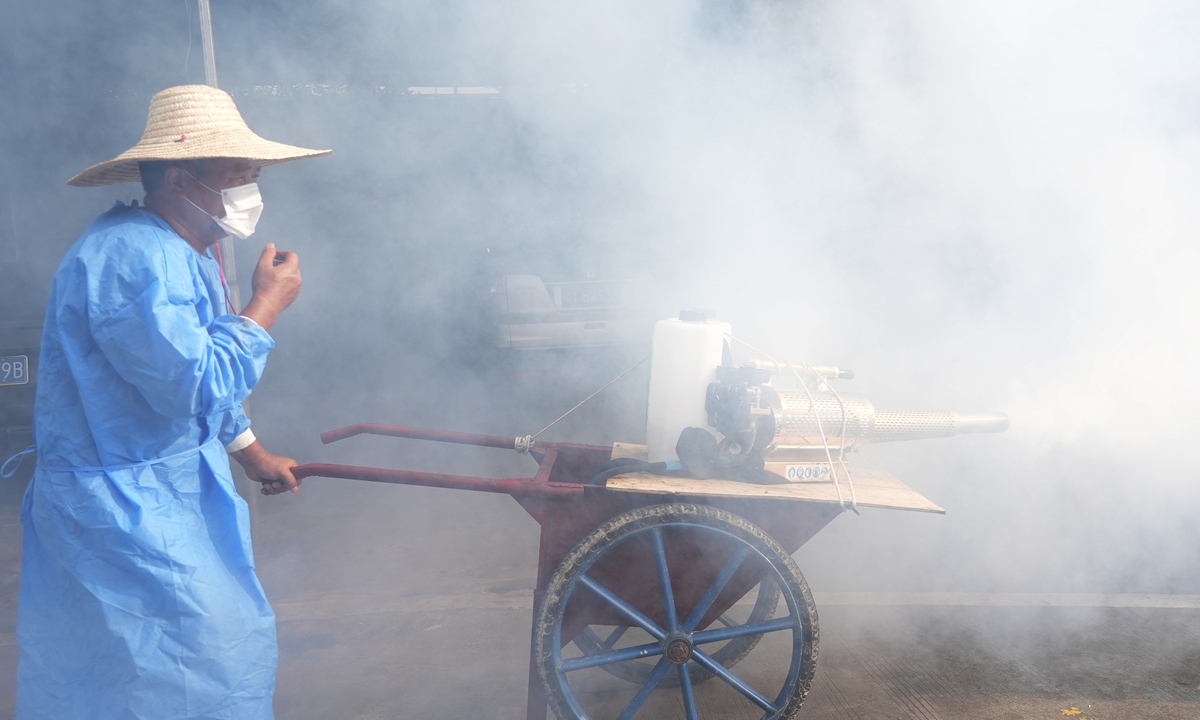
Sanitation workers in Foshan, South China's Guangdong Province conduct mosquito eradication work to combat the Chikungunya outbreak on July 29, 2025. Photo: VCG
Deputy Director of China's National Health Commission (NHC) Shen Hongbing led a team to Foshan in South China's Guangdong Province on Saturday to guide efforts to control the Chikungunya fever outbreak. He called for enhanced environmental sanitation, targeted disinfection of high-risk areas and thorough elimination of mosquito breeding sites to curb the spread of the virus.
Shen, also the head of the National Disease Control and Prevention Administration, visited Shunde district of Foshan to inspect mosquito control, environmental sanitation and public awareness efforts. He called for stricter grid-based management and stronger prevention measures.
From July 27 to Saturday, Guangdong has reported 2,892 new locally transmitted cases of chikungunya fever, with no severe or fatal cases reported. A total of 2,770 of the new cases were detected in Foshan and 65 in Guangzhou.
Shen stressed the need to contain the outbreak as quickly as possible to protect public health and maintain social stability. He urged stronger coordination across regions and departments, tighter control of key mosquito-borne transmission points and improved early warning systems.
He called for a flat and efficient command structure and a citywide effort to ensure all measures are implemented. Shen also urged continued patriotic health campaigns, regular mosquito control, stronger support for frontline efforts and public mobilization to eliminate standing water and maintain clean, tidy living environments.
A statement released Saturday evening on the official WeChat account of the Foshan government addressed the potential aftereffects of Chikungunya fever, providing residents with information on common symptoms, recovery timelines, and the importance of early treatment and mosquito control.
According to the statement, Chikungunya fever is an acute infectious disease transmitted by Aedes mosquitoes, with no specific cure. Infected individuals may experience high fever (over 39 C), severe joint pain and skin rashes. Some cases can develop into chronic conditions or serious complications.
The statement urged the public to use mosquito coils, hang mosquito nets and install window screens. It called on residents to remove standing water and clear trash, wear light-colored long-sleeved clothing when going out, and regularly apply mosquito repellent.
Previously, local officials across several cities in South China's Guangdong Province visited residential communities to support epidemic control efforts, China News Service reported in July. Measures included clearing and leveling vacant lots, removing standing water, disposing of garbage and using backpack sprayers for mosquito control.
However, according to observations and data from Guangdong's meteorological authorities, extremely heavy rainfall was recorded in parts of the province from the daytime of August 2 to the morning of August 3, local media reported.
The rain is expected to continue through August 5, with cumulative precipitation in areas such as eastern Guangdong and the southern Pearl River Delta potentially reaching up to 700 millimeters. Authorities have urged residents to take necessary precautions, said the report.
Wang Guangfa, a respiratory expert from Peking University First Hospital, told the Global Times on Sunday that during heavy rainfall, the chance of being bitten by mosquitoes is relatively low due to the intensity of the rain. However, after the rain, if standing water accumulates, mosquitoes can reproduce rapidly under favorable conditions of warmth and moisture, making post-rainfall the critical period for prevention and control, said Wang.
Commenting on the current outbreak, Wang said more than 4,000 cases have been reported nationwide so far. While the scale remains controllable given China's large population, he warned against complacency, noting that some countries have seen outbreaks surge to hundreds of thousands in a short time.
Wang went on to say that although Chikungunya fever rarely causes death, some patients may develop chronic symptoms like joint pain, which can reduce quality of life and raise medical costs. He stressed the need to stay alert and strengthen mosquito control and surveillance, especially in the hot and humid south.
"Guangdong has established an adaptive comprehensive mosquito-borne virus governance system amid rapid urbanization," said Lu Hongzhou, head of the Third People's Hospital of Shenzhen, in an interview with the Global Times.
"Driven by the recurrent outbreaks of diseases like dengue, the province has gradually built an integrated model of "monitoring response-community mobilization," which includes Al-driven real-time mosquito risk warnings, cross-border regional defense mechanisms, environmental management in high-risk areas like informal urban settlements (ie: "urban villages"), and public health education strategies involving community participation," Lu said.
Lu also noted that this governance experience not only proves the feasibility of interrupting vector transmission pathways in high-density urban environments but also provides a policy and practice template for developing countries similarly facing the dual pressures of urbanization and infectious diseases.
Hong Kong reported its first imported case of Chikungunya fever on Saturday, involving a 12-year-old boy who had recently stayed in Foshan, according to the Hong Kong local media Wen Wei Po.
From July 17 to 30, the boy and his mother traveled to Shunde, where he took part in outdoor activities and was bitten by mosquitoes, said the report.
After returning to Hong Kong on Wednesday, he developed symptoms including fever, rash and wrist joint pain. He visited a private doctor the following day and was referred to the emergency department of a local hospital.
Macao also reported its first locally transmitted case of Chikungunya fever on Friday, according to local health authorities. In a press release, the Macao Health Bureau said it received a case report on Friday and, following investigation, confirmed the infection was linked to a previously reported case involving an infected person notified earlier by the Chinese Mainland.
RELATED ARTICLES