Illustration: Liu Xidan/GT
The US government's broad tariffs and protectionist measures, as officials have repeatedly claimed, aim to safeguard domestic industries, including the vital US auto sector. However, mounting signs suggest these policies are increasingly harming, rather than bolstering, these industries.Rogelio Garza, president of the Mexican Auto Industry Association, warned that US auto tariffs on Mexico are "unsustainable," and US carmakers are ultimately losing out too, the Financial Times reported on Sunday. Garza said that this puts not only the Mexican auto industry at a disadvantage but the American and Canadian sectors as well.
Another Financial Times report said on Saturday that the so-called Big Three automakers in the US have forecast in recent weeks a combined $7 billion earnings hit from tariffs in 2025 - of which $1.5 billion involves Stellantis, $2 billion Ford and $3.5 billion General Motors.
Evidently, tariff barriers are sending shock waves throughout the entire North American automotive ecosystem, causing a "lose-lose" situation, and this predicament is no mere coincidence. Decades of deep integration between the US and Mexican auto industries have resulted in a highly interconnected and interdependent supply chain.
Mexico currently accounts for about 40 percent of the total auto parts imported by the US from around the globe, while a substantial portion of vehicles sold in the US market are assembled in Mexico.
This cross-border collaboration once facilitated optimal resource allocation and efficiency in production. However, the imposition of US tariffs, while ostensibly targeting foreign auto products, has plunged American manufacturers into a quagmire of parts shortages and skyrocketing production costs.
High tariffs may provide the American auto industry with a temporary "respite," offering a brief shield against external competitive pressures, but such protection is fragile and unsustainable. More troubling is the fact that these protectionist policies might be undermining - instead of boosting - the innovative drive of the US auto sector at a critical juncture.
As the global automotive landscape undergoes a rapid transformation toward electrification and digitalization, American automakers find themselves compelled to divert valuable financial resources and human capital to navigate supply chain disruptions, rather than channeling those investments into essential research and development initiatives. This jeopardizes the long-term competitiveness of the US auto industry in an increasingly dynamic and technologically advanced global market.
Fundamentally speaking, the challenge facing the US auto industry is not external competition but its own lagging transformation, and relying on protectionism is never a solution.
If the US fails to find a balance among technology, efficiency, and global cooperation, restoring its global competitiveness in the auto industry will be an uphill battle. It needs to actively pursue technological innovation, increase investments in critical areas such as battery technology and autonomous driving, and enhance production processes for greater efficiency. Furthermore, it is essential to cultivate healthy relationships within the industrial chain, collaborating with all partners, and optimizing resource allocation on a global scale to bolster competitiveness.
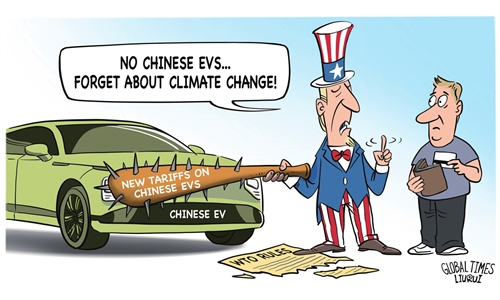
China's impressive advancements in electric vehicles (EVs) serve as a compelling counterpoint. Companies such as BYD and CATL have emerged as global leaders by excelling in competitive markets, while consistently innovating in battery technology, smart features, and manufacturing efficiency. Their success highlights a fundamental truth: it is technological advancement and market responsiveness, rather than tariff barriers, that drive automotive competitiveness.
With tariff and other protectionist measures, the US government has been relentless in its efforts to contain China's technological developments, including the Chinese EV industry, to preserve its previous dominance in relevant industries. However, in today's intricate global economic and technological landscape, no country can surpass others by adopting protectionist policies. Innovation and win-win cooperation are essential for businesses to stay competitive globally.
RELATED ARTICLES