AI Photo: VCG
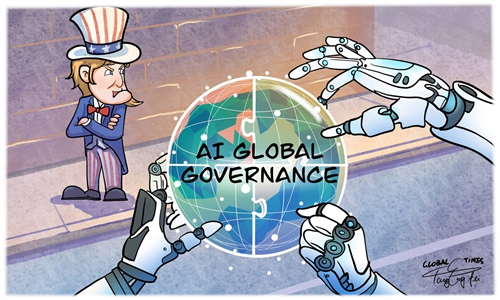
Building on President Xi Jinping's 2023 proposal for the Global AI Governance Initiative, the Chinese government has now called for the creation of a global AI cooperation organization.
On July 26, 2025, Premier Li Qiang announced the proposal during his address at the opening ceremony of the 2025 World AI Conference and High-Level Meeting on Global AI Governance, a three-day event themed "Global Solidarity in the AI Era."
China's call comes amid intensifying competition among the US, EU and UK, at a time when global efforts to regulate AI remain fragmented. There is a shared international interest in addressing existential risks posed by AI.
A broad societal consensus on how to strike a sustainable balance between technological advancement and security is needed. As AI becomes embedded in critical aspects of daily life, societies face the dual challenge of fostering innovation while managing complex risks.
Addressing these challenges requires inclusive dialogue among governments, industry leaders, researchers and civil society. The goal must be to ensure AI develops responsibly, ethically, and in alignment with the public interest and global stability. There is increasing recognition that AI governance must follow a more multipolar trajectory. A balanced approach is crucial to prevent any single bloc from shaping the future of this transformative technology.
China envisions the proposed organization as a comprehensive, inclusive platform for international AI cooperation, aiming to foster broad-based participation that reflects the diverse priorities of nations across the globe. A key objective is to address the growing "AI divide" - the technological gap between advanced economies and developing nations.
The initiative emphasizes pragmatic, action-oriented collaboration to translate shared objectives into tangible outcomes. China seeks to unite nations to promote innovation, share technological expertise and coordinate AI-related policies.
The proposed organization would also work to unlock the transformative potential of AI across sectors such as healthcare, education, agriculture and industry. China hopes this will catalyse more equitable global development, fostering inclusive growth, shared prosperity and stability in an increasingly interconnected digital world.
For decades, the West has disproportionately benefited from technological progress. However, the emergence of China, India, Singapore and other innovation-driven Global South countries is beginning to challenge this status quo.
Now is the time for the international community to align efforts toward establishing a robust, consensus-based framework for global AI governance that equitably serves the interests of all nations.
China is taking the lead by inviting interested countries to participate in shaping the proposed organization's structure and agenda, and reaffirming its commitment to advancing both multilateral and bilateral cooperation.
China's growing confidence in its AI capabilities including large language models, facial recognition and industrial applications positions it as a credible leader in this arena.
China is also offering to share its technologies, resources and insights with the international community, positioning itself as a partner in equitable development and as a counterbalance to Western dominance in AI.
Its support for open-source development reflects a commitment to shared growth over control and profit, demonstrating a willingness to empower other countries.
China has consistently promoted international cooperation in both software and hardware technologies, recognizing that addressing global AI challenges requires collective action.
This strategy aligns with China's broader vision of inclusive technological growth. It emphasizes key principles such as "AI for good," fairness, respect for national sovereignty and the development of non-discriminatory global standards.
Can a truly inclusive AI governance framework be built in a deeply divided geopolitical landscape? China's approach is gaining traction, particularly among Global South nations, which view China as a transparent and reliable partner.
China believes that by providing access to advanced AI tools, it can forge stronger political and economic ties through technology-driven diplomacy. In contrast, many Western powers favor restricting AI access to preserve strategic advantage and profit through technological concentration.
As the AI race accelerates, the architecture of global technology governance is undergoing a profound transformation. China's latest proposal is more than a call for cooperation - it is a strategic move to shape how AI is regulated, applied and understood globally.
The author is director of BRISL, an independent & pioneering Sri Lankan-led organization, with strong expertise in BRI advice and support. opinion@globaltimes.com.cn
RELATED ARTICLES