Illustration: Chen Xia/GT
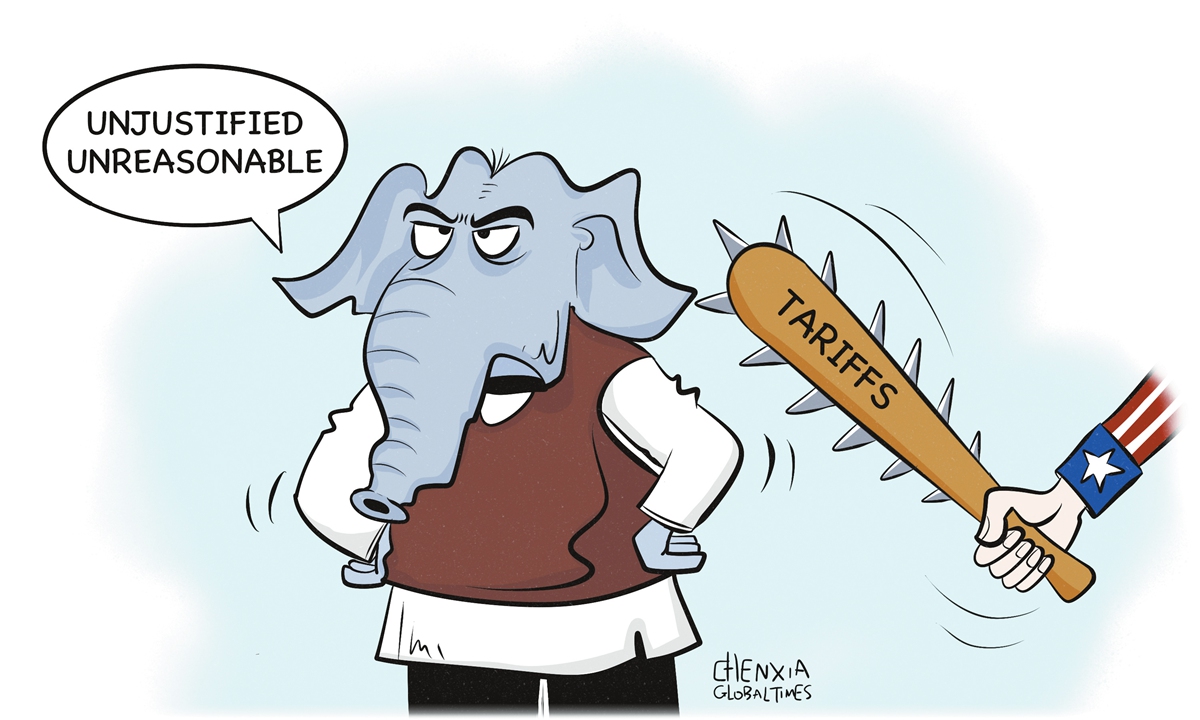
Once warm and thriving, the US-India relationship is now taking a dramatic nosedive. On Monday local time, after a string of tariff threats, Washington once again vowed to raise tariffs on India over Russian oil purchases. India hit back on the same day, saying that "the targeting of India is unjustified and unreasonable," and that the country will "take all necessary measures to safeguard its national interests and economic security." This diplomatic chill is more than a mere trade spat - it underscores a collision between unilateral hegemony and a nation's pursuit of strategic autonomy or diplomatic balancing.
The turnaround feels abrupt. Just back in February, Indian Prime Minister Modi was warmly embraced by the US president, hailed as a “great friend.” Yet months later, trade talks collapsed, and the once-promising rapport between India and the US quickly unraveled.
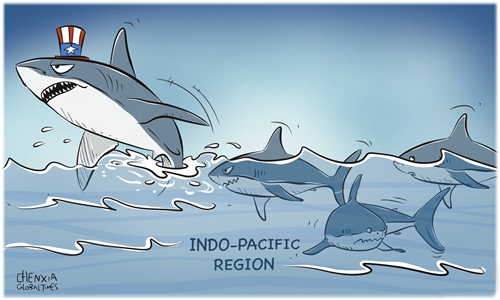
By the end of July, US announced a 25 percent tariff on goods from India, plus an additional import tax because of the country's purchasing of Russian oil. Since then, the US has been steadily piling pressure on India. On August 3, Stephen Miller, deputy chief of staff at the White House, said the US president has made it clear that India’s ongoing oil purchases from Russia to finance Russia-Ukraine war are unacceptable. Reuters said the criticism was some of the strongest yet by the current US administration about one of Washington’s major partners in the “Indo-Pacific.”
During this period, sources from the Indian side noted India will keep purchasing oil from Russia as “these are long-term oil contracts,” and that it’s “not so simple to just stop buying overnight.” Then comes the US-India tariff standoff on Monday, as mentioned at the beginning of the article.
How did US-India ties reach this point? Observers suggest that India's reluctance to open its market further to American agricultural products, in order to protect its local farmers, has stalled the US-India trade agreement. In response, the US government has adopted a strategy of leveraging India's energy ties with Russia as a pressure point, aiming to compel India to compromise. At the same time, since direct US economic pressure on Russia is limited by their small trade volume, Washington is now targeting New Delhi's close ties with Moscow to achieve two goals: punishing India while containing Russia.
Facing Washington's relentless pressure, the Indian Ministry of External Affairs pushed back by issuing a statement, condemning the US and Europe for their flip-flopping in trade-related issues and blatant double standards against India.
In summary, the statement argues that to ensure stable international energy supplies, the US initially encouraged India to buy Russian oil and that India's purchase of cheaper Russian oil serves its own interests. Meanwhile, those criticizing India, including the EU and the US, are themselves deeply involved in trading with Russia, so what right do they have to point fingers at India?
Is India's "mistake" really buying Russian oil, or simply not following US' orders? Behind this tariff battle lies a harsh reminder - India can be a "great friend," but only on the condition that it stays obedient. The moment India fails to meet US' strategic expectations, it instantly becomes expendable. Perhaps, to the US, India may have never been a guest at the table - only an item on the menu.
In recent years, India has tried to maintain strategic balance in geopolitics: joining BRICS and the Shanghai Cooperation Organisation to call for a multipolar world, while simultaneously deepening zero-sum security cooperation with the US, Japan, and Australia in the “Indo-Pacific.” This balancing act has offered India considerable diplomatic maneuvering room. But this strategy now clearly faces a harsh reality check - US' stubborn commitment to unilateral hegemony. What this reflects is a dangerous trend: with the US reviving Cold War-style bloc confrontations, "not taking a side" is equated with "picking the wrong side," and "neutrality" is seen as "disloyal."
In this direct clash between economic hegemony and strategic autonomy, what will happen next? At the very least, some Indians are beginning to see clearly: what they once believed to be a special relationship was nothing more than a one-sided illusion, and that relying on a hegemon who readily wields the stick and prefers coercion over dialogue can never bring true security or room to grow.
The opportunities ahead lie in steadfastly charting one's own course and in a multipolar world grounded in mutual respect, shared benefits, and win-win cooperation.
RELATED ARTICLES