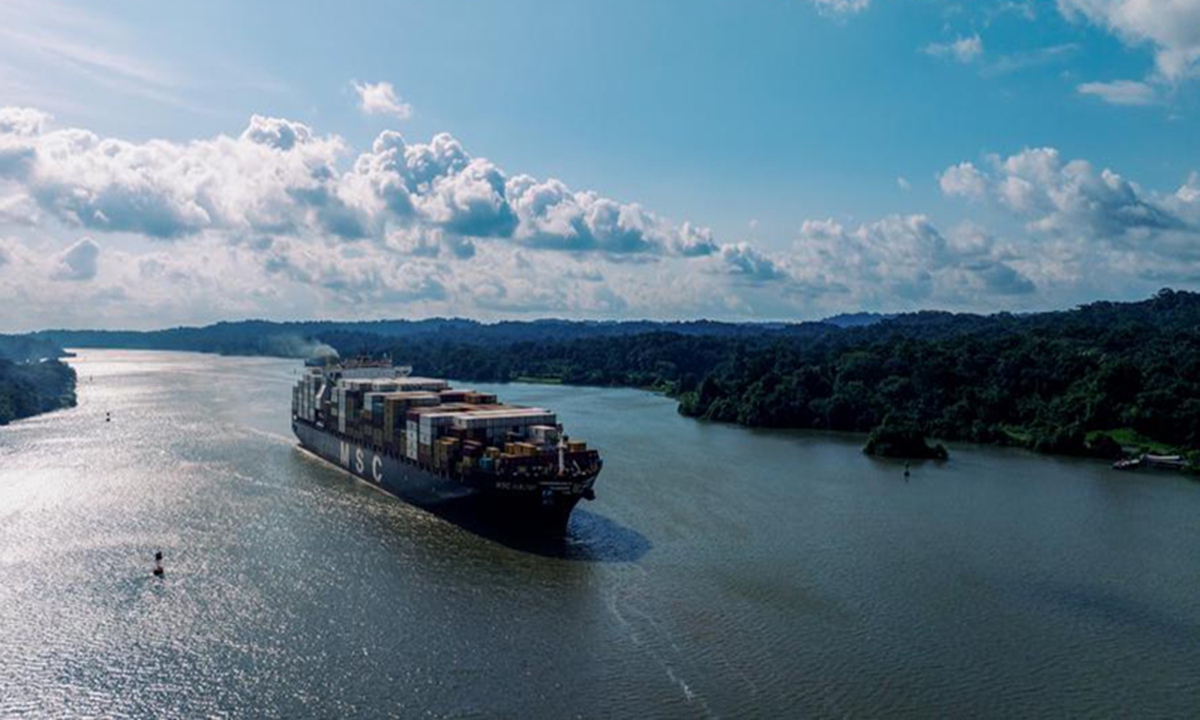
A drone photo shows a cargo vessel sailing on the Panama Canal near Panama City, Panama, Aug. 28, 2024. (Xinhua/Li Muzi)
Over 60 years ago, when American expats lowered the Panamanian flag in a 10-mile-wide strip of land in Panama known as the US-controlled Canal Zone, grievances against these foreign intruders boiled over into a string of anti-American demonstrations.
Today, the call for "no US interference" is again growing louder among the Panamanian people who are indignant at the latest US moves.
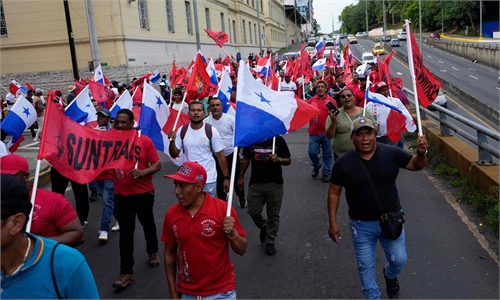
Since last December, the US has repeatedly threatened to "take back" the Panama Canal, which it had controlled for almost 85 years until Panama's full sovereignty in 1999, even floating the possibility of military intervention. Unsurprisingly, these outrageous remarks were soon met with strong local protests across Panama.
In April, teachers were the first to take to the streets, and were later joined by students, nurses, banana plantation laborers, construction workers and indigenous communities. The protests persisted across the country against the Panamanian government's perceived capitulation to Washington.
Public resentment reached its culmination when the government signed an agreement with Washington, allowing US military personnel to rotate on bases around the canal for training purposes.
The Panamanian people's anger was further fueled by the US' subsequent request for the free passage of its military and commercial vessels through the inter-oceanic route, which is another step toward full US control over the canal.
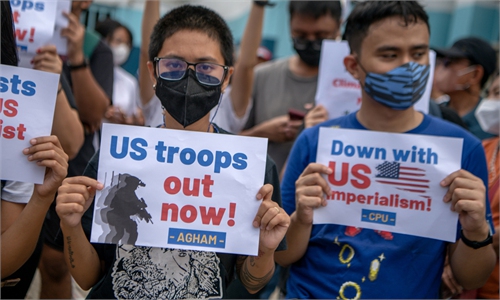
Recent drills between the US military and local Panamanian security forces again sparked demonstrations from trade unions and civil organizations, as the joint exercises are long viewed by local critics as a prelude to foreign military presence and a blow to the neutrality of the maritime artery.
The Panamanian people's antipathy has a legitimate basis. The uprising in the 1960s, honored annually as Martyrs' Day in Panama, laid the groundwork for the abolition of the original 1903 treaty and the signing of two treaties that set the country on a thriving course.
Among the two monumental treaties between the US and Panama, one is the Panama Canal Treaty, which allowed the conflict-torn country to take back its own canal from the US in 1999. The other one is the Neutrality Treaty, which states clearly in its Article 5 that "only the Republic of Panama shall...maintain military forces, defense sites and military installations within its national territory."
Undoubtedly, the US' military presence and use of local military bases is a grave violation of the treaty, and a betrayal of the US commitment to the Panamanian people who fought to keep their country intact throughout the 20th century. On America's mind are its own interests - "America First," and nothing else.
The canal handles around 40 percent of US container traffic and 5 percent of seaborne trade in the world. The free passage of US commercial vessels will put a large sum of money in American pockets. The smooth transit will also allow the US Navy to swiftly transfer vessels between the Atlantic and the Pacific.
The US serves its own geopolitical agenda and solves its headache of immigration, while Panama in return receives nothing but increasing foreign intervention, economic losses and simmering tensions at home.
Opposing Washington comes with risks - Panama knows this all too well. The US invasion in 1989, launched under the pretext of America's War on Drugs, remains an open wound in the national psyche. Now, with growing US military deployments near the Canal, many fear that history may repeat itself should Panama dare to defy its powerful neighbor.
America's military drills and presence in Panama's military bases are a victory of the US "do-as-I-say tactic" and an ill omen of foreign military invasion.
Panama's veins are again cut open by the US. The Panamanian government and people are bleeding while the US is licking the blood off its blade.
The author is a commentator on international affairs, writing regularly for Xinhua News Agency, Global Times, China Daily, CGTN etc. He can be reached at xinping604@gmail.com.
RELATED ARTICLES