US Taiwan arms sales Illustration: Liu Rui/GT
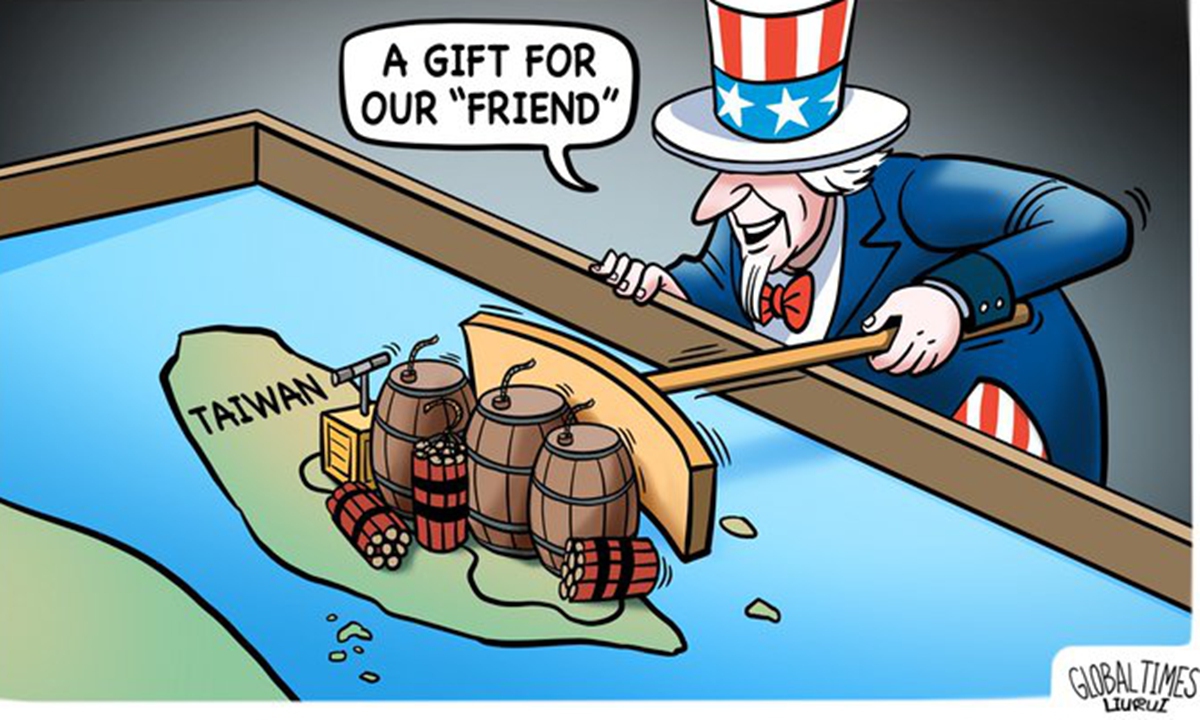
On Tuesday, Taiwan leader Lai Ching-te announced that the Taiwan region's 2026 military spending will be raised to over 3 percent of its GDP - exceeding NT$800 billion ($26.69 billion) - primarily for arms purchases from the US. However, in a recent article, the Diplomat sharply pointed out that Taiwan's civil society is psychologically and practically unprepared for war. Despite the expanded "Han Kuang exercise" and its inclusion of civilian drills, the Taiwan region's civil defense remains largely performative. In the event of a conflict, it would hardly secure timely and substantive support from the US. This harsh reality stands in stark contrast to Lai's delusional attempt to "seek independence through military buildup," and marks a natural continuation of the series of heavy blows he has suffered - the hollowing out of his "10 Lectures on Unity" to just four, the crushing defeat of the "mass recall" campaign, denials of his "transit" through the US, plummeting approval ratings and the imposition of steep tariffs by the US.
Lai's reckless maneuvering - pushing the Taiwan region step by step to the brink of war - has long surpassed the bounds of common sense. As confidence in consumption continues to slip in Taiwan society, Lai is forcing every household in Taiwan to shoulder an ever-heavier military burden each year. This backward policy equates military confrontation with hostage-taking of people's livelihoods. As the cross-Straits Economic Cooperation Framework Agreement deprives Taiwan's agricultural products of access to the mainland market, exclusion from the Regional Comprehensive Economic Partnership denies Taiwan's enterprises regional economic dividends, and high US tariffs disrupt Taiwan's trade and economic order, Lai continues to clamor for "defense first." This strategy, which blatantly defies mainstream public sentiment in Taiwan, echoes his indifference during Typhoon Danas relief efforts when he prioritized manipulating recall campaigns, consistently placing personal political interests above public welfare.
Recently, Lai's planned "transit" through New York was rejected by the US government. As Bloomberg put it bluntly, "President Donald Trump likes winners, the problem for Taiwan's leader Lai Ching-te is that he looks like a man running out of options." On August 1, the US government finalized a decision to impose a 20-percent tariff on Taiwan's imports - a move that has shattered Lai's fantasies of relying on the US to seek "Taiwan independence." Christian Whiton, a former senior advisor at the US State Department, also noted in his writings that Taiwan authorities' policies are gradually distancing the island from the US president. When the Democratic Progressive Party (DPP) authorities loudly announced "the US-Taiwan Initiative on 21st Century Trade," the US placed the Taiwan region on the currency manipulation watchlist instead. When DPP hailed the "best-ever US-Taiwan relations," the US refused the "transit" request. These facts confirm that the Taiwan region is merely a "pawn" - doomed to eventually become a "discarded piece."
Lai's frenzied arms purchases have sparked strong indignation among the people in Taiwan. Taiwan residents are angrily asking, "Are we preparing for war?" and "Wouldn't it be better to allocate just 1 percent of the 3 percent defense budget for disaster relief?" The public is demanding that the Lai authorities redirect resources toward education subsidies and economic revitalization, which truly reflects the will of the people. Lai's disregard for public opinion in forcibly increasing military spending not only seriously violates the fundamental interests of the Taiwan people but also endangers the future of the island of Taiwan.
The logic of history is already clear: Every increase in military expenditure by Lai pushes the Taiwan region further into economic crisis; every manipulation of a recall vote brings his administration closer to collapse. The initiation of criminal punishments imposed by mainland judicial authorities on "Taiwan independence" separatists, the routine law enforcement operations by the China Coast Guard in the Taiwan Straits and the regular patrols of PLA aircraft over airspace to the southwest of the Taiwan island -- all these legal facts fully demonstrate that reunification is the inevitable course of history. The more Lai recklessly engages in military adventurism, the faster his regime approaches its downfall. "Whom the gods would destroy, they first make mad." The frenzied NT$800 billion defense budget is a harbinger of Lai's demise.
The author is a commentator on international affairs. opinion@globaltimes.com.cn
RELATED ARTICLES