As China and US walk on separate paths on AI devt, whose approach is truly ‘open’?
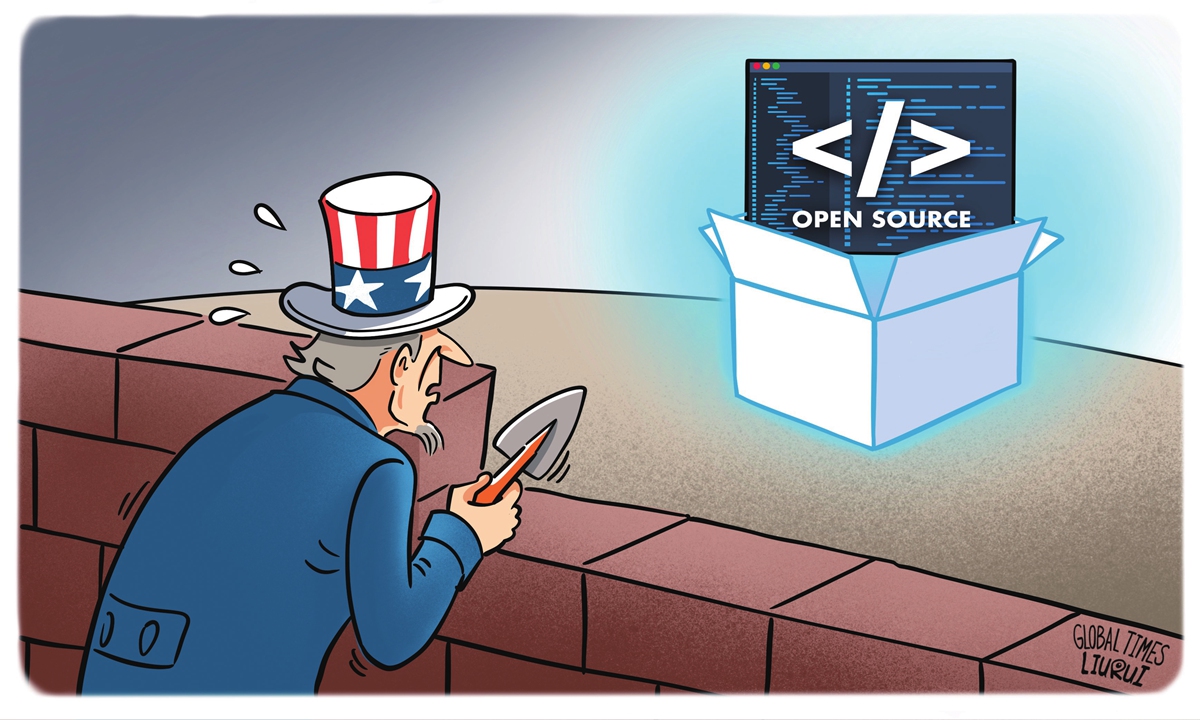
Illustration: Liu Rui/GT
OpenAI's release of two open-source large language models on Tuesday has sparked global attention. Many media outlets interpreted it as a direct response to the challenge posed by rivals, including China's AI company DeepSeek, once again thrusting the China-US AI competition into the spotlight. However, the two countries are pursuing starkly different paths in AI development, reflecting fundamental differences in governance philosophy between the two countries.
Recently, the US government has accelerated its global AI agenda through both policy and diplomacy. Why the urgency? At its core, this reflects Washington's strategic anxiety. On one hand, Chinese AI products like DeepSeek - which boast high performance and low inference costs - are gaining recognition and adoption globally, eroding US leadership in AI. On the other hand, the US understands that many economies are still in the early stages of building their AI ecosystems, from infrastructure and chips to models and applications. This leaves a critical window for the US to dominate the market.
However, this urgency exposes the geopolitical nature of US' so-called "openness." While touting the open and cooperative sides of its AI exports, the US simultaneously views Chinese competitors as "security threats." On the very day OpenAI released its new models, a group of seven Republican senators called on the US Commerce Department to investigate potential "data security vulnerabilities" posed by Chinese open-source models like DeepSeek, Reuters reported. Rather than a genuine concern for "national security," such a move reflects deeper fears over losing global technological influence.
While the US scrambles to secure its AI market position, China is advancing its AI ecosystem at its own pace. The efforts can be found in tech giants, such as Huawei, which announced the full open-source release of its Ascend AI hardware enablement framework, known as CANN, alongside a co-development initiative, on Tuesday.
On a broader scale, at the recently concluded 2025 World Artificial Intelligence Conference and High-Level Meeting on Global AI Governance in Shanghai, over 3,000 cutting-edge products were showcased to present diverse application scenarios of AI. It also saw the launch of the International Open Source AI Cooperation Initiative and the establishment of the Center for Global AI Innovation Governance.
This brings us to the key question: Both China and the US speak of the "openness" of AI, but are they talking about the same thing?
For the US, AI "openness" is primarily market-oriented - it means allowing other countries to adopt and integrate US-built AI tools. Whether by attracting foreign AI talent or exporting US technology stacks, the end result often entails absorption by US tech giants or the establishment of new technological monopolies. This pattern is evident in past US tech exports.
China's version of AI "openness," by contrast, emphasizes inclusiveness and public benefit. Its approach to AI development stresses the principle of "AI for good," aiming to make AI a global public good rather than a tool of a few wealthy nations or powerful tech conglomerates. China's "openness" encompasses not just technical sharing, but also ecosystem collaboration, capacity building and even value alignment.
As we examine this divergence over what "openness" truly means in AI, it becomes clear that this is no longer just a technology race between China and the US. It is a contest between two development philosophies and two governance models. The US follows a hierarchical model - "we lead, you adopt," while China embraces a networked model - "we enable, you co-build."
Ultimately, whose version of "openness" better reflects the spirit of our time? Whose path injects more genuine innovation into the global AI landscape?
These are questions that will be answered by developers, users and policymakers around the world.
RELATED ARTICLES