China to waive kindergarten fees for final year, benefiting 12 million children this fall
By and Published: Aug 07, 2025 11:15 AM


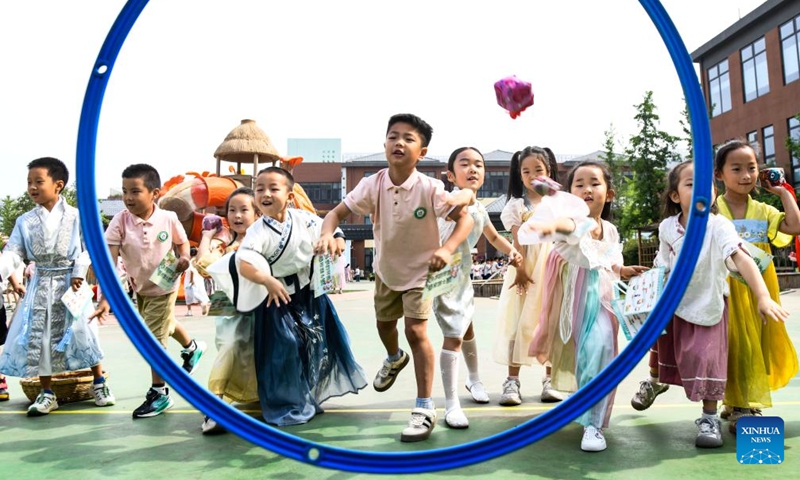
Children play a traditional game of "stoning the five pests" during a celebration of the Dragon Boat Festival at a kindergarten in Jiyuan City, central China's Henan province, May 30, 2025. Photo: Xinhua
As part of broader efforts to reduce the financial burden of education and enhance public education services, China will waive kindergarten tuition fees for all senior-class students, which is expected to benefit 12 million children this autumn semester while reducing household expenditures by 20 billion yuan ($2.78 billion), Vice Finance Minister Guo Tingting announced at a press conference on Thursday.The proportion of nursery education fees in the total preschool education expenditure of families is relatively high. After the fees are waived, the education expenditure of families will be effectively reduced. This autumn semester alone, national finance will increase its expenditure by 20 billion yuan, and families' expenditure will be reduced by 20 billion yuan accordingly, according to the press conference.
On Tuesday, China announced the phased exemption of care and education fees for children in their final year of kindergartens, which follows a commitment that China had made during its annual legislative session earlier this year to gradually implement free preschool education nationwide, according to the Xinhua News Agency.
Chinese education experts told the Global Times on Thursday that the nationwide implementation of free preschool education will significantly contribute to creating a childbearing-friendly society. This policy will require local governments to increase education funding, thereby establishing the necessary foundation for developing a preschool education system characterized by affordability, high quality, balanced resources, equity and safety.
At Thursday press conference, Chinese officials introduced that the funding for the fee waiver will be jointly shared by central and local governments, with the central government covering the majority and prioritizing central and western regions. Local authorities will coordinate central subsidies and their own fiscal resources to ensure timely and full disbursement, guaranteeing the smooth implementation of this pro-people policy.
According to Guo, the waiver will follow the fee standards set by local authorities for public kindergartens as outlined in the State Council's guidelines.
Specifically, for public kindergartens, the full amount previously charged will now be waived.
For children enrolled in private kindergartens approved by education authorities, the waiver will match the standard of comparable public kindergartens in the same locality, with families paying only the difference.
For example, if a private kindergarten charges 800 yuan per child per month while the equivalent public kindergarten charges 500 yuan, after the policy takes effect, families with children in public kindergartens will pay nothing, while those in private kindergartens will only pay the 300 yuan difference.
A mother surnamed Song of a 4-year-old child said she could feel the government's strong efforts to gradually implement free preschool education after seeing the latest policy. She told the Global Times on Thursday that the costs of attending a public kindergarten typically consist of two main fees: childcare and meals — about 900 yuan per month for childcare and 28 yuan per day for meals. Based on this, she estimates that she could save around 8,000 yuan over a 9-month school year.
"This policy is quite practical. I'm looking forward to seeing more family-friendly policies," Song said.
Chinese education experts believe, if following the model of the nine-year free compulsory education system, the free preschool education policy will advance in depth with progressively intensified efforts and expanded coverage.
Regarding when full three-year tuition-free preschool education can be achieved, Chu Zhaohui, a research fellow at the National Institute of Education Sciences, told the Global Times on Thursday that it will require a gradual process.
He stressed that with the formal implementation of the Preschool Education Law on June 1, local governments must clarify their legal obligations and implementation measures, recognizing preschool education as a "non-negotiable responsibility." Planning must account for local realities, avoiding a one-size-fits-all approach.
"Free preschool education does not mean lower-quality 'welfare' but higher standards for child development," Chu said, highlighting concurrent needs to address teacher's payment and regulatory gaps.
Combined with existing 0-3 years childcare subsidies and other policies, the implementation of free preschool education will effectively help alleviate family costs, constituting a crucial component of proactive population policies, Xiong Bingqi, director of the 21st Century Education Research Institute, told the Global Times on Thursday.
Meanwhile, the expert pointed out that while central and local governments are allocating funds, this only transfers payment responsibility from parents to governments without changing the fundamental landscape - quality disparities between urban and rural areas and among kindergartens persist.
To genuinely narrow regional gaps and provide quality preschool education for rural children, Xiong emphasized that the country should substantially increase investment, fully implement the Preschool Education Law, improve teacher's income and enhance school facilities.
According to Xinhua, on July 26, China emphasized the need to expand preschool infrastructure, raise the salaries and welfare of kindergarten teachers, and improve support for children's physical and mental well-being.
Xiong also highlighted a comprehensive set of measures to encourage young people's willingness is needed.
To tackle demographic challenges, China has been steadily loosening its family planning policies over the past decade and taken concrete steps to construct a birth-friendly society with improved hospitals, child education and care institutions and workplaces, and with appropriate financial and policy support for families with children, Xinhua reported on Tuesday.
Last week, China introduced a nationwide child care subsidy program slated to begin in 2025, which will provide families with an annual subsidy of 3,600 yuan for each child under the age of 3, the report said.
Chen Xingyu contributed to this story.
RELATED ARTICLES