World Games kicks off in Chengdu, highlighting 'unifying power of sport'
China's peaceful foreign policy, stability make it ideal for international events: expert
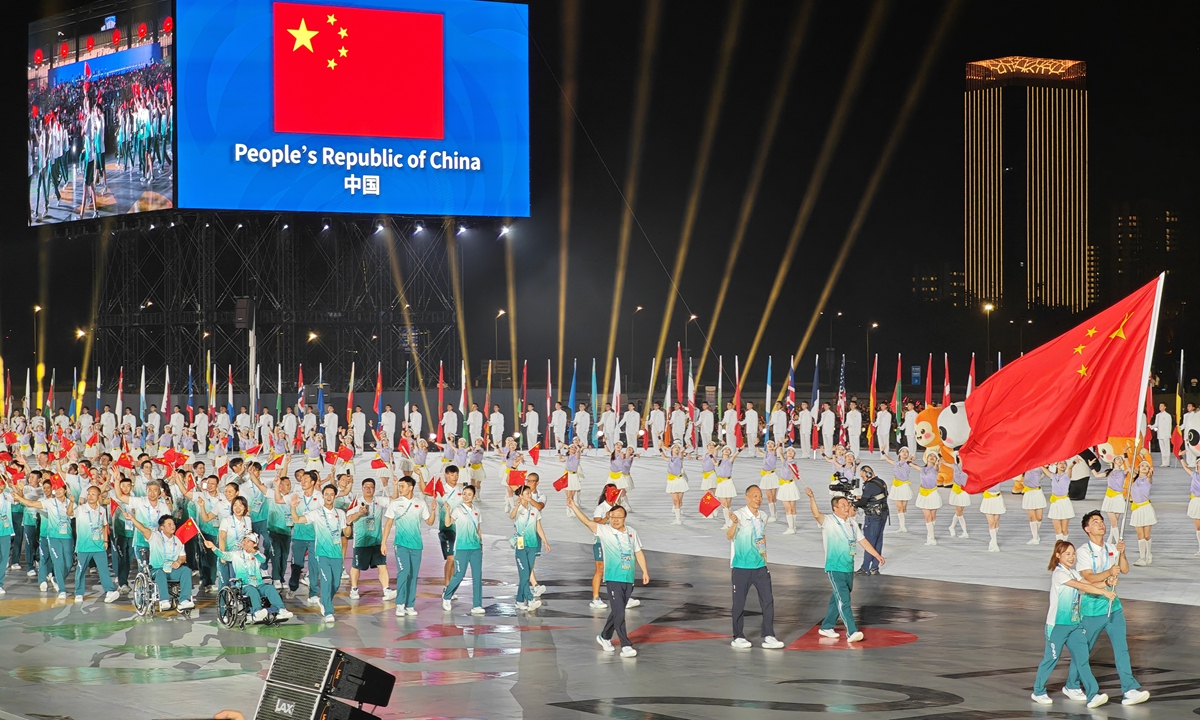
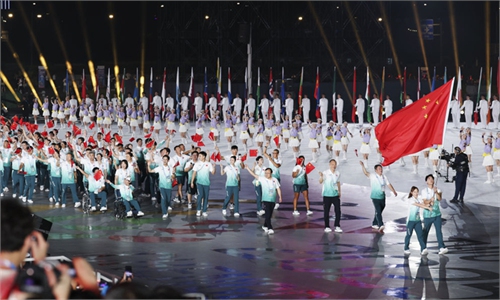
Athletes and officials from the Chinese delegation parade with gymnast Shi Jingwei and roller skater Guo Dan serving as flagbearers at the opening ceremony of the Chengdu 2025 World Games on August 7, 2025 in Chengdu, Southwest China's Sichuan Province. Photo: cnsphoto
The 12th World Games commenced on Thursday with a spectacular opening ceremony in Chengdu, the capital of Southwest China's Sichuan Province. As the fifth international multi-sport event hosted in China since 2022, the Chengdu World Games transcends athletics, fostering cultural exchange and mutual understanding, analysts said.
Chinese State Councilor Shen Yiqin declared the 12th edition of the World Games open, Xinhua News Agency reported.
International Olympic Committee (IOC) President Kirsty Coventry expressed in a video message to the opening ceremony that athletes embody the unifying power of sport across cultures and boundaries and expressed her wish to be present with them that evening, according to Xinhua.
Unlike the traditional practice of holding opening ceremonies in sports stadiums, the Chengdu World Games opted for the outdoor ground of the Tianfu International Conference Center.
One highlight of the opening ceremony was that the cauldron of the Games was set in the water in neighboring Qinhuang Lake as two watersurfers lit it with the green-silver torch Zhu Meng, or "Bamboo Dream." The flame soared from the water in a spectacular fusion of fire and water, as the cauldron burst into a fountain-like blaze.
Another highlight was the 408.5-meter-long and 26.7-meter-wide roof slope of the conference center, which turned out to be a giant LED screen that gave the audience a spectacular visual show.
Along with the melody of Jasmine Flower, the Chinese delegation entered the parade venue to enthusiastic cheers and applause from the crowd. Veteran athlete Guo Dan, who won gold in roller skating at the 2013 World Games before switching to speed skating to represent China at the 2018 and 2022 Winter Olympics, served as a flagbearer alongside gymnast Shi Jingwei for the Chinese delegation.
The Chinese delegation consists of 489 members, including 321 athletes who will compete in 28 sports and 152 events.
This marks the largest and most wide-ranging participation by China in the history of the World Games. Notably, it is also the first time that China has included para-athletes in its delegation.
The Chengdu World Games, which will last until August 17, features 34 main events, most of which are non-Olympic sports, including drone racing. Events such as para-jujitsu and para-diving are designed for athletes with disabilities.
Sports such as breaking, archery, sport climbing, flag football, softball, lacrosse, and squash are also part of the official program for the 2028 Olympics.
A total of 6,679 participants, including athletes, team officials, and technical staff from 116 countries and regions, are taking part in the Games. Of those, 3,942 are athletes, making this the largest and most well-attended edition in the history of the World Games.
This marks the first time the World Games has been held in a Chinese mainland city, following the 2009 edition hosted in Taipei, China's Taiwan region.
Impressive and impactful
Chengdu, which won the 2025 World Games bid in 2019, has also hosted the 2023 Summer World University Games as well as several single-sport events such as the table tennis team world championships in 2022 and badminton Thomas & Uber Cup in 2024.
It also made history by hosting the first ever torch relay of the World Games on July 26.
The route was designed to connect key landmarks of the local Bashu culture of Sanxingdui, the Jinsha archaeological site and Wuhou Shrine, integrating the sporting spectacle with the region's rich cultural heritage.
"The introduction of the first-ever torch relay for the World Games is a strong sign of the organizing committee's commitment to elevating the event's global profile," said Tom Dielen, vice president of the International World Games Association (IWGA), at a press conference Thursday.
Wang Dazhao, a veteran Beijing-based sports commentator, also noted to the Global Times the significance of cultural exchange in sports events.
"Cultural exchange is an essential part of hosting multi-sport events but previously this part was overshadowed by our athletic achievements," Wang told the Global Times. "Hosting such an international sports event also spreads the idea of peace to this world."
The Chengdu Games' emblem and mascots were thoughtfully designed to reflect the region's rich cultural heritage and unique natural beauty.
The mascots "Shubao" and "Jinzi" are inspired by Shu brocade, one of China's four most famous traditional silk fabrics, and are modeled after the iconic giant panda and Sichuan golden snub-nosed monkey.
The medals, titled "Zhu Guang", which means "Bamboo Light," feature the image of the ancient sunbird. The torch draws design inspiration from bamboo and bronze motifs.
By fusing local heritage with global values, the Games also spotlights athletes who embody the spirit of cultural integration and competitive excellence.
Among them is Paris Olympic breakdance bronze medalist Liu Qingyi, better known by her stage name B-Girl 671.
"Competitive events are very important to us [breakdance competitors] because street dance itself emphasizes constant competition and confrontation," Liu, now 19, said at a press conference on Thursday.
"By integrating with cultures from around the world, each dancer can deepen their own understanding and enrich their inner world. This cultural fusion helps street dance evolve and flourish."
Impressive and impactful
The Chengdu World Games is the fifth major international multi-sport events to be held in China, following the Beijing 2022 Winter Olympics, Chengdu World University Games and Hangzhou Asian Games in 2023 as well as Harbin Asian Winter Games earlier this year.
Jose Perurena, president of the International World Games Association (IWGA), lauded Chengdu's efforts in hosting the World Games, describing the city's preparations as both impressive and impactful.
"The sense of anticipation among the athletes is every bit as strong as my own," Perurena told the Global Times. "Creating excitement for an event of this scale in such a vast metropolis is no small feat."
He highlighted the remarkable visibility of the Games across the city, noting, "From video screens in the city center to posters along the motorways and even signage at the airport, the World Games are everywhere."
"We are confident that the World Games here in Chengdu will set a new standard. There's no doubt Chengdu will deliver an event of the highest quality, and that sets a clear benchmark for our next host city in 2029," he told the Global Times.
China's continuous hosting of international sporting events underscores the world's growing confidence in China's domestic stability and global responsibility, according to Li Haidong, a professor at the China Foreign Affairs University.
"Global sporting events being held in China amid the uncertainty in the world shows that the country is viewed as an anchor of stability," Li told the Global Times. "This reflects a high level of recognition and trust from the international community."
He noted that China's internal prosperity and peaceful foreign policy make it a natural host for international events.
Li pointed out that large-scale international sporting events require infrastructure and organizational capacity. "These events send a clear message to the world about China's peaceful and responsible posture," he said. "They also offer foreign participants a first-hand view of China's remarkable development."
RELATED ARTICLES