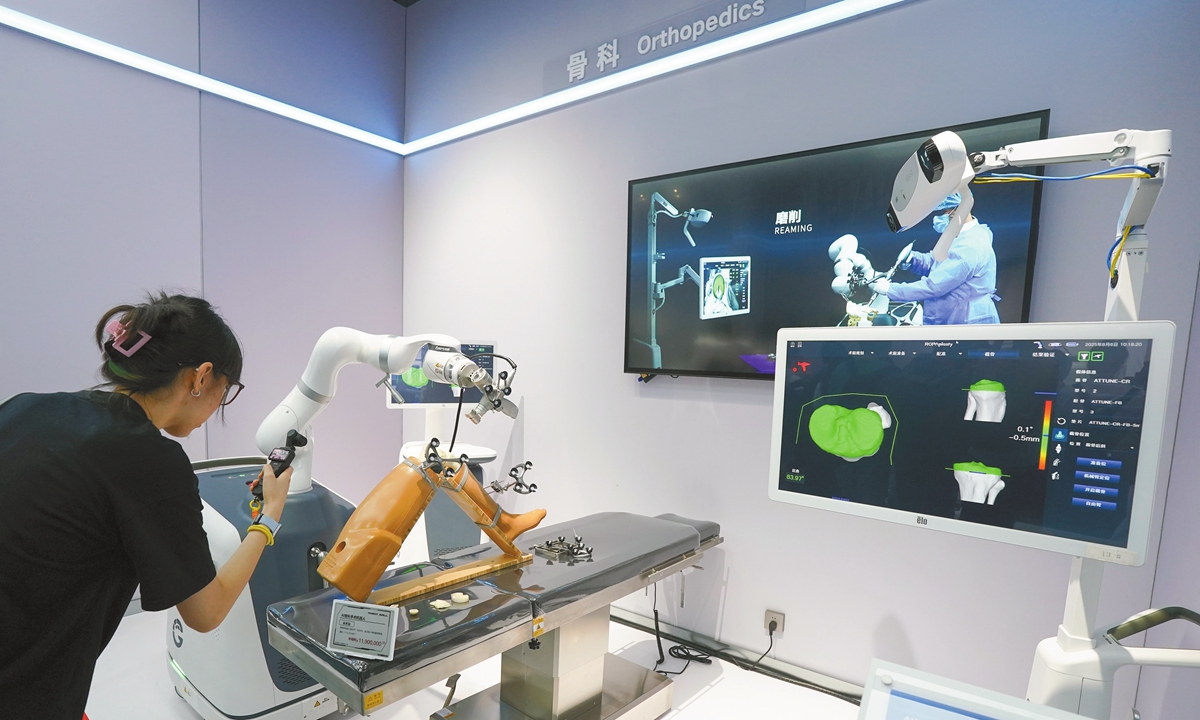
A bone surgery robot is demonstrated at a medical facility in Beijing on August 6, 2025, highlighting the integration of AI and robotics in precision healthcare. Photo: VCG
In Beijing, office worker Liu Liqin recently used an AI-powered health assistant on the Alipay platform to interpret her medical checkup report.
"I thought it was just a standard report and didn't expect anything unusual," she recalled. "But within seconds, the AI assistant flagged several abnormal indicators and recommended that I see a doctor." What surprised her most was how accessible the information was. "The report came with visuals and plain-language explanations. Even without any medical background, I could understand what was going on."
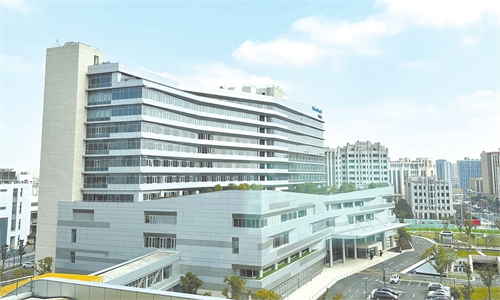
Prompted by the AI's suggestion, Liu visited a major hospital in Beijing. Upon arrival, she was greeted by an AI-powered guide robot in the lobby. "I simply told it which department I aspired to attend. Then, the robot briefed me exactly where to go, in both Chinese and English," she said.
"From getting the alert at home to finding the right floor at the hospital, the entire process was seamless and incredibly efficient."
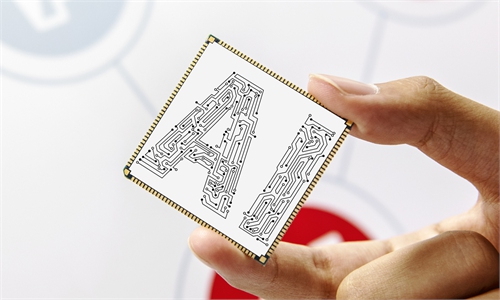
Liu's experience highlights the shift of AI-powered health care in China from laboratory testing to real-world application. From mobile health assistants to hospital guide robots, AI is increasingly embedded in daily care, improving efficiency and addressing resource disparities across the system.
The integration of generative AI, particularly large language models, is injecting new momentum into China's health care sector, Chen Jing, Vice President of the Technology and Strategy Research Institute, told Global Times on Thursday. "AI now plays a central role in connectig hospitals, research institutions, pharmaceutical companies, and patients—laying the foundation for a more efficient and personalized medical ecosystem," he said.
Chen said China's AI-powered health care remains in its early stage but is advancing rapidly. "We're already ahead of the curve in areas like medical imaging and intelligent triage, which is now deployed in hospitals and widely used in medical apps," he said.
Among the most notable breakthroughs is AI-based triage, which helps patients more accurately find the right department—whether through smart robots in major hospitals or multi-turn inquiry systems in community clinics. Some hospitals have also used AI to automate registration and billing, boosting efficiency and cutting wait times.
Backed by government policy and rising capital investment, China's AI-powered health care sector is progressing well. By 2030, large-scale pharmaceutical enterprises in China will essentially achieve full coverage of digital-intelligent transformation, according to an official document in April.
Rapid deployment
And, a report released in March by the China Hospital Association's Information Management Committee showed that, from 2023 to 2024, over 90 percent of top-tier hospitals in China have already completed the deployment of AI-assisted information systems, including electronic medical records, imaging archiving and communication systems, and laboratory information management platforms.
AI technology is now reshaping many traditional segments of the rehabilitation field. In a joint action led by medical materials researcher Qian Hongyi, his team collaborated with Beiqing Innovate Medical Technology to create an AI-powered screening and orthotic system, specially designed for adolescents with scoliosis.
By analysing people's back images with deep learning algorithms, the system can quickly identifies high-risk individuals. The candidates are referred to hospitals for detailed spinal contour scans, which are used to 3D print personalized orthotic devices—significantly boosting screening speed and minimizing delays in treatment.
In the field of foot correction, Qian noted that his partner company, Ganzhou Reach Technology Co, has developed an integrated AI-driven orthotic system for patients with flat feet, post-stroke foot deformities, and diabetic foot conditions. With just a simple foot scan, the system can swiftly generate ergonomically optimized orthotic supports or insoles, which are then rapidly manufactured using 3D printing—enhancing both precision and efficiency in personalized rehabilitation.
"The design process, which integrates AI and advanced materials, enables truly personalized orthotic solutions—making rehabilitation more scientific and accessible," a representative from the company said.
United Imaging Intelligence Co, a Shanghai-based medical AI company founded in 2017, is working with Zhongshan Hospital, affiliated to Fudan University in Shanghai, to bring AI deeper into clinical practice. Together, they developed an AI-powered chest scan tool based on the company's medical foundation model uAI NEXUS. The system can detect up to 73 types of abnormalities in a single CT scan and automatically highlight suspicious areas, helping doctors make faster, more accurate diagnoses, the company told Global Times.
Doctors now verify AI-generated reports rather than writing from scratch— which reduces physician workload and boosts diagnostic speed and consistency. The approach reflects how AI is increasingly integrated into everyday clinical workflows, supporting physicians rather than replacing them.
Efficient services
AI-powered health care in China is shifting from isolated applications to integrated system-level capabilities.
In April, the renowned Tsinghua University launched the world's first full-process AI hospital, Tsinghua AI Agent Hospital. The system features 42 AI doctors across 21 departments, replicating an end-to-end clinical workflow—from initial consultation and diagnosis to treatment recommendations, follow-up tests, and return visits. It offers a technical blueprint for AI-led medical services, Tsinghua University's official website said.
On July 23, Quark's medical AI model, developed by Alibaba Health, became the first in China to pass written assessments by 12 leading medical specialists at the chief physician level. Its advanced diagnostic capabilities are now fully available via Quark's deep-search health query feature for health-related queries.
AI is not only assisting diagnoses but also helping draft medical records.
United Imaging Intelligence's uAI NEXUS model uses voice, text, and image inputs to convert dialogue into structured clinical documentation in real time. It can automatically generate admission notes, progress updates, and discharge summaries. Now in use at Zhongshan Hospital's respiratory and cardiology departments, the tool has handled thousands of cases and cut record-writing time from about 20 minutes to just 5 minutes, cutting documentation time by 75 percent, according to the company.
China's AI-powered healthcare is shifting from isolated breakthroughs to systemic transformation. "AI was once only a tool , it's now integrating into medical workflows," Chen said. "The real challenge isn't AI capability but integrating it into the medical system as a reliable, scalable force to ease doctors' workloads and improve patient care."
However, Chen noted that the limited interpretability of AI remains a major obstacle, restricting its application in clinical decision-making.
"Its development must be aligned with healthcare policies and regulatory frameworks," Chen said. "Progress in areas such as surgical treatment planning, prognosis prediction, intraoperative navigation, rehabilitation care, and pharmaceutical research and development remains relatively limited now."
RELATED ARTICLES