Beijing set to host groundbreaking football match at 2025 World Humanoid Robot Games
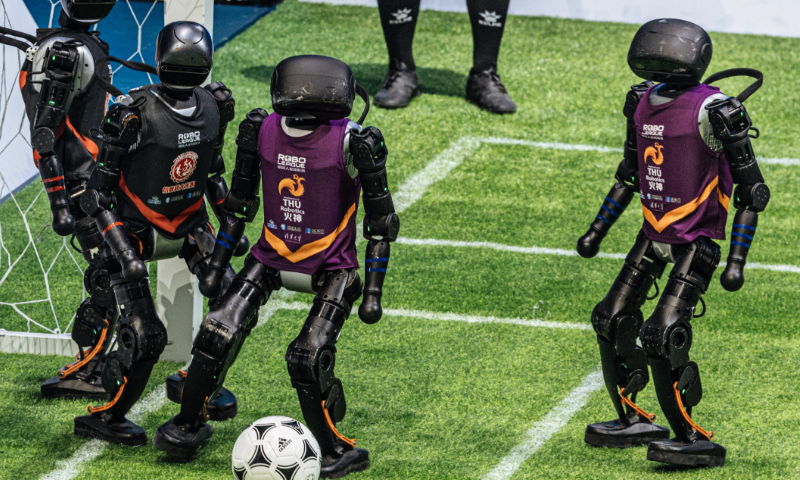
The final of the ROBO League robot football tournament concluded on Saturday in Beijing, the THU Robotics from Tsinghua University defeated the Mountain Sea from China Agricultural University team 5:3 to win the championship. This event served as the first test match for the upcoming 2025 World Humanoid Sports Games and marked China's first-ever fully autonomous 3v3 AI robot football competition.
The 2025 World Humanoid Robot Games will be held from August 14 to 17 in Beijing's National Speed Skating Oval, bringing together 280 teams from 16 countries across five continents. Over 500 humanoid robots will compete in 26 disciplines and 538 events, the organizing committee announced at a press conference on Friday.
The event will also feature the world's first 5v5humanoid robot football match, in which all gameplay will be autonomously controlled by artificial intelligence (AI) algorithms without any human intervention.
The event marks the largest competition of its kind to date. Among the 280 teams, 192 are university-based teams, alongside 88 corporate teams, including many of China's leading humanoid robotics manufacturers. The international teams hail from 15 countries including Germany, Australia, the US and Brazil. Altogether, the event will showcase humanoid robots from 127 brands, totaling more than 500 units.
All competitions will be concentrated at the National Speed Skating Oval over a three-day period from August 15 to 17. Each day will be divided into two competitive sessions - morning and afternoon - each lasting approximately three hours.
The football match is one of the most anticipated events. Ten robots will compete on the same field without human input, marking a major breakthrough in swarm intelligence and collaborative decision-making technologies. It will also be the first time that a humanoid robot football match will be staged at an Olympic venue.
Beyond the headline football match, the event will feature 487 other contests. Highlights include a "100-meter dash," with 90 teams competing for the title of fastest humanoid robot. The top six finishers of the world's first humanoid robot half-marathon that was held in Beijing on April 19 will also appear together in a showcase event.
Another crowd-puller will be the freestyle combat competition, with two special teams that feature six Olympic medalists, including judo champion Yang Xiuli, 400m freestyle swimming silver medalist Zhang Lin and synchronized swimming silver medalist Chang Si. Their participation brings Olympic-level athleticism and excitement to the Games.
As one of the key legacies of the event, the "Beijing Humanoid Robot Training Base" was officially unveiled on Friday at the National Speed Skating Oval.
Additionally, the world's first professional stadium for humanoid robot football, the "Panda Eye" training base, has also been completed. Located in the sunken plaza on the west side of the Oval, it features a striking geodesic dome made of an advanced ETFE membrane. The semi-transparent structure allows precise control over temperature, humidity, and cleanliness, creating a laboratory-grade competition environment for robots, while letting in sunlight, moonlight, and starlight, making it a new landmark in sci-tech aesthetics within the Oval.
Adjacent to the venue's southwest side, the ROBOLAND Robot Camp is designed with the core philosophy of "human-robot integration." In the future, this area is expected to evolve into a hub for the humanoid robot industry, fostering international cooperation and exchanges, and accelerating the sustainable development of the robotics sector.
Global Times
