Lula speaks with Modi, reaffirming commitment to multilateralism amid US tariff blitz
BRICS, SCO offer more stable, advantageous platforms: expert
By and Ma Tong Published: Aug 08, 2025 11:30 PM

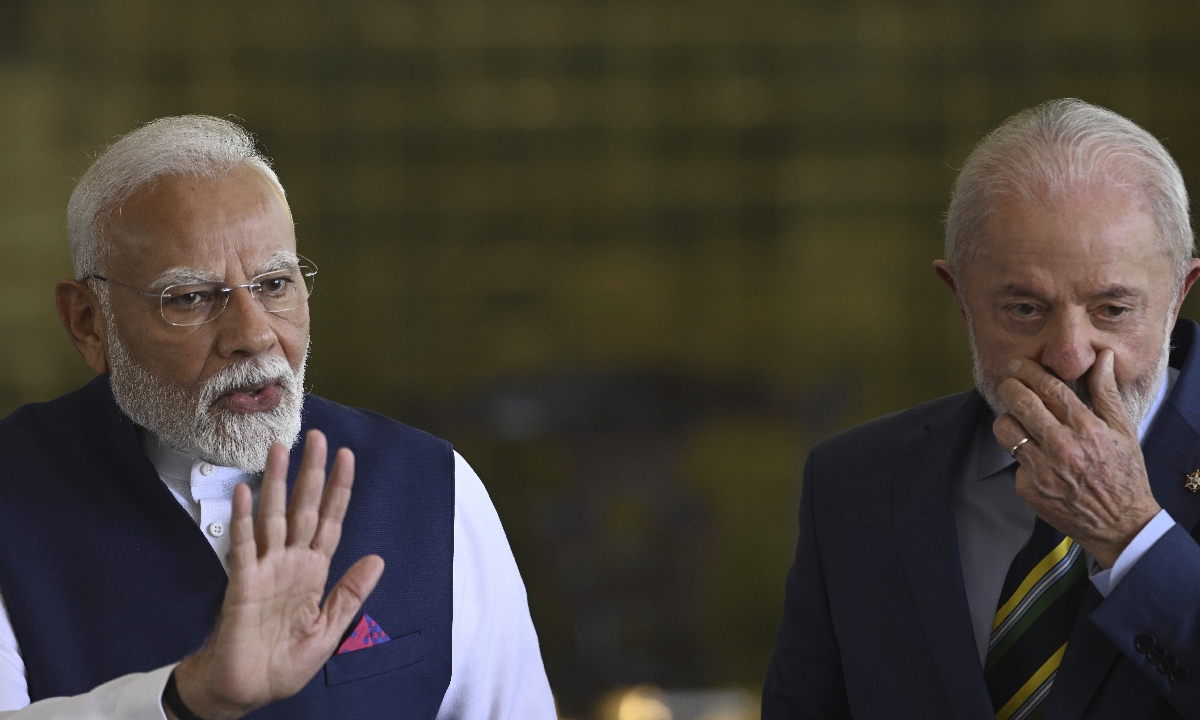
Prime Minister of India Narendra Modi speaks during a joint press statement with President of Brazil Luiz Inacio Lula da Silva at the Alvorada Palace in Brasilia, Brazil, on July 8, 2025. Photo: VCG
Brazilian President Luiz Inacio Lula da Silva and Indian Prime Minister Narendra Modi held a phone conversation on Thursday, reaffirming their commitment to bilateral cooperation and multilateralism in the face of rising global trade tensions, the Xinhua News Agency reported on Friday.The discussion came shortly after the US announced steep tariff increases on goods from both Brazil and India.
According to Reuters, the US on Wednesday announced an additional 25 percent tariff on Indian goods, bringing the total duty to 50 percent. The hike, effective from August 28, is intended to punish India for continuing to import Russian oil. Brazil was also hit with a 50 percent tariff on most goods, and Trump linked the move to what he described as a "witch hunt" against former President Jair Bolsonaro.
Citing a release from the prime minister's office, the Times of India said the two leaders have discussed "imposition of unilateral tariffs" in the "hour-long" conversation, exploring the possibility of greater integration between the two countries.
The two leaders exchanged views on various regional and global issues of mutual interest. "They recalled the goal of increasing bilateral trade to over 20 billion US dollars by 2030. They also agreed to expand the scope of the agreement between Mercosur and India," the Brazilian president's office said in a statement, per Xinhua.
In an X post after the meeting, Modi said the two sides had a "good" conversation. "We are committed to deepening our strategic partnership including in trade, energy, tech, defense, health and more. A strong, people-centric partnership between Global South nations benefits everyone," he wrote.
Lula said in a post on X on Friday, that "Brazil and India are, so far, the two most-affected countries [by US tariffs]. We reaffirmed the importance of defending multilateralism and the need to address the challenges of the current situation, as well as to explore possibilities for greater integration between the two countries."
The two sides confirmed Lula's state visit to India in early 2026 during the call, Lula said in the post.
The interaction between Lula and Modi signals their growing dissatisfaction with US trade policies, Liu Xiaoxue, an associate research fellow at the National Institute of International Strategy under the Chinese Academy of Social Sciences, told the Global Times on Friday.
Although India once held expectations for collaboration with the US, it has increasingly acknowledged the constraints of such a partnership and is now pivoting its strategic focus, Liu said.
Amid the increasing tariff pressure, Indian media reports said on Wednesday that Modi will visit China to attend the Shanghai Cooperation Organisation (SCO) summit in the city of Tianjin from August 31 to September 1, but there has not yet been official confirmation from both sides.
The conversation between Lula and Modi also touched on collaboration within the BRICS group. The two leaders reviewed the outcomes of the recent BRICS Summit in Brazil and discussed coordination for India's upcoming presidency of the bloc, according to Xinhua.
India will take over the rotating chairmanship of the BRICS in 2026 and will host the 18th BRICS Summit, Indian media reports said.
Prior to his conversation with Modi, Lula revealed in an interview with Reuters on Wednesday that he will initiate a discussion in the BRICS group about a joint response to tariffs on US imports.
Similarly, citing Russian Security Council Secretary Sergey Shoigu, Tass reported on Thursday that Russia and India will set a date for new full-scale talks between Modi and Russian President Vladimir Putin.
Wang Youming, director of the Institute of Developing Countries at the China Institute of International Studies in Beijing, told the Global Times that the US' latest tariff offensive has jolted India into recognizing that frameworks like the BRICS and the SCO offer more stable and advantageous platforms for safeguarding and advancing India's interests, Wang said.
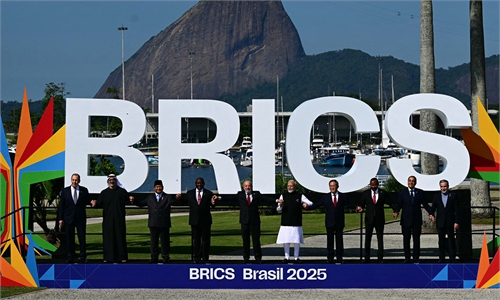
During the BRICS Summit held in Rio de Janeiro, Brazil in July, leaders of the 11 largest emerging economies signed a joint declaration, voicing serious concerns about the rise of unilateral tariffs and non-tariff measures that distort trade and are inconsistent with WTO rules, per the official BRICS website.
"A tariff war has no winners - this is not a political slogan but a consensus and common sense in economics," said Wang. "Just as the US' imposition of tariffs on global goods in the 1930s failed to lift the country out of the Great Depression, today's reckless tariffs will not make America great again."
The average tariff rate on US imports is now the highest since the 1930s, according to the Budget Lab at Yale, CNN reported.
Citing US industrial insiders and economists, the Associated Press reported that the tariff risk is that "the American economy is steadily eroded rather than collapsing instantly."
"The higher tariff prices lower workers' real wages. The economy has become less productive, and firms cannot pay the same real wages as before," AP reported.
RELATED ARTICLES