China’s national strategy gives it an edge in humanoid robotics development: US Automation leader

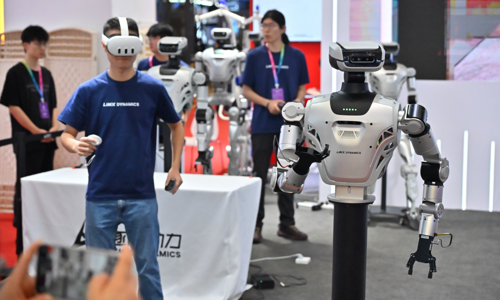
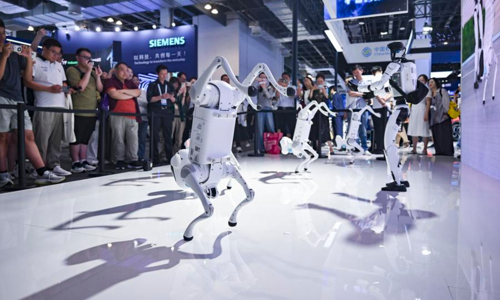
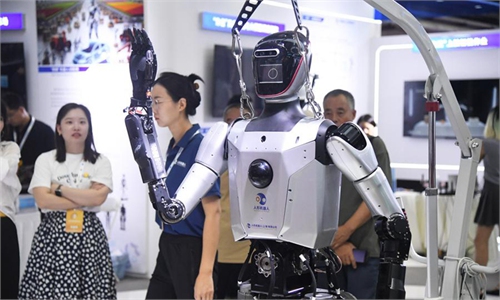
The 2025 World Robot Conference is held in Beijing on August 9, 2025. Photo: Courtesy of the 2025 World Robot Conference
At the 2025 World Robot Conference in Beijing, Jeff Burnstein, president of the Association for Advancing Automation (A3), told the Global Times on Saturday that China holds a clear advantage in humanoid robotics, supported by strong national strategies and policy support, while noting that there remains potential for cooperation between China and the US across various segments of the robotics manufacturing chain.
"China is by far the biggest user of robots in the world. They dwarf anybody else in terms of the number of robots installed," Burnstein said. "The government is committed, funding programs, and there is a wealth of engineering talent, artificial intelligence (AI) expertise and manufacturing capabilities. This creates an ideal environment for companies, especially Chinese companies, to deploy robots domestically."
Burnstein noted that Chinese humanoid robotics leaders, such as Unitree and UBTech, benefit from government strategy. "That's a huge advantage over countries that don't have a national strategy to drive it," he said.
While acknowledging current policy uncertainties between China and the US, Burnstein said he believes "today's uncertainties will eventually resolve" and pave the way for greater collaboration. "Right now, both countries are working to build their own robotics infrastructure," he said. "But in areas like AI and robotics improvements, there will come a point where more cooperation is needed to safeguard these technologies. Safety is going to be a key issue going forward."

Jeff Burnstein, president of the Association for Advancing Automation (A3) gives a speech at the 2025 World Robot Conference in Beijing on August 9, 2025. Photo: Courtesy of the 2025 World Robot Conference
He identified multiple opportunities for bilateral cooperation along the robotics manufacturing chain, from components to system integration.
Burnstein observed that the development paths of robotics in China and the US are diverging. China is moving much faster to deploy humanoids in factories, learn from real-world use, and iterate to more advanced models. In the US, companies such as GXO mainly act as incubators, running pilot programs, and so far, Agility is the only one known to have moved into mass production, he said.
However, Burnstein said the key question is not which company leads, but whether the humanoid form itself is the right solution for the future, given the inherent challenges of bipedal walking and the possibility that other designs may better meet specific industrial needs.
Burnstein stressed that both countries have abundant talent and deep expertise in AI and robotics. "The US has great educational institutions, a long history in robotics and AI," he said. "China clearly has brilliant students and no shortage of skilled engineers. From my standpoint, this should not be a competition. Our goal as a global trade group is to see these technologies advance, because they can solve difficult challenges and make our societies better."
Venture capital is also playing a significant role in advancing humanoid robotics, particularly in the US. "This may turn out to be a great investment, or it may not," Burnstein said. "Even if it's not, the innovations and ancillary developments could be applied to other robotic forms."
Comparing industry events, Burnstein said A3's Automate show, held each June in Chicago, focuses on solving practical, real-world industrial problems. "This event in China is focused on industry as well, but it also engages the general public — and that's a big advantage," he said, noting that demonstrations such as dancing and soccer-playing humanoids inspire children to pursue careers in robotics. "That's the future."
RELATED ARTICLES