Statement of Australia, NZ mentions China-related issues without directly naming the country, reflecting a delicate approach: expert
By Published: Aug 10, 2025 03:52 PM

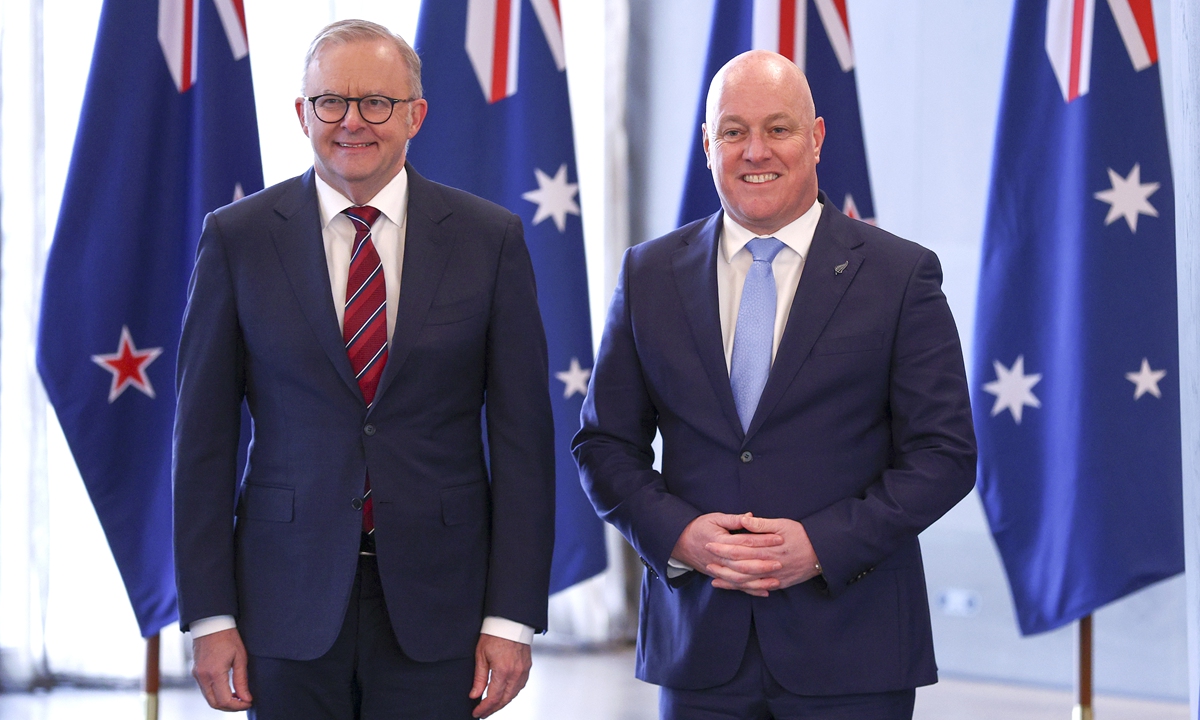
Australian Prime Minister Anthony Albanese and New Zealand Prime Minister Christopher Luxon pose during an Australia-New Zealand Leaders' Meeting at Taramea on August 09, 2025 in Queenstown, New Zealand. Photo: VCG
Certain Australian media outlet claimed that the meeting between Australian and New Zealand's prime ministers on Saturday in Queenstown, New Zealand was dominated by China and Gaza. However, reports indicate both leaders also acknowledged areas of cooperation with China during their talks, and a joint statement following the meeting mentioned China-US competition, the South China Sea, the East China Sea and Taiwan Straits without directly naming China. An expert noted this approach indicates a delicate approach of the two countries.
A Chinese expert warned on Sunday that the intention of Australia and New Zealand to enhance military cooperation should be viewed with vigilance, calling on both countries to act as contributors to regional peace and stability.
"China [and] Gaza dominate Albanese's meeting with New Zealand Prime Minister Christopher Luxon," Australian news outlet AAP claimed in a headline on Sunday. Both leaders agreed that competition between the world's superpowers, China and the US, needed to be managed, and continued dialogue was important to reduce risks of misunderstanding, miscalculation, escalation and conflict in the Pacific region, according to the report.
Notably, Luxon said the Asian superpower was a significant player in the world and a permanent feature of global affairs. "We have an approach which is about co-operating where we can ... We disagree where we must. We have different systems, different values," he said, which Albanese echoed, according to the AAP report.
The joint statement following the meeting, published on the Australian Prime Minister's official website on Saturday, mentioned "China" three times. One sentence stated that the two prime ministers emphasized "the need for competition to be managed responsibly and underscored the importance of continued dialogue between the United States and China."
The other two mentions of "China" were made in the context of the two prime ministers expressing "grave concern about dangerous and provocative behaviour in the South China Sea," and "serious concern about the situation in the East China Sea." They did not single out any particular country in the references, according to the joint statement.
Also, the joint statement claimed that the two prime ministers mentioned the Taiwan question and "called for the peaceful resolution of cross-strait issues through dialogue, without the threat or use of force or coercion and confirmed their shared opposition to unilateral changes to the status quo."
Chen Hong, a professor and director of the Australian Studies Center at East China Normal University, told the Global Times on Sunday that the Australian and New Zealand prime ministers stopped short of directly criticizing China, and the remarks "cooperate where we can… disagree where we must" reflect a pragmatic stance.
Chen said that the two countries should be aware of the fact that the cost of following the US' approach of confrontation would be far greater than pursuing independent dialogue.
The expert urged the two countries to stop using the Taiwan question to interfere in China's internal affairs. Chen stressed that the one-China policy is clearly stated in the joint communiqués on the establishment of diplomatic ties between China and New Zealand and between China and Australia. "Australia and New Zealand must clearly recognize that the Taiwan question is at the very core of China's core interests," he said.
Meanwhile, Australian media outlet ABC reported that despite a consistent push from Washington for countries to boost their defense spending, both Albanese and Luxon stood by their current commitments to lift their spending to about 2 percent of GDP. "However, Mr Luxon did signal that he hoped to raise that figure, if possible," ABC claimed.
Chen said that the US' pressure on countries to increase defense spending is essentially aimed at forcing allies to share the costs of US hegemony, rather than addressing genuine security needs. While Australia and New Zealand are strengthening military coordination, their policies also remain driven by economic rationality, and they are well aware of the tremendous economic costs of the confrontation approach.
Chen added that the intention of Australia and New Zealand to enhance military cooperation should be viewed with vigilance, calling on both countries to act as contributors to regional peace and stability.
Official exchanges between China and Australia, and between China and New Zealand have been increasing recently.
Last month, Albanese visited China, during which he said that Australia values its relations with China and looks forward to working with the Chinese side to treat each other as equals, seek common ground while shelving differences, and engage in mutually beneficial cooperation to advance bilateral ties, the Xinhua News Agency reported on July 15.
Noting that Australia adheres to the one-China policy and does not support "Taiwan independence," he said Australia stands ready to maintain dialogue and exchanges with China at all levels to enhance mutual trust, according to Xinhua.
In June, Luxon also visited China, during which he said that New Zealand attaches great importance to its relations with China and will continue to adhere to the one-China policy, and that that his country is willing to uphold mutual respect and understanding with China and maintain high-level exchanges, Xinhua reported on June 20.
Luxon said the world today is full of uncertainties, and the international community expects China to play a greater role. He said New Zealand is willing to actively communicate and coordinate with China to safeguard the multilateral trading system and jointly address global challenges, according to Xinhua.
In response to Albanese's trip which concluded on July 18, Guo Jiakun, a spokesperson for the Chinese Foreign Ministry, said at press conference on July 21 that during Prime Minister Albanese's visit here, the leaders of both sides reached important consensus on further deepening and expanding mutually beneficial cooperation. China stands ready to work with the Australian side to strengthen the planning and design for cooperation in various sectors, enhance communication and exchanges at different levels and make greater effort for mutual benefit at a higher level that better serves the interests of both peoples, Guo said.
When commenting on Luxon's official visit to China from June 17 to 20, Lin Jian, another spokesperson for the Chinese Foreign Ministry, said on June 13 that in a complex and rapidly changing world, China stands ready to work with New Zealand to step up strategic communication, enhance political mutual trust, deepen practical cooperation, consolidate traditional friendship, jointly address challenges, and promote the building of a bilateral relationship featuring mutual respect, inclusiveness, focusing on cooperation and common development so as to deliver greater benefits to our two peoples.
RELATED ARTICLES