Minnie Vautrin’s legacy: highlighting human connections between Americans and Chinese
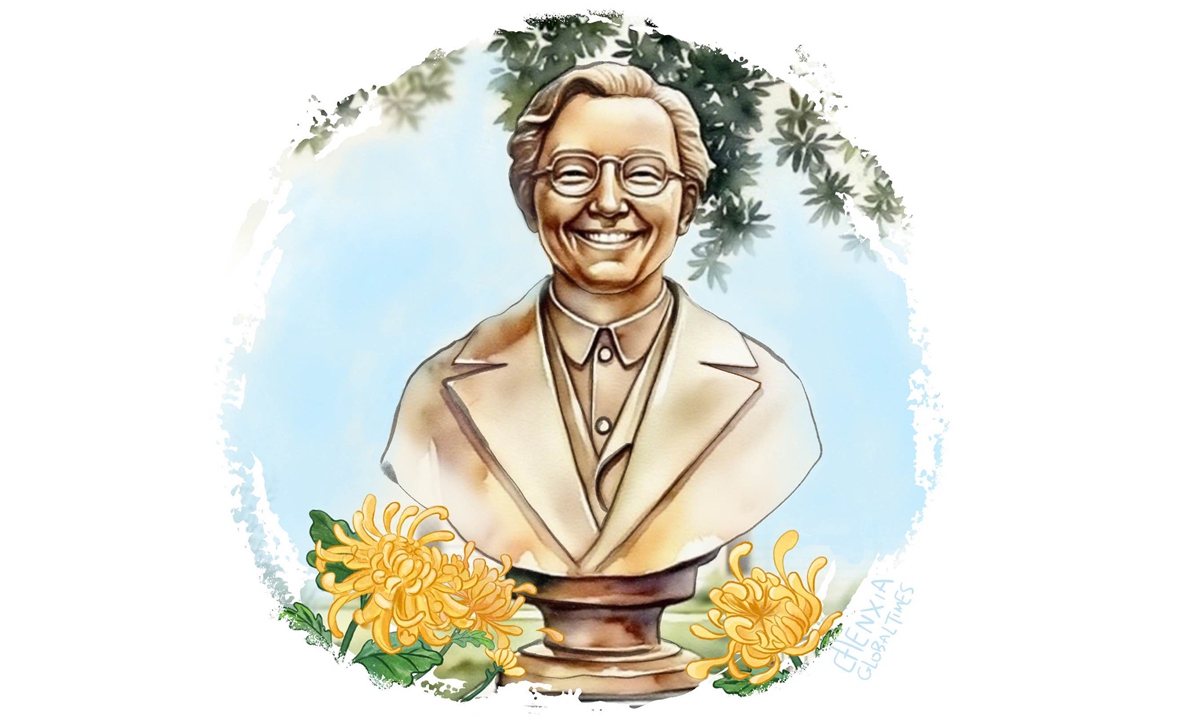
Illustration: Chen Xia/GT
The new film Dead to Rights will be shown in North American theaters this week. Based on real events, the film follows several ordinary Chinese individuals who risked everything to preserve photographic evidence of Japanese atrocities during the Nanjing Massacre. It also includes the story of a foreign female doctor who shielded Chinese women from violence. It is believed that the character was inspired by American missionary Minnie Vautrin.The film brings the story of Vautrin back into the public eye. Many Americans might have forgotten her name, but many Chinese people remember - and will never forget.
Anyone who has visited Nanjing Normal University will have seen her statue, where chrysanthemums are laid throughout the year. An educator from Illinois, Vautrin, turned the campus of Ginling College into a sanctuary during the Nanjing Massacre, sheltering more than 10,000 Chinese women and children. Grateful refugees called her a "Goddess of Mercy," and to many Chinese, she remains one of the "friends who stood with us in our darkest hour."
Serving as acting president of Ginling College as the Japanese army closed in, Vautrin defied an evacuation order from the US embassy. In her diary, she wrote, "…Colonel Oka came to call, and insisted that he had promised in Shanghai to protect all Americans and he wanted us to live in one place. I told him we could not leave our particular places of responsibility." That brief but resolute statement has become a classic expression of humanitarian duty.
History records that she repeatedly faced down armed soldiers. When Japanese troops tried to seize refugees, she stood in their way and declared, "Whoever wants to go through this gate will have to do so over my dead body." It was this extraordinary courage that helped her protect more than 10,000 women and children over six harrowing weeks.
Vautrin's diary documented the brutality she witnessed; those pages later served as evidence of the Nanjing Massacre in court. Her fate, however, adds a tragic dimension to the story. Crushed by trauma and unrelenting strain, she was forced to return to the US in 1940 and died by suicide in Indianapolis on May 14, 1941, at the age of 55.
"If I had two lives, I would still be willing to serve the Chinese," she wrote near the end of her life. Her story lays bare the psychic wounds of the Japanese Army's brutal atrocities during the war - an aspect of this history that deserves special attention today.
As the spirit Vautrin embodied is demonstrated in Dead to Rights, this movie resonates across languages and cultures because it highlights the most fundamental forms of goodness and courage. Anyone, regardless of background, can recognize the humanitarian spirit that transcends borders. That spirit remains a precious asset in the interactions among people and nations today.
The film arrives at a moment of strain in China-US relations, which gives this history added urgency. Vautrin was not alone. During those dark months, international friends risked their lives to protect Chinese civilians. Their names are still taught in Chinese schools, and their statues stand in public squares. This enduring gratitude is a reminder that, whatever the political weather, bonds between ordinary people are the ballast of bilateral ties.
Despite current challenges, the human connections between Americans and Chinese people have not been severed. People on both sides hope to see renewed momentum in student exchanges, joint research, business partnerships and cultural engagement. These ties stabilize the broader relationship and create the channels needed to address differences.
History is not a weapon for stoking resentment; it is a wellspring of wisdom. When facing significant historical junctures, the people of both countries have been able to support each other, making cooperation feasible and well-grounded. No matter what ups and downs the relationship between the two countries experiences, the exchanges and friendship between the people are the most resilient and sustainable forces. By remembering the past and carrying forward the spirit Vautrin embodied, the peoples of both countries can work toward a more peaceful, cooperative and mutually beneficial future.
RELATED ARTICLES